
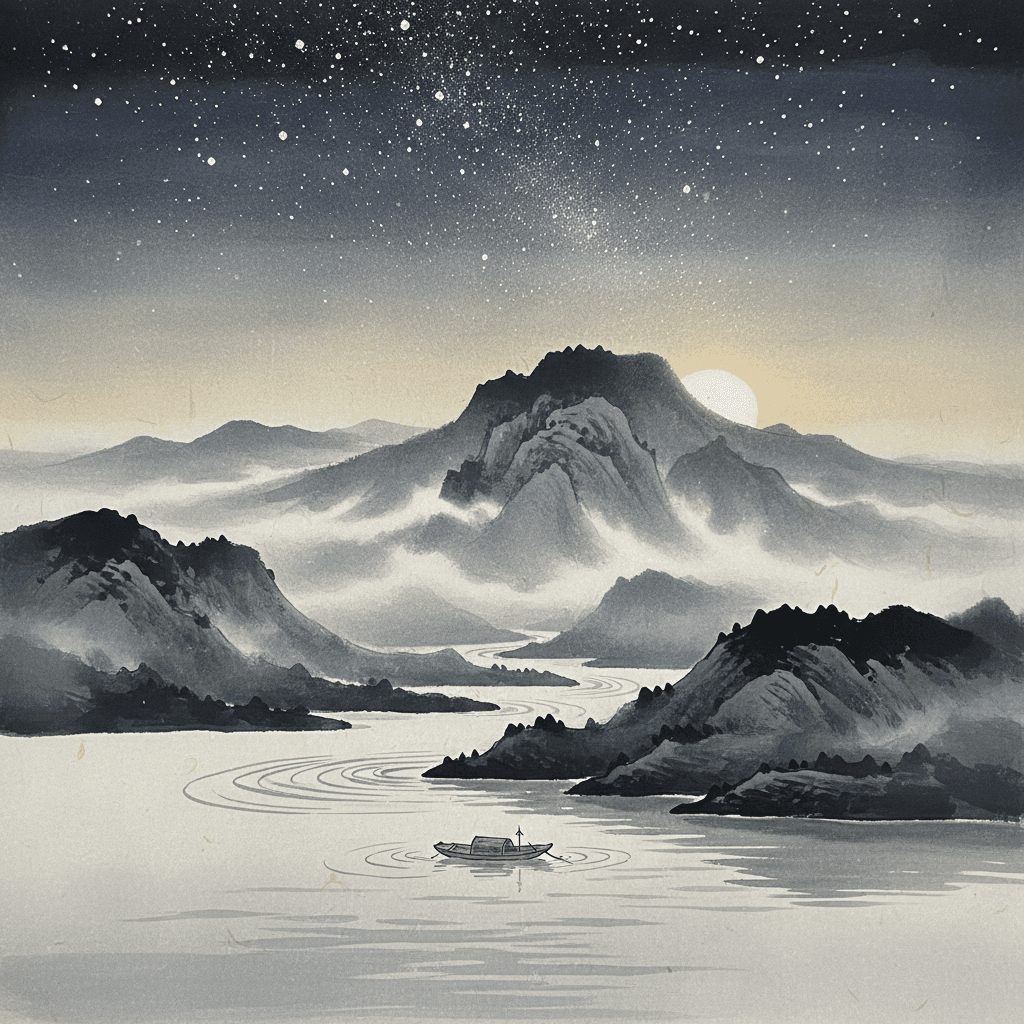
The Dao is empty; in use it is never exhausted. Deep and unfathomable, it seems to be the ancestor of the myriad things. It blunts what is sharp, unravels what is tangled, softens its light, and mingles with the dust. Clear and still, it seems to be there. I do not know whose child it is; it appears to have preceded the Lord of Heaven. - Laozi
—What lingers after this line?
Emptiness as Limitless Capacity
Laozi opens with an image of emptiness that is not lack but capacity. In Daodejing 4, the Dao is likened to a well drawn upon yet never depleted. The paradox clarifies in chapter 11, where the empty hub, door, and window make wheel, room, and jar truly useful. Emptiness here names the open space that allows form to function. Because the Dao offers no fixed contour of its own, it can receive all things and meet every situation. Rather than an object among objects, it is the enabling field in which objects arise; hence inexhaustibility. This shift from substance to capacity reframes power as receptivity, inviting us to measure strength not by accumulation but by the spaciousness to let things be.
Before Heaven: A Non-Theistic Origin
From this capacious emptiness, Laozi moves to origin. When he says the Dao seems to be the ancestor of the myriad things and to precede the Lord of Heaven, he places it before gods and rulers alike. Daodejing 25 echoes the claim with an image of a formless and complete source, the mother of the world, named Dao only for convenience. The point is not theology but priority: process before persons, pattern before power. Because the Dao is prior, it grants legitimacy without itself demanding worship. This humility of the source cautions against absolutizing any single authority; even Heaven is downstream of the Way.
Blunting Edges, Untying Knots
Consequently, the images of blunting what is sharp and untying what is tangled describe how the Dao acts without aggression. In Daodejing 36 and 22, softening and yielding are the strategies by which life renews itself. Zhuangzi dramatizes this with the story of the so-called useless tree that survives precisely because it is not a sharp beam fit for the axe; its very oddness unknots the woodcutter’s purpose (Zhuangzi, ch. 4). In human affairs, this means tempering hard stances, relaxing knots of opinion, and letting complexity breathe. Wu wei—effortless action—does not mean inaction; it means removing the excess that snags, so the situation can disentangle itself.
Soft Light and Dust: The Politics of Humility
In the same vein, the Dao softens its light and mingles with the dust. Rather than dazzling, it dims; rather than ascending, it descends. Daodejing 66 offers the river as model: seas are kings because they dwell below all streams. Likewise, sages hide brilliance and take the low place—wearing rough cloth while keeping the jewel within (Daodejing 70). By sharing the dust of ordinary life, they avoid provoking rivalry and therefore accomplish more. This ethic of self-effacing presence is not meekness for show; it is strategic invisibility that reduces friction. When the light is soft, egos relax; when leaders mingle, trust thickens.
Clear and Still: The Practice of Wu Wei
Thus Laozi’s closing image—clear and still—signals the inner posture that makes such action possible. Clarity without stillness becomes glare; stillness without clarity becomes stagnation. Zhuangzi calls the requisite discipline fasting of the mind, an emptying that allows things to come of themselves (Zhuangzi, ch. 4), and elsewhere praises sitting in forgetfulness, where the self’s edges blur into the larger flow (Zhuangzi, ch. 6). From this quiet receptivity, responsiveness ripens: one can sense where sharpness needs blunting or tangles need loosening. Still water does not conquer the world; it reflects it truly, and in that fidelity lies its power.
Modern Echoes of an Ancient Way
Finally, the teaching scales into contemporary life. In design, valuing emptiness means giving users breathing room—the blank margins that make content legible. In leadership, servant-like humility resonates with Laozi’s counsel to stay low, enabling others to act; modern articulations such as Robert Greenleaf’s servant leadership (1970) echo the insight. In conflict resolution, loosening knots by reframing rather than forcing concessions often proves durable. Even ecological practice learns from the Dao’s mingling with dust: living lightly, cycling materials, and letting systems self-heal. Across these arenas, the Way’s gentle power shows that the deepest influence arrives not as impact but as invitation.
One-minute reflection
Where does this idea show up in your life right now?
Related Quotes
6 selectedThe valley spirit never dies; it is called the mysterious female. The gate of the mysterious female is called the root of Heaven and Earth. Unceasing, as if it were there; use it, and it never fails. - Laozi
Laozi
Laozi evokes the “valley spirit” to name a power that endures by being low, open, and receptive. In valleys, waters gather; by yielding, they become inexhaustibly nourished.
Read full interpretation →Muddy water is best cleared by leaving it alone. — Lao Tzu
Lao Tzu
Lao Tzu’s image is disarmingly simple: when water is churned, it turns opaque, yet if you stop agitating it, gravity and time do their work and clarity returns. In this sense, the saying is less a metaphor than an observ...
Read full interpretation →Don't underestimate the value of Doing Nothing, just going along, listening to all the things you can't hear, and not bothering. — A.A. Milne
A. A. Milne
At first glance, A.A. Milne’s line sounds playful, almost like permission to be lazy.
Read full interpretation →Quiet is a superpower in a world that thrives on noise. — Susan Cain
Susan Cain
At first glance, Susan Cain’s remark elevates something easily overlooked: quiet. In cultures that often reward speed, volume, and constant self-display, silence can seem passive.
Read full interpretation →Heaven and Earth are not benevolent: they regard the myriad things as straw dogs; the sage is not benevolent: he regards the common people as straw dogs.
Lao Tzu
At the outset, the line jars modern readers because “not benevolent” seems to deny ordinary morality. In the Daodejing (ch.
Read full interpretation →Stillness is not the absence of energy. It is the consolidation of it. — Seneca
Seneca
At first glance, Seneca’s line challenges a common assumption: that stillness means passivity, emptiness, or retreat from life. Instead, he reframes it as a disciplined state in which energy is not scattered but drawn in...
Read full interpretation →More From Author
More from Lao Tzu →Do you have the patience to wait until your mud settles and the water is clear? — Lao Tzu
Lao Tzu’s question frames patience not as passive delay but as an active kind of wisdom. The image of muddy water settling on its own suggests that confusion often clears not through force, but through restraint.
Read full interpretation →Anything that is living must have a rest. If it does not rest, it will lose its strength. — Lao Tzu
Lao Tzu’s insight begins with a simple observation: all living things move in cycles, not in endless exertion. By saying that anything alive must rest, he frames rest not as laziness but as a biological and spiritual nec...
Read full interpretation →Yield and overcome, bend and be straight. — Lao Tzu
At first glance, Lao Tzu’s line seems contradictory: how can yielding lead to overcoming, or bending result in straightness? Yet this paradox lies at the heart of Taoist thought.
Read full interpretation →Confidence is silent. Insecurities are loud. — (Skipped due to author uncertainty) -> Let's use: A truly strong person does not need to dominate. — Lao Tzu
At its core, Lao Tzu’s saying reframes strength as something inward rather than theatrical. A truly strong person, in this view, does not need to overpower others to prove worth, because genuine power is already settled...
Read full interpretation →