
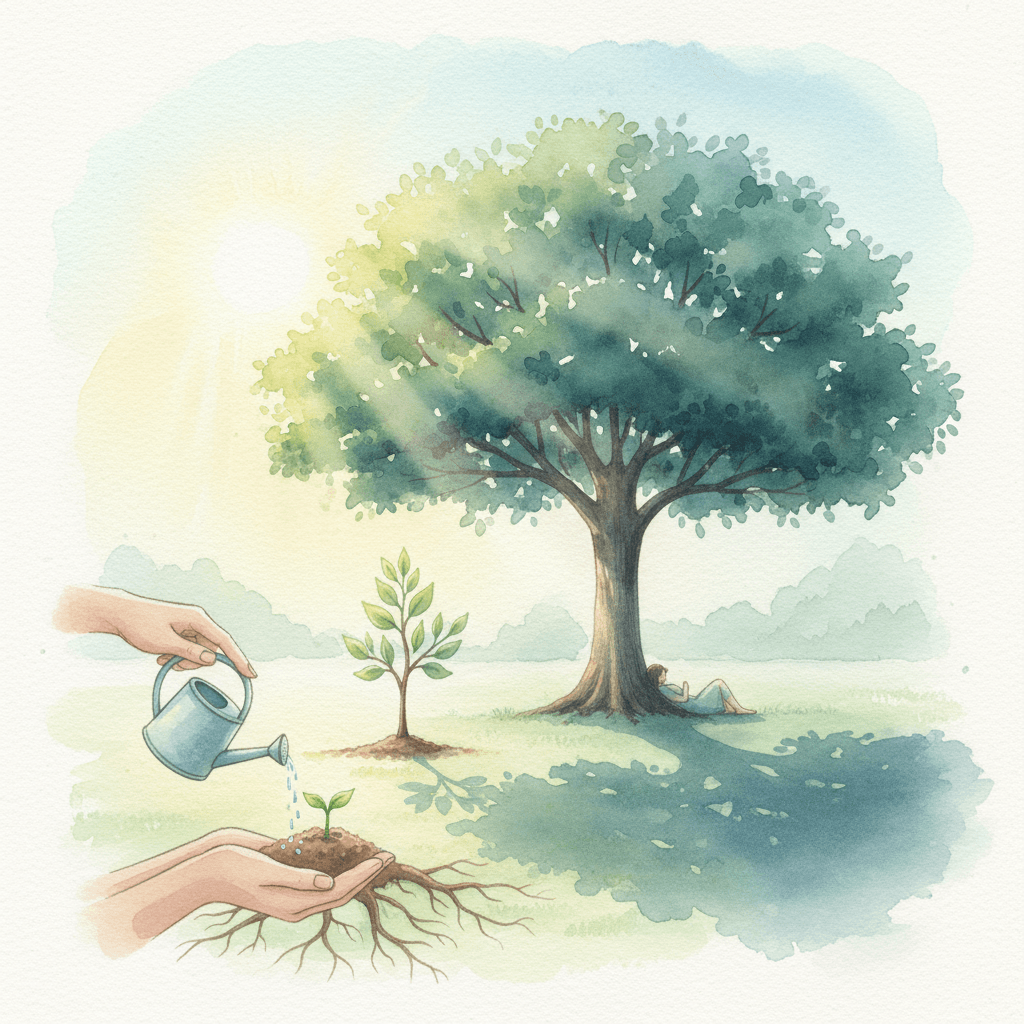
Nurture the seed of your vision until it grows tall enough to cast shade — Alice Walker
—What lingers after this line?
Planting a Vision with Patient Care
To begin, Walker’s image treats a vision like a seed: alive, small, and demanding steady attention. Seeds do not ask for fireworks; they ask for water, light, and time. Likewise, early ideas need daily tending—drafts, practice, and recalibration—before they ever sprout into visible form. Walker often drew on garden metaphors to describe creative survival, as in In Search of Our Mothers' Gardens (1983), where patient cultivation becomes both artistic method and moral stance. By highlighting nurture over haste, the quote reframes ambition as stewardship, implying that gentleness and consistency—not brute force—enable real growth.
Roots First: The Unseen Work
From there, the metaphor directs our gaze underground, where roots anchor and feed long before branches appear. Botany shows that young trees invest heavily in roots to secure water, nutrients, and stability; only then can they reach for light. Charles Darwin’s The Power of Movement in Plants (1880) explored how root tips sense and respond to the environment, quietly steering growth. Similarly, the groundwork of any vision—skills, networks, ethics—develops out of sight. Emails no one reads, drafts no one sees, habits no one praises: this subterranean labor is what prevents the first strong wind from toppling the sapling dream.
Fertile Soil: Community and Mentors
Moreover, seeds prosper or fail according to their soil. In ecology, facilitation research shows how “nurse plants” create microclimates that help other species establish (Callaway, Positive Interactions and Interdependence in Plant Communities, 2007). Human visions, too, root deeper in communities that offer shade, nutrients, and pollinators—mentors, peers, and constructive critics. Anecdotally, many creators credit a single teacher’s encouragement with turning a fragile idea into a hardy perennial. Thus, cultivating your vision includes cultivating its habitat: choosing rooms where curiosity is welcome, feedback is honest, and shared resources make individual growth possible.
Weathering Droughts: Adapting Through Change
Even so, every season brings stress: droughts, pests, and late frosts. Resilience comes from adaptation. Octavia Butler’s Parable of the Sower (1993) distilled this into the Earthseed creed, “God is Change,” a reminder that flexibility is the lifeblood of survival. In practice, that means iterating when conditions shift—pivoting strategies, revising timelines, or grafting new skills onto the original stock. Far from betraying the seed, adaptation protects its essence, allowing the vision to continue growing toward light. Setbacks are weather, not verdicts; the caretaker’s task is to adjust water, mulch, and staking until the next flush of leaves appears.
When Growth Gives Shade: Service Beyond Self
Consequently, maturity is not just height; it is shelter. A tall tree casts shade that cools, protects, and makes new life possible beneath it. Urban forestry studies show tree canopies reduce heat, improve air quality, and lower stress (Nowak & Heisler, 2010), turning private growth into public good. Wangari Maathai’s Green Belt Movement demonstrated this literally: planting 50 million trees yielded environmental restoration and women’s empowerment (Maathai, Unbowed, 2006; Nobel Peace Prize, 2004). So it is with visions—once established, they create conditions for others to rest, recover, and begin. Shade, in this sense, is impact.
Pruning, Seeding, and Lasting Legacy
Finally, caretaking continues after the canopy forms. Orchard wisdom recommends pruning to channel energy into strong scaffolds—an apt analogy for focus and boundaries. Deadwood cleared, the tree bears more fruit, and those fruits carry seeds. In long-term endeavors, this becomes cathedral thinking: building projects whose benefits will outlast their builders. Alice Walker’s image invites that horizon—tend your vision until it not only stands but also multiplies, offering shade and seeds to people you may never meet. Thus the cycle closes and renews: nurture, grow, shelter, and sow again.
One-minute reflection
Where does this idea show up in your life right now?
Related Quotes
6 selectedTo cultivate anything—a garden, a skill, a soul—requires the courage to wait for what you have planted. — Wendell Berry
Wendell Berry
At first glance, Wendell Berry’s quote seems to praise patience, yet it goes further by naming patience as courage. To plant anything—a seed, a habit, a belief in oneself—is to act without immediate proof of success.
Read full interpretation →The slow work of cultivation is the only antidote to the frantic pace of our digital existence. — Mary Oliver
Mary Oliver
Mary Oliver’s line sets two tempos against each other: the hurried pulse of digital life and the patient rhythm of cultivation. By calling cultivation an antidote, she implies that our overstimulated routines are not mer...
Read full interpretation →Drawing is vision on paper. — Andrew Loomis
Andrew Loomis
At first glance, Andrew Loomis’s remark condenses the whole art of drawing into a single elegant idea: drawing is not merely the movement of a hand, but the translation of perception into form. In this sense, the page be...
Read full interpretation →Right things are rare flowers that need cultivation. — Charles Spurgeon
Charles Spurgeon
Spurgeon’s image immediately turns morality into something living, fragile, and beautiful. By calling right things “rare flowers,” he suggests that goodness does not appear everywhere by accident; instead, it emerges und...
Read full interpretation →A rock pile ceases to be a rock pile the moment a single man contemplates it, bearing within him the image of a cathedral. — Antoine de Saint-Exupéry
Exupéry
At first glance, Saint-Exupéry’s line seems to describe an ordinary heap of stones. Yet the moment someone looks at it while carrying the image of a cathedral within, the pile is transformed in meaning.
Read full interpretation →Plant the seeds of your intentions today and tend them with steady hands — Langston Hughes
Langston Hughes
Langston Hughes frames intention not as a passing wish but as something alive—small at first, yet capable of becoming substantial. A seed holds potential, but it also requires placement in the right ground; likewise, an...
Read full interpretation →More From Author
More from Alice Walker →The most beautiful things are those that take time to grow, requiring a commitment to the process rather than a hunger for the end. — Alice Walker
Alice Walker’s reflection shifts beauty away from instant results and toward slow formation. At its heart, the quote suggests that what becomes truly beautiful does so through time, care, and endurance rather than speed...
Read full interpretation →Hard times require furious dancing. Each of us is the proof. — Alice Walker
Alice Walker’s line treats “hard times” not as a cue for silence, but as a summons to movement. The phrase “furious dancing” reads like an intentional contradiction—how can joy or art survive suffering?
Read full interpretation →The most common way people give up their power is by thinking they don't have any. — Alice Walker
Alice Walker’s line points to a paradox: people often lose power not through force, but through a belief that power was never theirs to begin with. That assumption quietly reshapes behavior—choices narrow, risks feel poi...
Read full interpretation →In an age of speed, I began to think nothing is as precious as slowness. — Alice Walker
Alice Walker’s line begins with a modern assumption—life is accelerating—and then performs a quiet reversal: the rarer something becomes, the more it is worth. In an age that prizes quick replies, rapid production, and c...
Read full interpretation →