
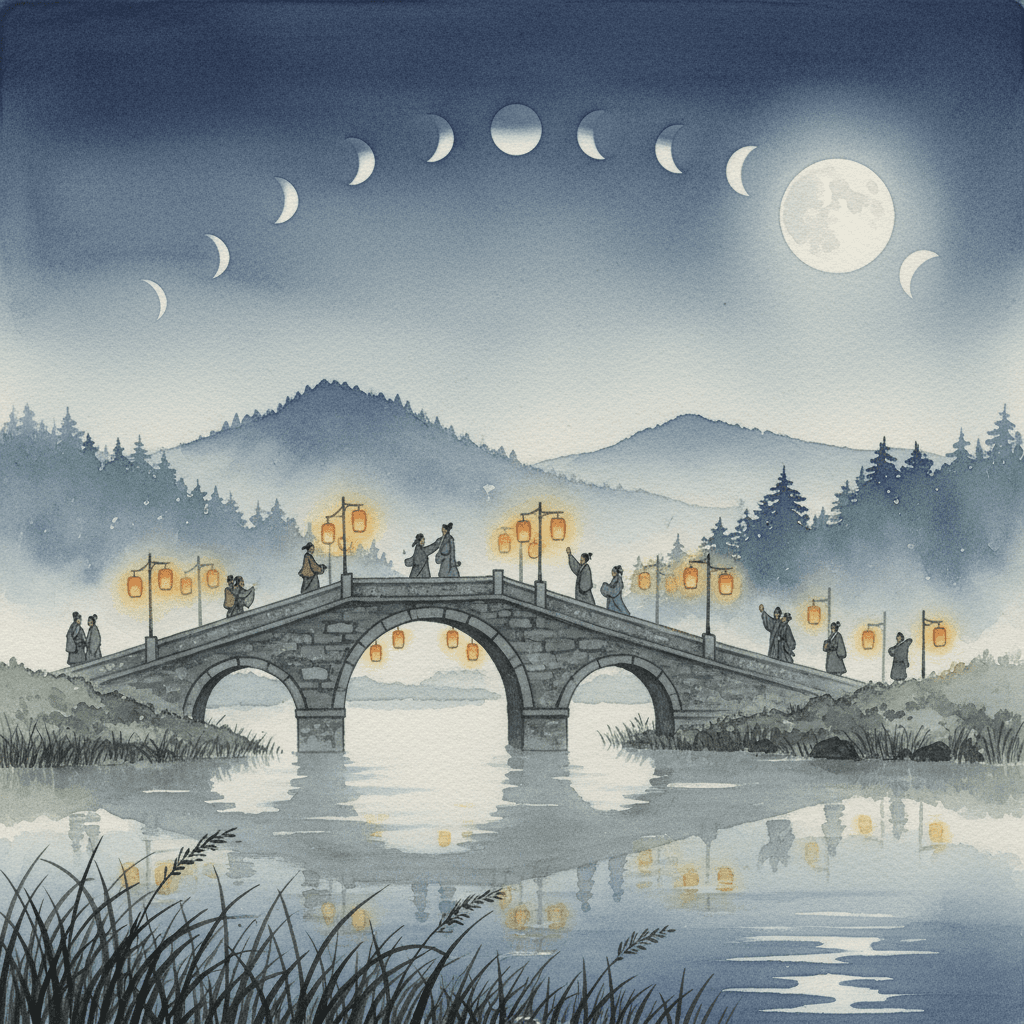
"Men experience sorrow and joy, parting and reunion; the moon waxes and wanes." — Su Shi
—What lingers after this line?
A Mid-Autumn Message Across Distance
Su Shi wrote these lines during the Mid-Autumn Festival of 1076, while serving in Mizhou after political demotion. In Shuidiao Getou, he consoles his brother Su Zhe with a clear-eyed refrain: people know sorrow and joy, partings and reunions; likewise, the moon shows shadow and fullness—this has been hard to perfect since ancient times (此事古难全). Yet the poem turns from lament to blessing: may we live long, and though a thousand miles apart, share the moon’s grace (但愿人长久,千里共婵娟). The couplet you cite distills the poem’s moral chemistry, placing human feeling into a cosmic cadence.
Impermanence in Chinese and Global Thought
From this familial scene, the thought broadens into a philosophy of impermanence. Daoist writings urge flowing with change—Zhuangzi’s discussions of transformation (ch. 2) portray life as ceaseless metamorphosis—while Mahāyāna texts like the Diamond Sutra describe phenomena as momentary and empty. Kindred echoes sound elsewhere: Heraclitus’s fragment that all flows (DK B12) and Ecclesiastes 3’s seasons of loss and gain. Su Shi’s insight harmonizes these strands: completeness is not promised; continuity arises through acceptance and reframing.
The Moon as a Shared Human Mirror
Carried forward, the moon becomes our shared mirror. In East Asia, Mid-Autumn gatherings, mooncakes, and lanterns honor reunion under the same sky. Poets made the moon a conduit of longing: Li Bai’s Quiet Night Thought (c. 8th century) links pale light with homesickness, while Sappho’s fragment on the setting moon folds desire into celestial rhythm. Islamic communities glimpse the slender hilāl to begin Ramadan, and Japanese tsukimi marks appreciative watching. Across cultures, the lunar face steadies our scattered lives by offering a common point of attention.
Science of Phases, Lessons of Cycles
Turning to science deepens the metaphor without dispelling its warmth. Lunar phases arise because we see varying portions of the Moon’s sunlit side as it orbits Earth each 29.53 days (the synodic month). The cycle is regular yet never static—illumination waxes, wanes, returns. Popular lore links full moons to outbreaks of madness, but meta-analyses find little robust effect (Rotton and Kelly, 1985). Thus the Moon models a kinder lesson: cycles need not be ominous; they are patterns to ride, not enemies to defeat.
From Separation to Ritual Connection
Consequently, when separation arrives, we can ritualize connection rather than fight the tide. Su Shi proposes a simple practice—look up. Families apart can schedule shared moon-viewing, exchange photographs, or cook the same dish while on video call. Diasporic communities long have built calendars of memory around lunar festivals, and in 1969 the world collectively watched Apollo 11 step onto that very surface, momentarily becoming one audience. Such rituals transform distance from a wound into a bridge.
Equanimity Without Losing Tenderness
And so the ethical invitation emerges: cultivate equanimity without dulling tenderness. Stoic counsel—attend to what is within control (Epictetus, Enchiridion)—aligns with Buddhist compassion that meets change with care (Shantideva, 8th c.). We acknowledge sorrow and joy as visiting weather, while we commit to reunion in spirit and practice. By pacing our hearts to the Moon’s calm pulse, we honor change without surrendering connection, sharing the same light even when paths diverge.
One-minute reflection
Where does this idea show up in your life right now?
Related Quotes
6 selectedEverything in our life keeps changing—our inner moods, our bodies, our work. We can't hold on to anything. — Tara Brach
Tara Brach
At its heart, Tara Brach’s reflection points to impermanence as the basic condition of human life. Our feelings rise and fall, our bodies age and heal, and even the work that structures our days shifts in ways we cannot...
Read full interpretation →Few words accord with nature; therefore a whirlwind does not last all morning, and a sudden rain does not last all day. -- Laozi
Laozi
Laozi begins with a simple observation: even nature’s fiercest displays are temporary. A whirlwind burns itself out, and a sudden downpour cannot sustain its intensity for long.
Read full interpretation →We don't need to learn how to let things go; we just need to learn to recognize when they are already gone. — Suzuki Roshi
Suzuki Roshi
At first glance, Suzuki Roshi’s remark gently overturns a familiar self-help idea. We often imagine letting go as a difficult skill, something we must force ourselves to do through discipline or emotional effort.
Read full interpretation →You are the sky. Everything else—it's just the weather. — Pema Chödrön
Pema Chödrön
Pema Chödrön’s line hinges on a simple but expansive metaphor: awareness is the sky, while thoughts, emotions, and circumstances are weather. The sky is vast enough to hold anything without being permanently altered by i...
Read full interpretation →"May we all be blessed with longevity, and though a thousand miles apart, share the beauty of this moon together." — Su Shi
Su Shi
On a Mid-Autumn night in 1076, Su Shi (1037–1101) looked up from Mizhou and composed the ci “Shui diao ge tou.” Missing his younger brother Su Zhe, he closed with the benediction, “May we all be blessed with longevity, a...
Read full interpretation →You are the sky. Everything else—it’s just the weather. — Pema Chödrön
Pema Chödrön
Pema Chödrön’s line offers a simple but radical reframe: who you are is not the passing content of experience, but the spacious awareness in which experience appears. If the mind is “the sky,” then thoughts, moods, and e...
Read full interpretation →More From Author
More from Su Shi →