
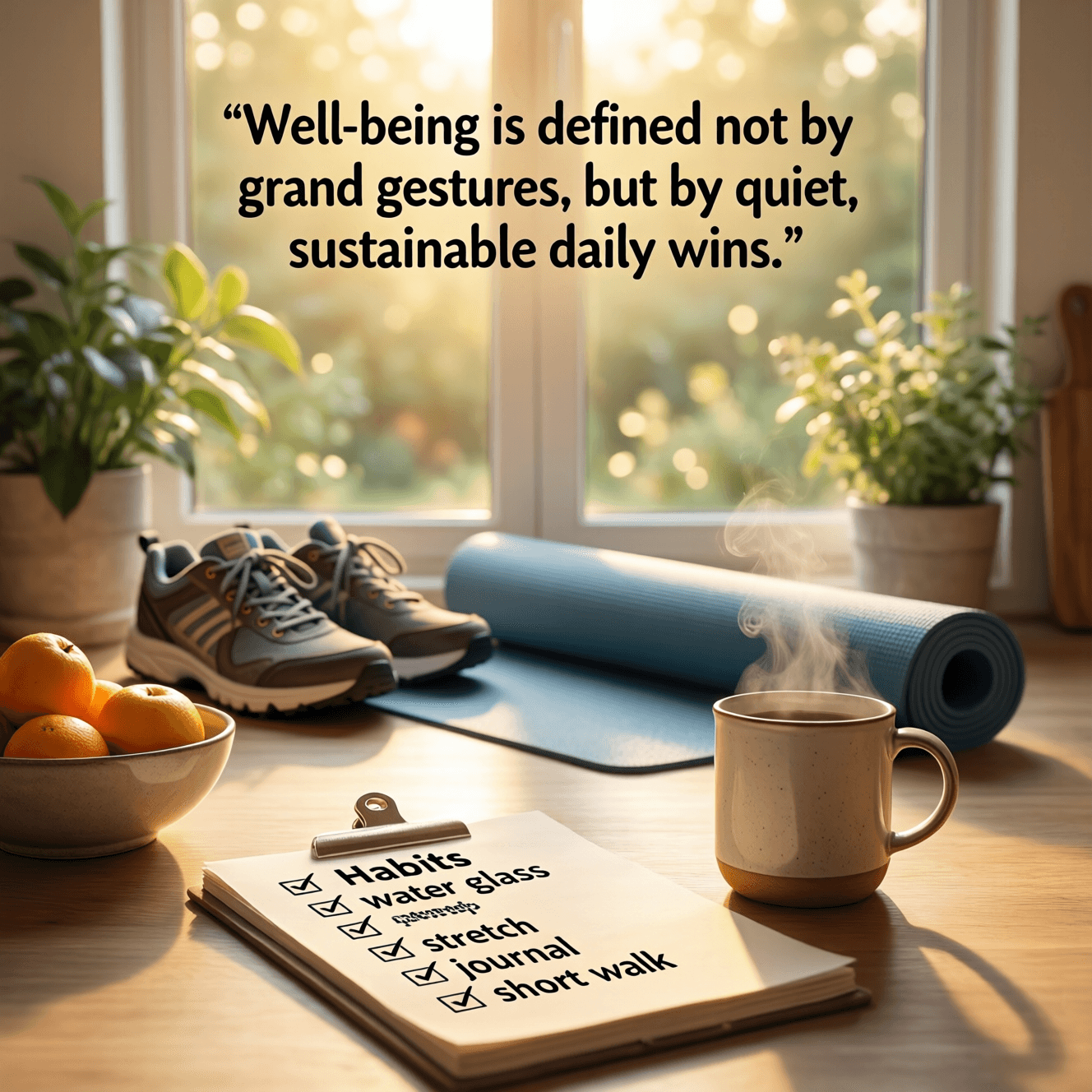
Well-being is defined not by grand gestures, but by quiet, sustainable daily wins. — Proverb
—What lingers after this line?
Redefining What Counts as Progress
The proverb challenges a common assumption: that well-being must be proven through dramatic changes, visible achievements, or occasional bursts of motivation. Instead, it reframes progress as something modest and repeatable—small actions that accumulate into a stable life. This shift matters because grand gestures often depend on rare conditions—extra time, perfect energy, or sudden inspiration—while quiet wins can happen even on ordinary days. By moving the goalpost from “impressive” to “sustainable,” the quote suggests that well-being is less a destination and more a pattern you practice.
The Power of Sustainability Over Intensity
Building on that redefinition, the word “sustainable” becomes the moral center of the proverb. Intense efforts can create short-term change, but they can also invite burnout, guilt, and the sense of starting over repeatedly. Sustainable actions, by contrast, are designed to fit the life you actually have. This is why a ten-minute walk after dinner can outperform a once-a-week heroic workout plan that collapses under stress. Over time, sustainability turns self-care from a project into a default, making well-being resilient rather than fragile.
Daily Wins as Habit Architecture
From sustainability, it’s a natural step to habit—because daily wins are essentially the bricks of routine. James Clear’s Atomic Habits (2018) popularizes the idea that small behaviors compound, not unlike interest in a bank account. The proverb echoes that logic: what you repeat becomes what you are. A quiet win might be refilling a water bottle, stepping outside for sunlight, or preparing tomorrow’s breakfast before bed. These actions look unimpressive in isolation, yet they build structure, and structure quietly reduces the decision fatigue that so often undermines mental and physical health.
Quiet Wins and the Psychology of Self-Trust
Another layer emerges when we consider what daily follow-through does to the mind: it creates self-trust. Each small promise kept—going to bed when you said you would, stretching for five minutes, sending the email you’ve avoided—serves as evidence that you can rely on yourself. Albert Bandura’s work on self-efficacy, including “Self-Efficacy: Toward a Unifying Theory of Behavioral Change” (1977), shows how belief in one’s ability influences motivation and persistence. In that sense, quiet wins are not just practical; they’re psychological training, turning “I can’t” into “I do, regularly.”
Why Grand Gestures Can Mislead Us
With self-trust established, the proverb also warns against the seduction of grand gestures. Big actions can feel cleansing—like a dramatic restart—but they can mask deeper problems, such as inconsistent routines, unrealistic expectations, or a cycle of shame and overcompensation. Consider the familiar pattern: an extreme schedule begins on Monday, collapses by Thursday, and ends with frustration that “nothing works.” The quote gently implies that the problem isn’t lack of character; it’s the choice of a strategy that requires constant heroism. Quiet wins avoid that trap by asking only for what can be repeated.
Making Well-Being Visible Through the Ordinary
Finally, the proverb invites a practical conclusion: if well-being is built quietly, you measure it quietly too. Progress may appear in steadier moods, fewer “crash” days, improved sleep, a calmer relationship with food, or a growing ability to handle stress without spiraling. In practice, this can look like choosing two or three daily anchors—hydration, movement, and a consistent bedtime—then letting those wins set the tone for everything else. The grand gesture becomes unnecessary, because the ordinary day is no longer something to escape; it’s where well-being is steadily made.
One-minute reflection
Why might this line matter today, not tomorrow?
Related Quotes
6 selectedWhat you do daily matters more than what you do occasionally. — Gretchen Rubin
Gretchen Rubin
At first glance, Gretchen Rubin’s quote seems simple, yet it points to a profound truth: our lives are built less by rare bursts of effort than by repeated daily actions. A single healthy meal, workout, or kind gesture m...
Read full interpretation →What you do daily determines what you become permanently. — Mike Murdock
Mike Murdock
Mike Murdock’s statement turns attention away from occasional effort and toward the quiet force of repetition. In essence, it argues that permanence is not built in dramatic moments but in daily patterns.
Read full interpretation →The secret to a life of quality is found in your daily agenda; it is what you do consistently that becomes your reality. — Aristotle
Aristotle
At its heart, this saying argues that life is not transformed mainly by rare dramatic moments, but by ordinary actions repeated over time. The phrase “daily agenda” points to the quiet structure of a day—what we prioriti...
Read full interpretation →It is not the intensity of what you do once that changes your life; it is the persistence of what you do daily. — Myles Munroe
Myles Munroe
At its core, Myles Munroe’s statement shifts attention away from dramatic one-time efforts and toward the quieter force of repetition. A single burst of motivation may feel transformative in the moment, yet lasting chang...
Read full interpretation →Honor the ordinary tasks; they are the scaffolding of greatness — John Steinbeck
John Steinbeck
John Steinbeck’s line reads like practical wisdom disguised as poetry: treat ordinary tasks with honor because they hold up everything else. Rather than romanticizing rare moments of inspiration, he points attention to w...
Read full interpretation →Build tiny edges of progress every day and mountains will rearrange themselves. — James Clear
James Clear
James Clear’s line reframes progress as something you construct in edges—thin, almost invisible layers of effort—rather than dramatic breakthroughs. At first glance, a few minutes of practice or a single page read can fe...
Read full interpretation →More From Author
More from Proverb →Your nervous system is a landscape, not a machine; it requires the soft rain of rest, not the constant lightning of urgency. — Proverb
The proverb begins by rejecting the idea that the nervous system is a simple machine with replaceable parts and predictable outputs. Instead, it frames the body as a landscape—complex, interconnected, and shaped over tim...
Read full interpretation →If you bring forth what is within you, what you bring forth will save you. If you do not, it will destroy you. — Proverb
The proverb frames self-expression as a decisive fork in the road: what lies within us is not neutral, and it will shape our fate one way or another. In this view, inner fears, desires, convictions, and gifts resemble a...
Read full interpretation →The world will provide you with a label if you are too lazy to define yourself. Pick your own name before someone else names you their tool. — Proverb
The proverb begins with a blunt warning: if you don’t articulate who you are, other people will do it for you. In everyday life, that labeling can be subtle—“quiet,” “difficult,” “gifted,” “unreliable”—but once applied,...
Read full interpretation →I am allowed to have limits. My needs matter too. I deserve moments of rest. — Proverb
The proverb begins with a simple but radical permission: you are allowed to have limits. In many families, workplaces, or cultures, saying “no” can be treated as selfishness, yet limits are often the very structure that...
Read full interpretation →