
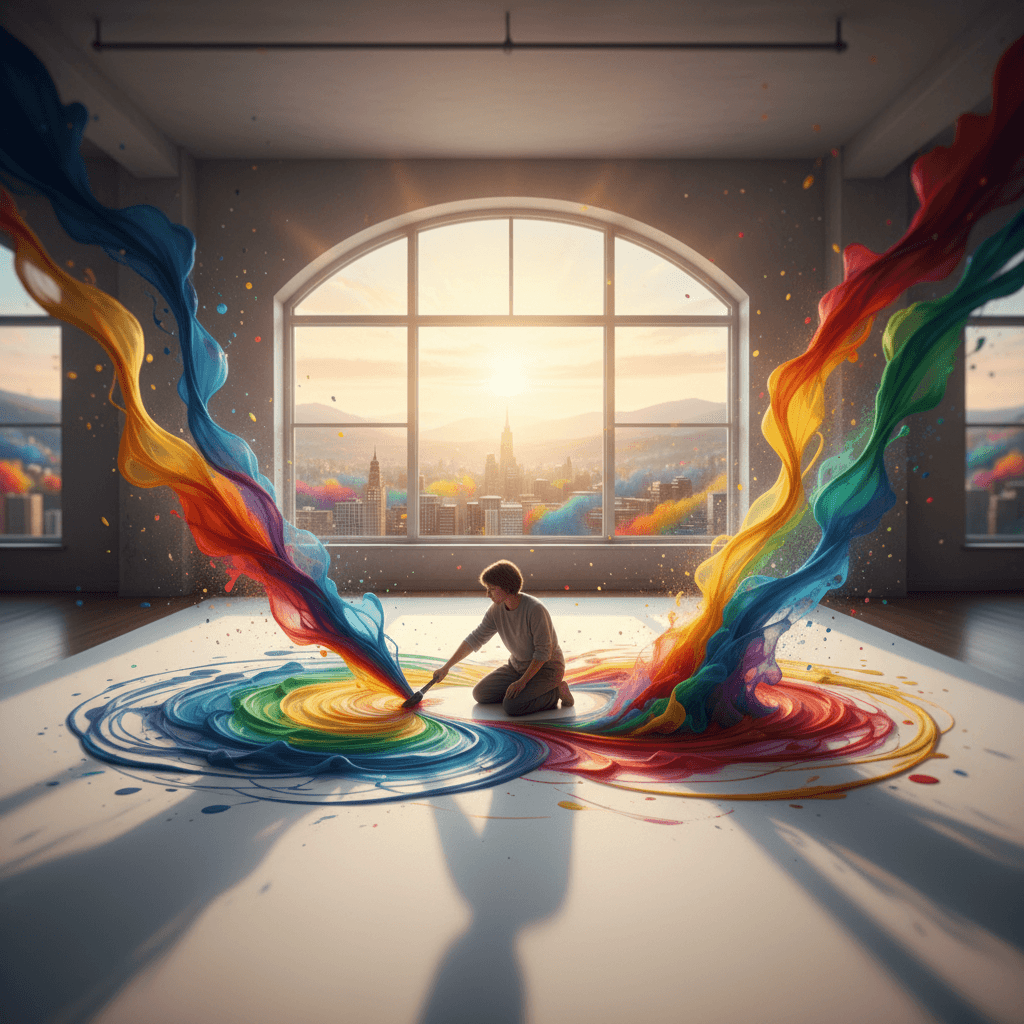
Make the present your canvas: begin, and the world will find colors to meet you. — Chimamanda Ngozi Adichie
—What lingers after this line?
A Call to Begin Where You Stand
Adichie’s line frames the present not as a waiting room but as raw material—something you can shape rather than endure. The “canvas” metaphor implies agency: your life is not merely observed; it is made. Importantly, she links meaning to initiation, suggesting that clarity and momentum often arrive after you start, not before. This reframes procrastination as a kind of misplaced respect for certainty. Instead of demanding full confidence, the quote invites a smaller, braver act: begin with what you have today. From there, the world’s response—resources, allies, opportunities—can become visible in ways that only movement reveals.
Why Action Creates Its Own Inspiration
From that starting point, the promise that “the world will find colors to meet you” describes a feedback loop between effort and possibility. When you act, you generate signals—work to react to, questions to answer, drafts to improve—which draw out responses that remain dormant when you stay still. In other words, beginnings can be catalytic. This echoes a practical truth in creative and professional life: a first attempt may be plain, but it gives reality something to collaborate with. Much like a painter’s initial sketch, it’s not the final image that matters first; it’s the mark that makes the next mark possible.
Colors as People, Chances, and Serendipity
The “colors” can be read as more than aesthetic beauty; they can be the unexpected elements that arrive once you commit—help from a colleague, an idea sparked by a conversation, or an opportunity you couldn’t have predicted. By choosing the present as your medium, you place yourself in the path of such encounters. Many careers illustrate this quietly: a writer shares a small essay and meets an editor; a programmer publishes a simple tool and attracts collaborators. The world often “meets” visible effort with its own palette—connections and openings that are difficult to access through planning alone.
The Present as a Discipline, Not a Mood
Still, treating the present as a canvas requires more than optimism; it asks for discipline. If you only create when you feel inspired, the canvas remains blank more often than not. Adichie’s emphasis on “begin” suggests that presence is an action—showing up, making time, setting boundaries—rather than a fleeting emotional state. Because the present is always available, it also removes excuses tied to perfect conditions. You may not control the larger context, but you can control the next brushstroke: one page, one email, one rehearsal, one difficult conversation. Over time, those strokes become a picture.
Courage to Risk Imperfect First Strokes
Finally, the quote offers a gentle argument against perfectionism. A blank canvas can feel safer than a messy one, yet a messy beginning is often the only route to something vivid. By promising that the world will answer with “colors,” Adichie implies that early imperfection is not a verdict; it is an invitation for refinement and response. In this way, the present becomes both stage and studio: you act, learn, adjust, and act again. The deeper message is hopeful but unsentimental—life grows more colorful not by waiting for the right moment, but by daring to make this moment the start.
One-minute reflection
Where does this idea show up in your life right now?
Related Quotes
6 selectedLife is a blank canvas, and each day is a brushstroke.
Unknown
This quote highlights the idea that life is full of endless possibilities, like a blank canvas ready to be painted. Each day presents an opportunity to shape our destiny and bring our unique vision to life.
Read full interpretation →Creativity takes courage. — Henri Matisse
Henri Matisse
This quote highlights that being creative often involves exposing one's inner thoughts and feelings, which requires a significant amount of courage as it makes one vulnerable to criticism and judgment.
Read full interpretation →Embrace the uncertainty of the journey, for within it lies the magic of limitless possibilities. - Alex Grey
Alex Grey
This quote encourages embracing the unknown aspects of life's journey. It highlights that uncertainty is a natural and valuable part of the process rather than something to fear.
Read full interpretation →In order to be open to creativity, one must have the capacity for constructive use of solitude. One must overcome the fear of being alone. — Rollo May
Rollo May
Rollo May’s insight begins with a quiet but demanding premise: creativity requires the ability to stand apart from constant noise, approval, and distraction. To be open to new ideas, a person must first become comfortabl...
Read full interpretation →To create is to live twice. — Albert Camus
Albert Camus
This quote suggests that the act of creation gives life a deeper meaning. By creating, individuals experience a second life as they bring new ideas and forms to existence.
Read full interpretation →The moment a man begins to talk about technique, that's proof that he is fresh out of ideas. — Dylan Thomas
Dylan Thomas
Dylan Thomas’s remark begins with a sharp suspicion: when an artist talks too much about technique, the living impulse behind the work may already be gone. Technique, in this sense, becomes a substitute language, a way o...
Read full interpretation →More From Author
More from Chimamanda Ngozi Adichie →To love is to recognize that another person is a separate universe, and yet to choose, daily, to walk through it beside them. — Chimamanda Ngozi Adichie
At its heart, Adichie’s line defines love not as possession but as perception. To love someone is first to grasp that they are irreducibly distinct: a ‘separate universe’ with their own memories, fears, loyalties, and in...
Read full interpretation →True milestones are not found in our public achievements, but in the quiet, transformative moments of connection we share with those we hold dear. — Chimamanda Ngozi Adichie
At first glance, Adichie’s quote gently overturns a common modern assumption: that the most important markers of a life are public victories, titles, or visible accomplishments. Instead, she redirects our attention towar...
Read full interpretation →Your job is not to be likable. Your job is to be yourself. — Chimamanda Ngozi Adichie
Adichie’s line begins by stripping away a common social bargain: if you act agreeable enough, you’ll be accepted. By saying your job is not to be “likable,” she points to how easily a person can become an employee of oth...
Read full interpretation →Make today the workshop where your best self is assembled piece by piece. — Chimamanda Ngozi Adichie
Chimamanda Ngozi Adichie’s line turns “today” from a deadline into a worksite: a place where something is being made. Instead of waiting for a future version of life to begin, she suggests the present is where constructi...
Read full interpretation →