
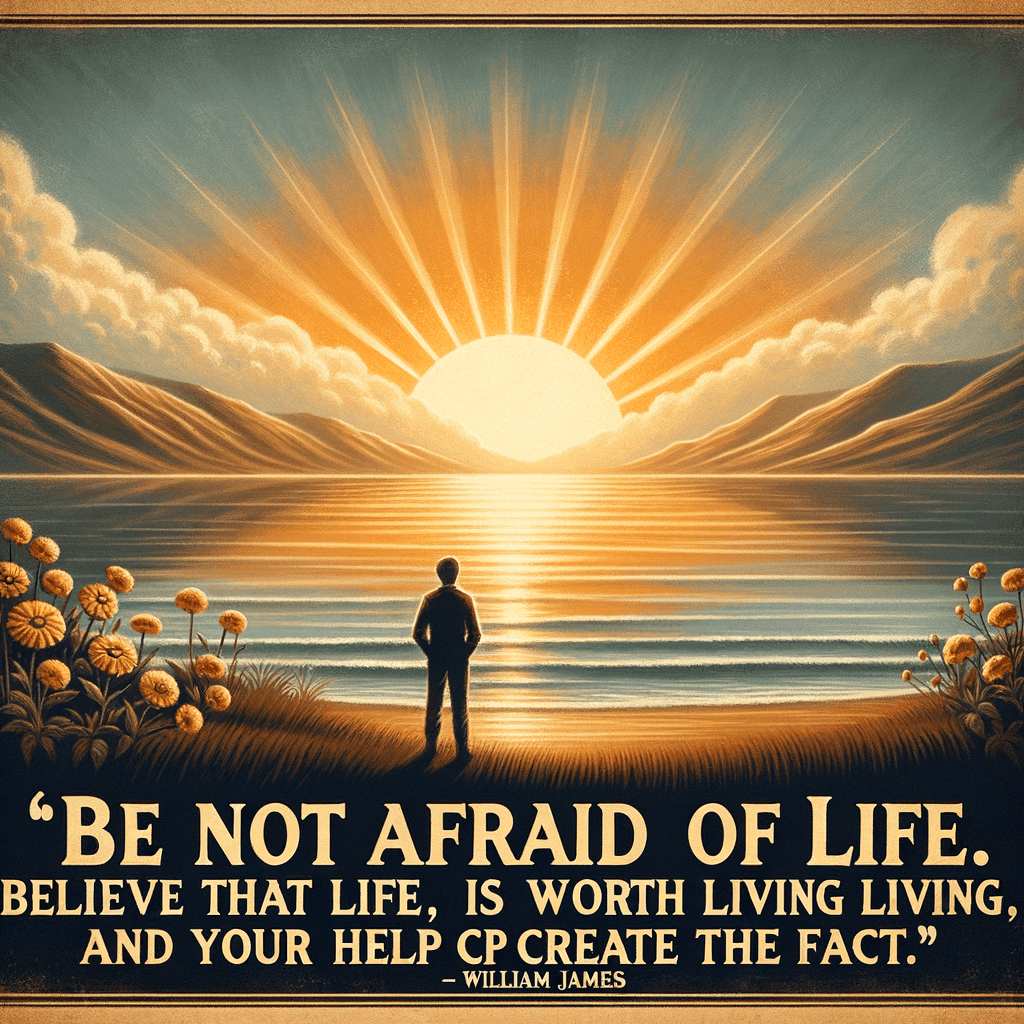
Be not afraid of life. Believe that life is worth living, and your belief will help create the fact. — William James
—What lingers after this line?
Overcoming Fear
This quote encourages individuals to face life with courage and not be paralyzed by fear. It implies that fear can prevent people from experiencing the richness of life.
Power of Belief
William James suggests that believing in the worthiness of life can shape one's reality. Positive beliefs can transform one's experiences and make life more fulfilling.
Mental Attitude
The quote emphasizes the impact of a positive mental attitude. By choosing to believe that life is worth living, individuals can influence their outlook and actions, leading to more positive outcomes.
Agency and Creation
It highlights the role of personal agency in creating one's life experiences. Belief is depicted as a powerful tool that helps shape and create the desired reality.
Philosophical Context
William James was an American philosopher and psychologist, known for his work on pragmatism. This quote reflects his pragmatic approach, which focuses on the practical effects of beliefs and their role in shaping reality.
One-minute reflection
What feeling does this quote bring up for you?
Related Quotes
6 selectedTo be courageous is to act with the heart. — Molière
Molière
Molière’s line suggests that courage is not merely the absence of fear, but the decision to move despite it. By connecting courage with the heart, he frames bravery as an emotional and moral act rather than a simple disp...
Read full interpretation →The best people possess a feeling for beauty, the courage to take risks, the discipline to tell the truth, the capacity for sacrifice. — Ernest Hemingway
Ernest Hemingway
Hemingway’s line presents goodness not as politeness or success, but as a demanding inner code. The “best people” are those who combine sensitivity, bravery, honesty, and self-denial—qualities that do not always coexist...
Read full interpretation →If you are not willing to look stupid, nothing great is ever going to happen to you. — Julia Cameron
Julia Cameron
Julia Cameron’s remark begins with a hard truth: many people do not fail because they lack talent, but because they fear embarrassment. In that sense, ‘looking stupid’ becomes shorthand for being seen trying, stumbling,...
Read full interpretation →You don't have to bully yourself out of feeling fear. You just have to move while it's still there. — Annie Wright
Annie Wright
At its core, Annie Wright’s quote challenges the common belief that courage begins only after fear has disappeared. Instead, it reframes fear as something that can accompany action rather than prevent it.
Read full interpretation →For what matters in life is not whether we receive a round of applause; what matters is whether we have the courage to venture forth despite the uncertainty of acclaim. — Amor Towles
Amor Towles
At its core, Amor Towles shifts attention away from public approval and toward private resolve. The quote argues that a life’s value is not determined by applause—those visible signs of recognition—but by the willingness...
Read full interpretation →Confidence doesn't mean being fearless. It means creating, even when your hands shake. — Lisa Golightly
Lisa Golightly
At first glance, Lisa Golightly’s quote overturns a common myth: that confident people move through life without fear. Instead, she presents confidence as action taken in spite of fear, not in the absence of it.
Read full interpretation →More From Author
More from William James →No matter how full a reservoir of maxims one may possess, if one has not taken advantage of every concrete opportunity to act, one's character may remain entirely unaffected. — William James
At first glance, William James draws a sharp line between knowing and becoming. A person may store up countless moral sayings, noble principles, and wise resolutions, yet these remain largely ornamental if they never pas...
Read full interpretation →It is our attitude at the beginning of a difficult task which, more than anything else, will affect its successful outcome. — William James
William James argues that the decisive moment in any hard undertaking arrives before the real work is even underway. In this view, success does not begin with talent, resources, or luck, but with the posture of mind we b...
Read full interpretation →Great emergencies and crises show us how much greater our vital resources are than we had supposed. — William James
William James suggests that ordinary life can conceal our deepest capacities. In routine conditions, people often act within familiar limits, assuming those limits define their true strength.
Read full interpretation →We are like islands in the sea, separate on the surface but connected in the deep. — William James
William James’s metaphor begins with a simple visual truth: islands appear isolated when viewed from above. In the same way, human beings often seem self-contained, bounded by private thoughts, personal histories, and in...
Read full interpretation →