
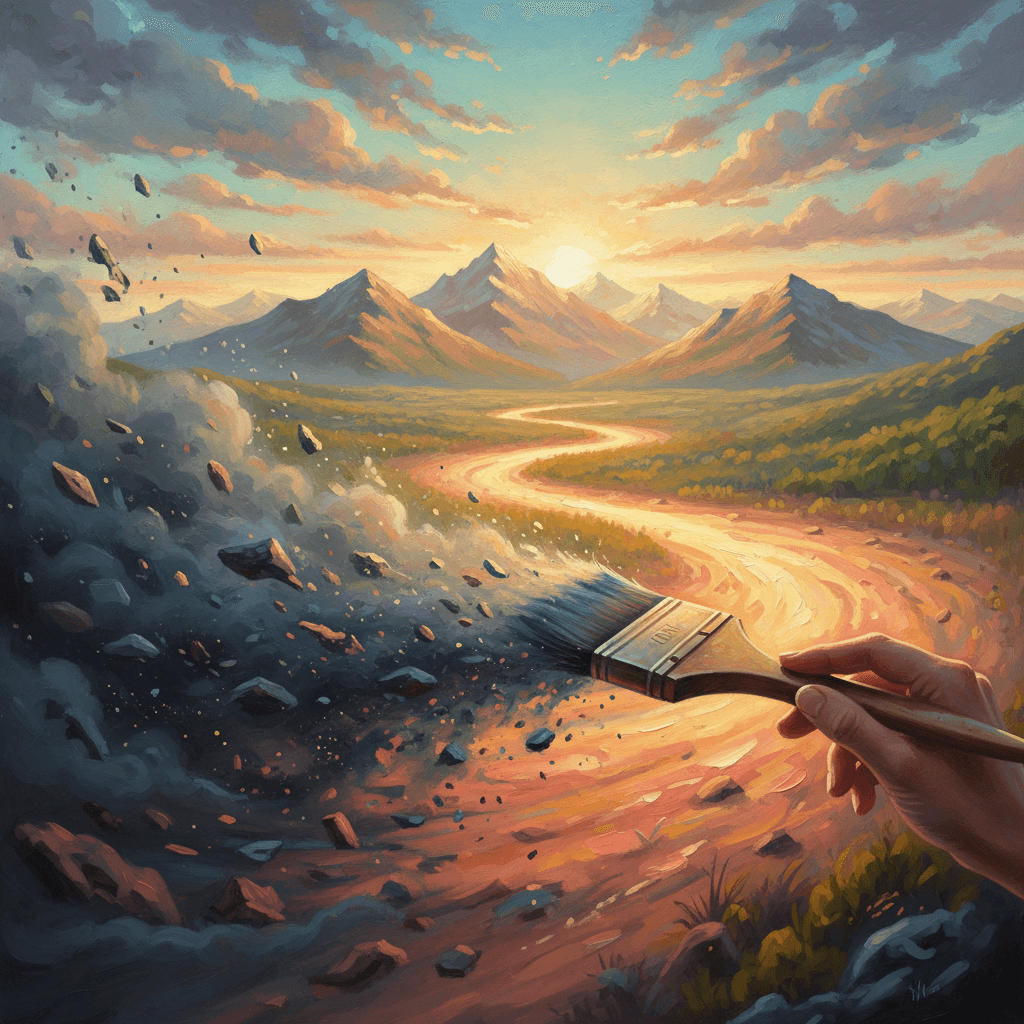
Brush fear aside like dust and paint the life you want to live. — Georgia O'Keeffe
—What lingers after this line?
Fear as Dust, Not a Wall
At first glance, O’Keeffe reframes fear as dust—real but light, settling only if left alone. Instead of a dragon to slay, it is a film to brush away, a daily gesture that restores clarity. The second clause invites agency: do not merely remove; create. To paint the life you want is to replace avoidance with intention. That turn from removal to making begins with a single brush in hand—the chosen tool of agency, ready to meet the canvas of ordinary days.
The Brushstroke of Deliberate Agency
Indeed, O’Keeffe’s trajectory embodied that brushstroke of will. In 1916, Alfred Stieglitz exhibited her charcoal abstractions at 291, launching a career that refused prevailing scripts (O’Keeffe Museum archives). She simplified forms into commanding shapes and color, not to please trends but to see on her own terms. Consequently, the brush becomes more than technique; it is a vote for a way of living. Each deliberate stroke says, ‘this is my edge, my line,’ preparing us for the broader landscapes she later claimed.
New Mexico: A Self-Made Horizon
That broader claim arrived when she first traveled to New Mexico in 1929 and returned for decades, ultimately settling there in 1949 after Stieglitz’s death (1946). Among bleached bones and boundless sky, she fashioned a new vocabulary: consider Ram’s Head, White Hollyhock-Hills (1935), where earth, air, and symbol converge. Thus the desert was not escape but selection—a chosen horizon that aligned work and life. By choosing place, she curated attention; by curating attention, she shaped self. This is the quote enacted.
From Vision to Routine Practice
Translating inspiration into practice, however, happens in increments. Behavioral research shows that tiny actions, repeated, accumulate into identity; BJ Fogg’s Tiny Habits (2019) demonstrates how a two-minute starter behavior can unlock a larger routine. Accordingly, ‘brushing fear aside’ can be ritualized: name the next smallest stroke (send one email, draft 100 words, stretch five minutes), tether it to an existing cue, and close with a quick celebration. Small wins keep the canvas open for bolder color.
What Psychology Teaches About Fear
Moreover, psychology suggests we need not eradicate fear to move. Acceptance and Commitment Therapy invites us to carry discomfort while acting toward chosen values (Hayes et al., 1999). Similarly, exposure research shows that gently approaching what scares us reduces avoidance over time. Seen this way, dust is acknowledged, not denied; we sweep while it settles, and we paint anyway. A growth mindset supports this stance, framing stumbles as information rather than verdicts (Dweck, 2006).
Composing Your Palette of Possibilities
With fear now right-sized, we can design. Bill Burnett and Dave Evans’s Designing Your Life (2016) proposes building three ‘Odyssey Plans,’ prototyping futures with low-risk experiments: audit a class, shadow a role, volunteer two weekends. In paint terms, you mix small batches before committing to a full wall. Each prototype returns data about energy, fit, and meaning, allowing you to remix until the colors ring true.
Maintenance: Keep Sweeping, Keep Painting
Finally, the work endures through maintenance. O’Keeffe pursued her vision across decades, culminating in the monumental Sky Above Clouds IV (1965), a panorama of floating forms that required stamina and scale. When vision loss arrived in the 1970s, she adapted with new materials and assistance from Juan Hamilton (O’Keeffe Museum), continuing to create. In the same spirit, schedule periodic ‘dustings’: prune commitments, refresh rituals, and recommit to the scene you want to inhabit. Fear will always settle; so will courage, if you keep brushing—and keep painting.
One-minute reflection
Why might this line matter today, not tomorrow?
Related Quotes
6 selectedEach day is a blank canvas; paint on it the life you desire.
Unknown
This quote emphasizes the potential each day holds. Every dawn brings a fresh start, offering countless opportunities to shape your life according to your wishes and goals.
Read full interpretation →Your life is your story; write it boldly and don't be afraid to color outside the lines. — Unknown, Global.
Unknown, Global.
This quote emphasizes that each individual has the power to author their own life. It encourages embracing one’s unique journey and experiences as personal narrative.
Read full interpretation →The sort of fearless openness required to turn toward our suffering is only possible within the spacious receptivity of love. — Frank Ostaseski
Frank Ostaseski
Frank Ostaseski’s statement begins with a striking claim: real courage is not simply toughness or willpower. Instead, the bravery required to face suffering honestly arises from love’s presence.
Read full interpretation →There is no must in art because art is free. — Wassily Kandinsky
Wassily Kandinsky
At its core, Kandinsky’s statement rejects the idea that art must obey fixed obligations. By saying there is no ‘must’ in art, he frees creation from rigid formulas, academic demands, and social expectation.
Read full interpretation →Often what the artist expresses is unconscious, but we can learn to decode the story by collaboratively finding the pieces to the puzzle that create new possibilities for innovation. — Ben Okri
Ben Okri
At the heart of Ben Okri’s statement is the idea that art often says more than the artist consciously intends. A poem, painting, or song may carry hidden fears, cultural memories, or emotional truths that emerge without...
Read full interpretation →It is only when we are no longer fearful that we begin to create. — J.M.W. Turner
J.M.W. Turner
Turner’s statement begins with a simple but profound insight: fear often stands between imagination and expression. Before a person can create, they must first loosen the grip of self-doubt, judgment, and uncertainty.
Read full interpretation →More From Author
More from Georgia O'Keeffe →We are not here to copy the reality that is already sold to us, but to use our own lenses to reshape the world we see. — Georgia O'Keeffe
Georgia O’Keeffe’s statement begins with a refusal: we are not here merely to reproduce a ready-made version of reality. In that sense, she challenges the passive habit of accepting what culture, commerce, and convention...
Read full interpretation →Making your unknown known is the important thing. — Georgia O'Keeffe
At its core, Georgia O’Keeffe’s statement turns creativity into an act of revelation. “Your unknown” suggests the private territory within a person—feelings, intuitions, memories, and perceptions not yet fully understood...
Read full interpretation →To create one's own world takes courage. — Georgia O'Keeffe
The quote speaks to the importance of forming unique perspectives and paths in life, rather than conforming to societal norms.
Read full interpretation →I found I could say things with color and shapes that I couldn't say any other way — things I had no words for. — Georgia O'Keeffe
At the outset, O’Keeffe’s line proposes that colors and shapes constitute a language with its own grammar—one that conveys nuance before sentences can. We routinely ‘read’ a room’s palette or a landscape’s contours; acco...
Read full interpretation →