
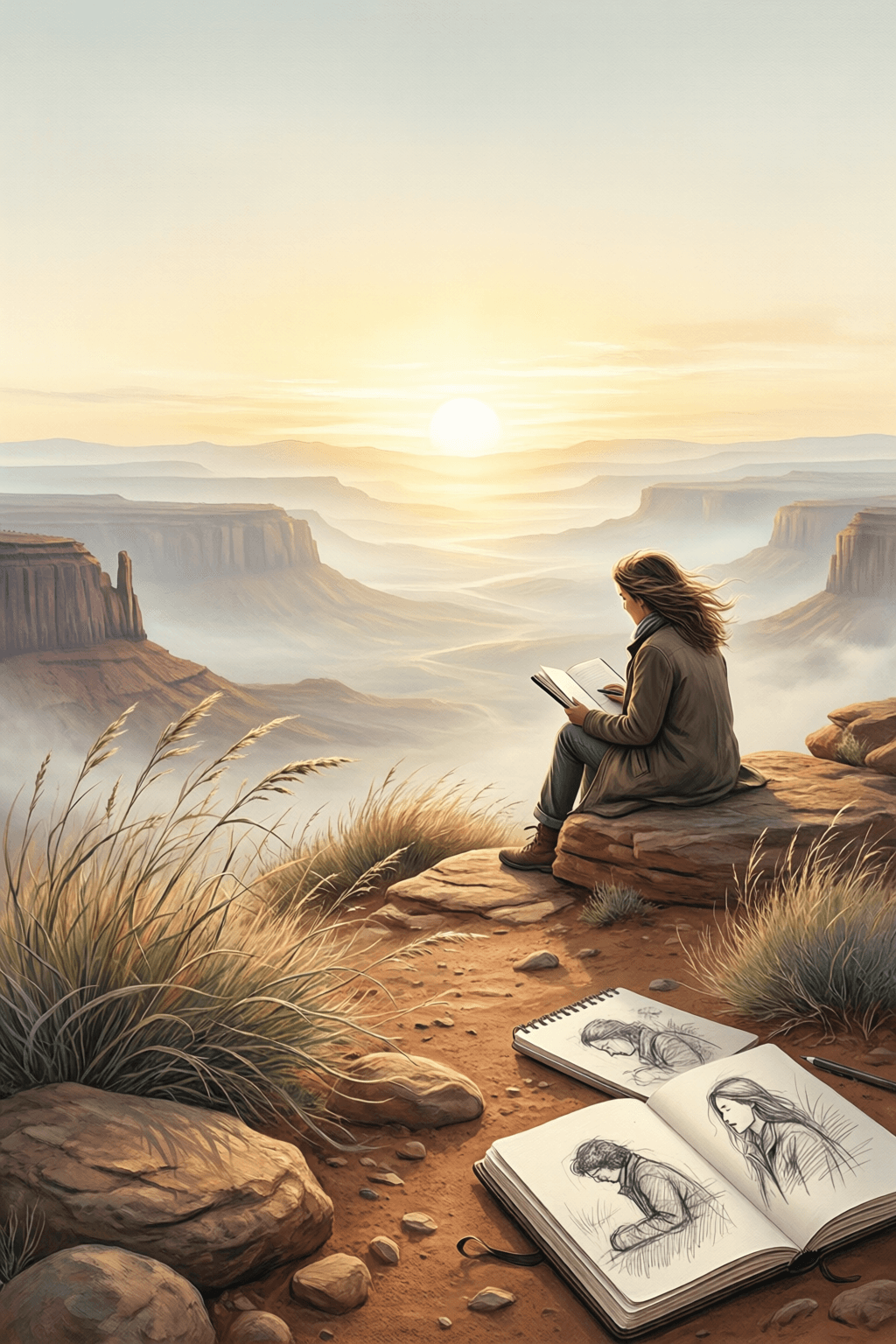
Making your unknown known is the important thing. — Georgia O'Keeffe
—What lingers after this line?
A Call to Reveal the Inner World
At its core, Georgia O’Keeffe’s statement turns creativity into an act of revelation. “Your unknown” suggests the private territory within a person—feelings, intuitions, memories, and perceptions not yet fully understood even by the self. By saying that making it known is what matters, she shifts the goal of art away from decoration or approval and toward discovery. In this way, O’Keeffe frames expression as a bridge between inner life and outer form. What begins as something vague or hidden becomes visible through painting, writing, or any honest act of making. The quote therefore speaks not only to artists, but to anyone trying to give shape to what they sense but cannot yet easily explain.
Why the Unknown Matters
From there, the quote suggests that the most valuable material often lies beneath habit and certainty. People usually present what is polished, conventional, or already understood, yet O’Keeffe points toward the opposite: the unformed part of experience. That is where originality lives, because what is unknown has not yet been reduced to cliché. This idea aligns with much of modern art, which sought to move beyond surface realism and expose perception itself. O’Keeffe’s own flower paintings and desert landscapes, discussed in exhibitions such as the Art Institute of Chicago’s studies of her work, transform ordinary subjects into intimate emotional encounters. Thus, the unknown is not necessarily exotic; often, it is the depth hidden inside familiar things.
Art as a Process of Discovery
Consequently, the quote implies that artists do not always begin with clarity; often, they begin with uncertainty. The work becomes a means of finding out what one feels or knows. Rather than illustrating a fully formed message, the creative act uncovers meaning step by step, allowing the maker to meet parts of the self that had remained obscure. This process recalls Rainer Maria Rilke’s counsel in Letters to a Young Poet (1903–1908), where he urges the reader to “live the questions.” In a similar spirit, O’Keeffe treats uncertainty not as failure but as raw material. The unknown is valuable precisely because it invites exploration, and making becomes the method through which hidden knowledge emerges.
The Courage to Be Personal
However, making the unknown known requires vulnerability. To reveal what is deeply personal is to risk misunderstanding, simplification, or rejection. O’Keeffe herself resisted narrow interpretations of her paintings, especially when critics projected meanings onto them that overshadowed her own intentions. Her career shows that honest expression often demands independence from public expectations. For that reason, the quote also contains a quiet ethic of courage. It asks the creator to trust private vision before external validation arrives. In doing so, O’Keeffe suggests that authenticity is not merely stylistic; it is moral. One must be willing to stand by what feels inwardly true, even when others do not immediately recognize its value.
Beyond Art Into Everyday Life
Ultimately, O’Keeffe’s insight reaches beyond the studio. In ordinary life, people also carry “unknowns”: unrealized desires, unspoken convictions, and identities still taking shape. Making these known can mean speaking honestly, choosing a truer path, or naming an experience that has long remained buried. The quote therefore becomes a broader philosophy of self-clarification. Seen this way, her words invite a life of attentiveness and expression. What matters is not having every answer in advance, but bringing hidden truths into form little by little. Whether through art, conversation, or deliberate choice, making the unknown known becomes a way of becoming more fully oneself.
One-minute reflection
What's one small action this suggests?
Related Quotes
6 selectedBe who you are and say what you feel, because those who mind don't matter, and those who matter don't mind. — Bernard M. Baruch
Bernard M. Baruch
Baruch’s quote begins with a simple but demanding instruction: be yourself and speak honestly. At its core, the line argues that authenticity is not merely a personality trait but an act of courage, especially in a world...
Read full interpretation →You will never be able to experience everything. So, please, do poetical justice to your soul and simply experience yourself. — Albert Camus
Albert Camus
Camus begins from a humbling truth: no person can live every possible life, see every landscape, or test every path. Because existence is finite, the dream of total experience becomes a source of restlessness rather than...
Read full interpretation →You cannot express something you have not first discovered. — Carl Jung
Carl Jung
At its core, Jung’s remark suggests that authentic expression begins not with performance but with discovery. A person cannot meaningfully speak, create, or reveal what has never been encountered within the self.
Read full interpretation →Sometimes losing everything is how you find yourself. — J.K. Rowling
J.K. Rowling
At first glance, J.K. Rowling’s line frames devastation not simply as an ending, but as a brutal kind of beginning.
Read full interpretation →My body is a garden rooted in gratitude. Thank you is the biggest poem i've got inside of me. — Sabrina Benaim
Sabrina Benaim
At first, Sabrina Benaim’s line transforms the body into a garden, a place of growth, care, and seasonal change. By saying the body is “rooted in gratitude,” she suggests that thankfulness is not a passing mood but a sus...
Read full interpretation →No man has the right to dictate what other men should perceive, create or produce, but all should be encouraged to reveal themselves. — Ansel Adams
Ansel Adams
At its core, Ansel Adams’s statement rejects artistic authoritarianism. He insists that no individual has the moral authority to prescribe what others must see, make, or express.
Read full interpretation →More From Author
More from Georgia O'Keeffe →We are not here to copy the reality that is already sold to us, but to use our own lenses to reshape the world we see. — Georgia O'Keeffe
Georgia O’Keeffe’s statement begins with a refusal: we are not here merely to reproduce a ready-made version of reality. In that sense, she challenges the passive habit of accepting what culture, commerce, and convention...
Read full interpretation →To create one's own world takes courage. — Georgia O'Keeffe
The quote speaks to the importance of forming unique perspectives and paths in life, rather than conforming to societal norms.
Read full interpretation →I found I could say things with color and shapes that I couldn't say any other way — things I had no words for. — Georgia O'Keeffe
At the outset, O’Keeffe’s line proposes that colors and shapes constitute a language with its own grammar—one that conveys nuance before sentences can. We routinely ‘read’ a room’s palette or a landscape’s contours; acco...
Read full interpretation →Brush fear aside like dust and paint the life you want to live. — Georgia O'Keeffe
At first glance, O’Keeffe reframes fear as dust—real but light, settling only if left alone. Instead of a dragon to slay, it is a film to brush away, a daily gesture that restores clarity.
Read full interpretation →