
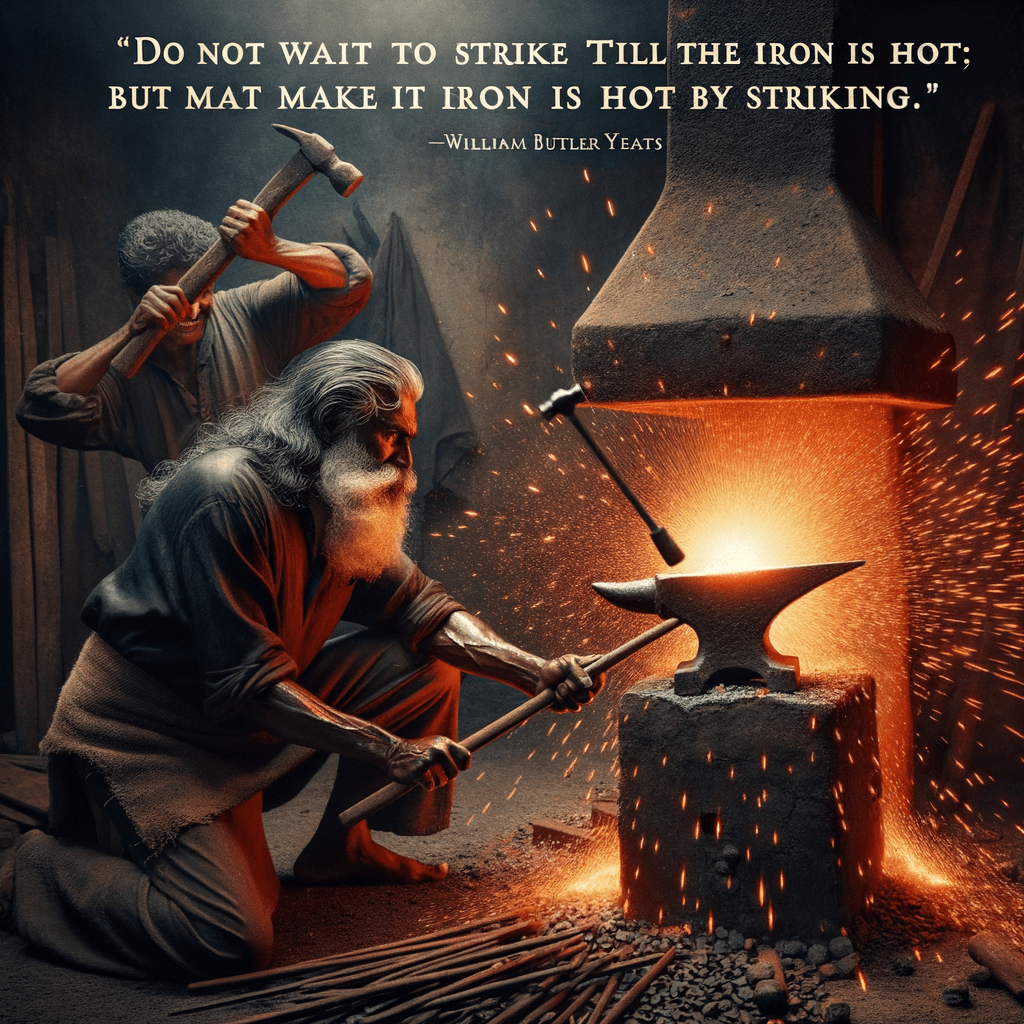
Do not wait to strike till the iron is hot; but make it hot by striking. – William Butler Yeats
—What lingers after this line?
Taking Initiative
This quote emphasizes the importance of taking initiative rather than waiting for perfect conditions. It suggests that we should act to create opportunities rather than passively waiting for them to arise.
Proactive Approach
It advocates for a proactive approach to achieving goals. By continually working and putting in effort, we can generate the favorable circumstances we need rather than waiting for them.
Creating Momentum
The idea of making the iron hot by striking implies that action itself can create momentum and lead to success. Consistent effort and persistence can produce the conditions necessary for achievement.
Personal Empowerment
This quote empowers individuals to take control of their destiny. It suggests that we have the power to shape our future through our actions and decisions.
Overcoming Inertia
Waiting for the 'right time' can lead to complacency and inaction. Yeats' advice encourages us to overcome inertia and start moving forward, trusting that our efforts will generate the opportunities we seek.
Historical Context
William Butler Yeats was an Irish poet and playwright, and one of the foremost figures of 20th-century literature. His works often explored themes of perseverance, destiny, and the human condition, which are reflected in this quote.
One-minute reflection
Why might this line matter today, not tomorrow?
Related Quotes
6 selectedDo not wait to strike till the iron is hot; but make it hot by striking. – William Butler Yeats
William Butler Yeats
This quote emphasizes the importance of taking proactive actions instead of waiting for ideal conditions. By taking initiative, one can create opportunities rather than waiting for them to appear.
Read full interpretation →My will shall shape my future. Whether I fail or succeed shall be no man's doing but my own. — Elaine Maxwell
Elaine Maxwell
At its core, Elaine Maxwell’s statement is a declaration of personal agency. By saying that her will shall shape her future, she rejects the idea that destiny is merely handed down by circumstance, luck, or the judgments...
Read full interpretation →If it is to be, it is up to me. — William H. Johnsen
William H. Johnsen
At first glance, William H. Johnsen’s line compresses an entire philosophy into a few plain words: desired outcomes do not arrive by wish alone, but through personal action.
Read full interpretation →The road ahead is not some predetermined path that I am forced to trod, but it is a rich byway that I can help create. — Craig D. Lounsbrough
Craig D. Lounsbrough
At its core, Craig D. Lounsbrough’s quote resists the idea that life is a rigid script already written for us.
Read full interpretation →Begin, therefore, from little things. — Seneca
Seneca
Seneca’s brief instruction, drawn from his Stoic outlook, turns attention away from grand ambitions and toward manageable first steps. By saying, “Begin, therefore, from little things,” he suggests that progress is rarel...
Read full interpretation →The flame doesn't appear before the match. It is always action that creates the fire. — Napoleon Hill
Napoleon Hill
Napoleon Hill’s image is simple but forceful: a flame does not mysteriously appear on its own; it requires the friction of a struck match. In the same way, desire, talent, and intention remain dormant until they are tran...
Read full interpretation →More From Author
More from William Butler Yeats →Do not wait to strike till the iron is hot; but make it hot by striking. – William Butler Yeats
This quote emphasizes the importance of taking proactive actions instead of waiting for ideal conditions. By taking initiative, one can create opportunities rather than waiting for them to appear.
Read full interpretation →Happiness is neither virtue nor pleasure nor this thing nor that but simply growth, we are happy when we are growing. — William Butler Yeats
William Butler Yeats departs from traditional understandings of happiness by asserting that it is not rooted in virtue, pleasure, or any single fixed aspect of existence. Instead, he argues that happiness derives from on...
Read full interpretation →Think like a wise man but communicate in the language of the people. — William Butler Yeats
Yeats’s counsel draws a bright line between discovery and delivery: keep the rigor of a sage, but let your words walk comfortably among ordinary listeners. This is not an invitation to dilute ideas; rather, it is a deman...
Read full interpretation →