
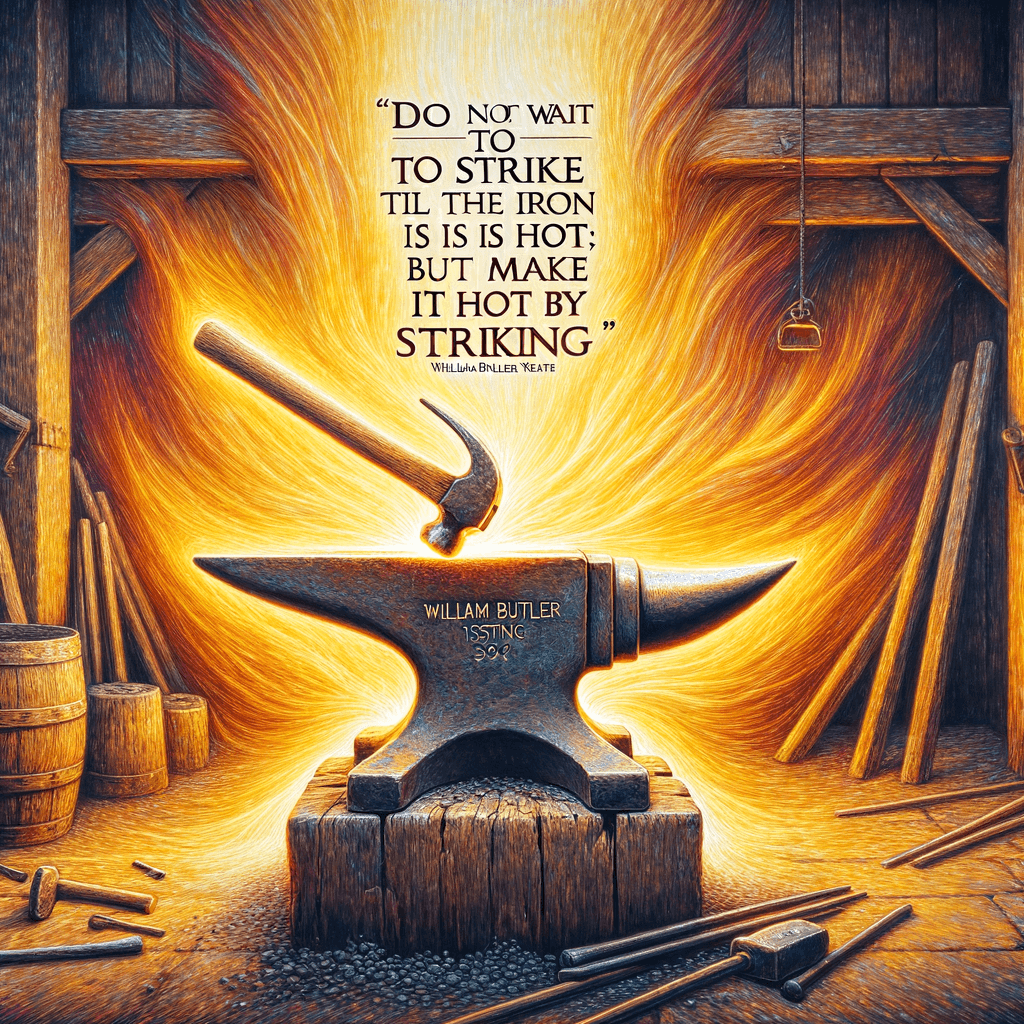
Do not wait to strike till the iron is hot; but make it hot by striking. – William Butler Yeats
—What lingers after this line?
Proactivity
This quote emphasizes the importance of taking proactive actions instead of waiting for ideal conditions. By taking initiative, one can create opportunities rather than waiting for them to appear.
Self-Motivation
It underscores the value of self-motivation and determination. Success often requires creating momentum through consistent effort and not merely relying on favorable circumstances.
Control Over Circumstances
Yeats suggests that we have the power to shape our own circumstances. By actively working toward our goals, we can influence the conditions to our advantage.
Action-Oriented Approach
The metaphor of striking iron highlights the necessity of an action-oriented mindset. Positive outcomes often result from direct and deliberate efforts rather than passive waiting.
Historical Context
William Butler Yeats was a prominent Irish poet and playwright. His works frequently explored themes of human effort, the passage of time, and the importance of action, reflecting his belief in the power of the human spirit.
One-minute reflection
Why might this line matter today, not tomorrow?
Related Quotes
6 selectedDo not wait to strike till the iron is hot; but make it hot by striking. – William Butler Yeats
William Butler Yeats
This quote emphasizes the importance of taking initiative rather than waiting for perfect conditions. It suggests that we should act to create opportunities rather than passively waiting for them to arise.
Read full interpretation →Begin, therefore, from little things. — Seneca
Seneca
Seneca’s brief instruction, drawn from his Stoic outlook, turns attention away from grand ambitions and toward manageable first steps. By saying, “Begin, therefore, from little things,” he suggests that progress is rarel...
Read full interpretation →The flame doesn't appear before the match. It is always action that creates the fire. — Napoleon Hill
Napoleon Hill
Napoleon Hill’s image is simple but forceful: a flame does not mysteriously appear on its own; it requires the friction of a struck match. In the same way, desire, talent, and intention remain dormant until they are tran...
Read full interpretation →Dare to begin where fear says to stop; the first step redraws the map — Paulo Coelho
Paulo Coelho
Paulo Coelho’s line treats fear less as a warning and more as a border we mistakenly accept as permanent. When fear says “stop,” it often isn’t pointing to actual danger; it’s signaling uncertainty, inexperience, or the...
Read full interpretation →It's easier to beg forgiveness than get permission. — Grace Hopper
Grace Hopper
Grace Hopper’s line distills a practical strategy: when progress is stalled by bureaucracy or uncertainty, acting first can be faster than waiting for formal approval. The aphorism isn’t primarily about rudeness; it’s ab...
Read full interpretation →To hell with circumstances; I create opportunities. — Bruce Lee
Bruce Lee
Bruce Lee’s line is less a complaint about life’s unfairness than a refusal to negotiate with it. By dismissing “circumstances,” he points to the many external conditions—money, timing, background, gatekeepers—that peopl...
Read full interpretation →More From Author
More from William Butler Yeats →Do not wait to strike till the iron is hot; but make it hot by striking. – William Butler Yeats
This quote emphasizes the importance of taking initiative rather than waiting for perfect conditions. It suggests that we should act to create opportunities rather than passively waiting for them to arise.
Read full interpretation →Happiness is neither virtue nor pleasure nor this thing nor that but simply growth, we are happy when we are growing. — William Butler Yeats
William Butler Yeats departs from traditional understandings of happiness by asserting that it is not rooted in virtue, pleasure, or any single fixed aspect of existence. Instead, he argues that happiness derives from on...
Read full interpretation →Think like a wise man but communicate in the language of the people. — William Butler Yeats
Yeats’s counsel draws a bright line between discovery and delivery: keep the rigor of a sage, but let your words walk comfortably among ordinary listeners. This is not an invitation to dilute ideas; rather, it is a deman...
Read full interpretation →