
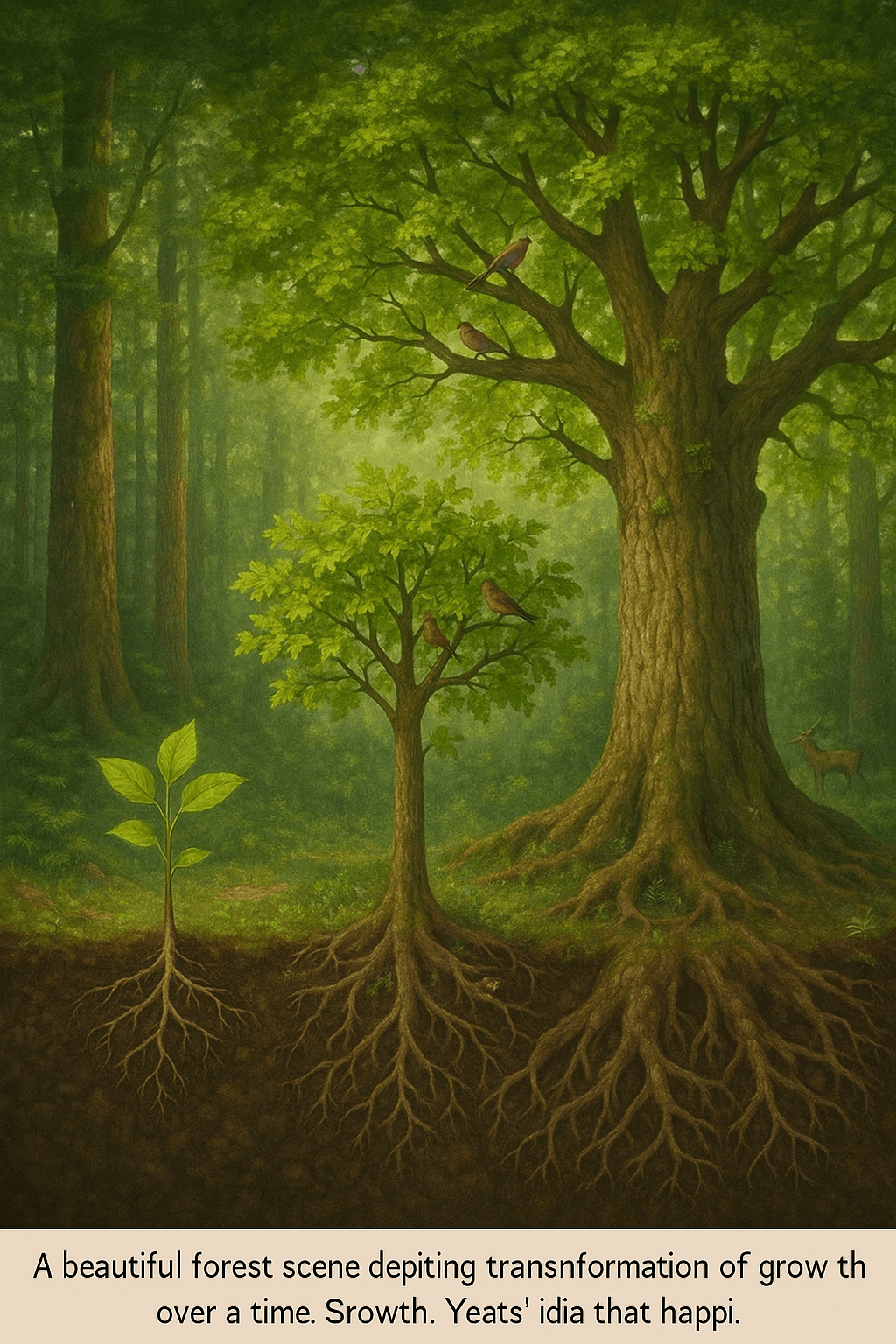
Happiness is neither virtue nor pleasure nor this thing nor that but simply growth, we are happy when we are growing. — William Butler Yeats
—What lingers after this line?
Yeats’s Unique Definition of Happiness
William Butler Yeats departs from traditional understandings of happiness by asserting that it is not rooted in virtue, pleasure, or any single fixed aspect of existence. Instead, he argues that happiness derives from ongoing personal growth. This perspective challenges established philosophical views—Plato’s association of happiness with virtue, for example—by relocating its source from achievement or possession to the continual process of development.
Contrast with Classical Philosophies
Historically, philosophers such as Aristotle have linked happiness (eudaimonia) to virtuous living, while others, like Epicurus, saw it as the pursuit of pleasure. Yeats, however, suggests these classical categorizations are inadequate. His stance implies that static states, whether moral or pleasurable, lack the dynamic quality necessary for true fulfillment, inviting us to reconsider happiness as a moving target rather than a destination.
Growth as Transformation and Renewal
Expanding on Yeats’s idea, growth encompasses not only intellectual and emotional development but also the broader experience of transformation. In literature, the motif of change is central—such as in Hermann Hesse’s ‘Siddhartha’ (1922), where the protagonist’s happiness emerges through continuous learning and spiritual progression. This narrative echoes Yeats’s belief that the journey itself, rather than any fixed point, defines our sense of well-being.
Personal and Societal Implications
This philosophy has implications at both the individual and collective level. For the individual, it places value on lifelong learning, resilience, and self-discovery—processes deeply explored in modern psychology’s growth mindset theory, as popularized by Carol Dweck. For society, it suggests that cultures which prioritize progress and adaptability may cultivate a more authentic, sustained form of happiness among their members.
Embracing Uncertainty and Change
Ultimately, Yeats’s view encourages us to embrace change and uncertainty as essential elements of a happy life. Rather than seeking contentment in stability, we find it in the willingness to evolve. In this light, setbacks and challenges become opportunities for growth, reinforcing the idea that happiness lives not in perfection but in the uninterrupted pursuit of becoming more fully ourselves.
One-minute reflection
Why might this line matter today, not tomorrow?
Related Quotes
6 selectedLearning to love yourself is like learning to walk – essential, life-changing, and the only way to stand tall. — Vironika Tugaleva
Vironika Tugaleva
Vironika Tugaleva’s comparison begins with a simple but powerful truth: self-love is not a luxury, but a basic human necessity. Just as walking allows a child to move through the world with growing independence, learning...
Read full interpretation →The most gifted members of the human species are at their creative best when they cannot have their way, and must compensate for what they miss by realizing and cultivating their capacities. — Bryant H. McGill
Bryant H. McGill
Bryant H. McGill’s observation begins with a striking reversal: gifted people may not reach their highest potential when everything comes easily, but when something blocks their path.
Read full interpretation →A mind grows by staying with difficulty long enough for the experience to change it. — Mary Catherine Bateson
Mary Catherine Bateson
Mary Catherine Bateson’s observation begins with a quiet but demanding truth: the mind does not grow merely by encountering difficulty, but by remaining with it. Challenge becomes transformative only when we resist the u...
Read full interpretation →Consistency is a superpower. — Ryan Holiday
Ryan Holiday
Ryan Holiday’s line begins with a deceptively simple idea: greatness is rarely built through dramatic gestures. More often, it emerges from repeated actions that seem ordinary in isolation but become extraordinary over t...
Read full interpretation →Confidence is silent. Insecurities are loud. — Unknown (Wait—skip/replace with: True nobility is being superior to your former self. — Ernest Hemingway)
Ernest Hemingway
At its core, Hemingway’s line redefines nobility as an inward achievement rather than a social rank. Instead of measuring worth by wealth, pedigree, or dominance over others, it points to a quieter standard: becoming bet...
Read full interpretation →When you look at your life, the greatest happinesses are family happinesses. — Joyce Brothers
Joyce Brothers
Joyce Brothers’ remark begins with a retrospective question: when people survey their lives, what moments shine most brightly? Her answer is strikingly ordinary yet profound—family happiness.
Read full interpretation →More From Author
More from William Butler Yeats →Do not wait to strike till the iron is hot; but make it hot by striking. – William Butler Yeats
This quote emphasizes the importance of taking initiative rather than waiting for perfect conditions. It suggests that we should act to create opportunities rather than passively waiting for them to arise.
Read full interpretation →Do not wait to strike till the iron is hot; but make it hot by striking. – William Butler Yeats
This quote emphasizes the importance of taking proactive actions instead of waiting for ideal conditions. By taking initiative, one can create opportunities rather than waiting for them to appear.
Read full interpretation →Think like a wise man but communicate in the language of the people. — William Butler Yeats
Yeats’s counsel draws a bright line between discovery and delivery: keep the rigor of a sage, but let your words walk comfortably among ordinary listeners. This is not an invitation to dilute ideas; rather, it is a deman...
Read full interpretation →