
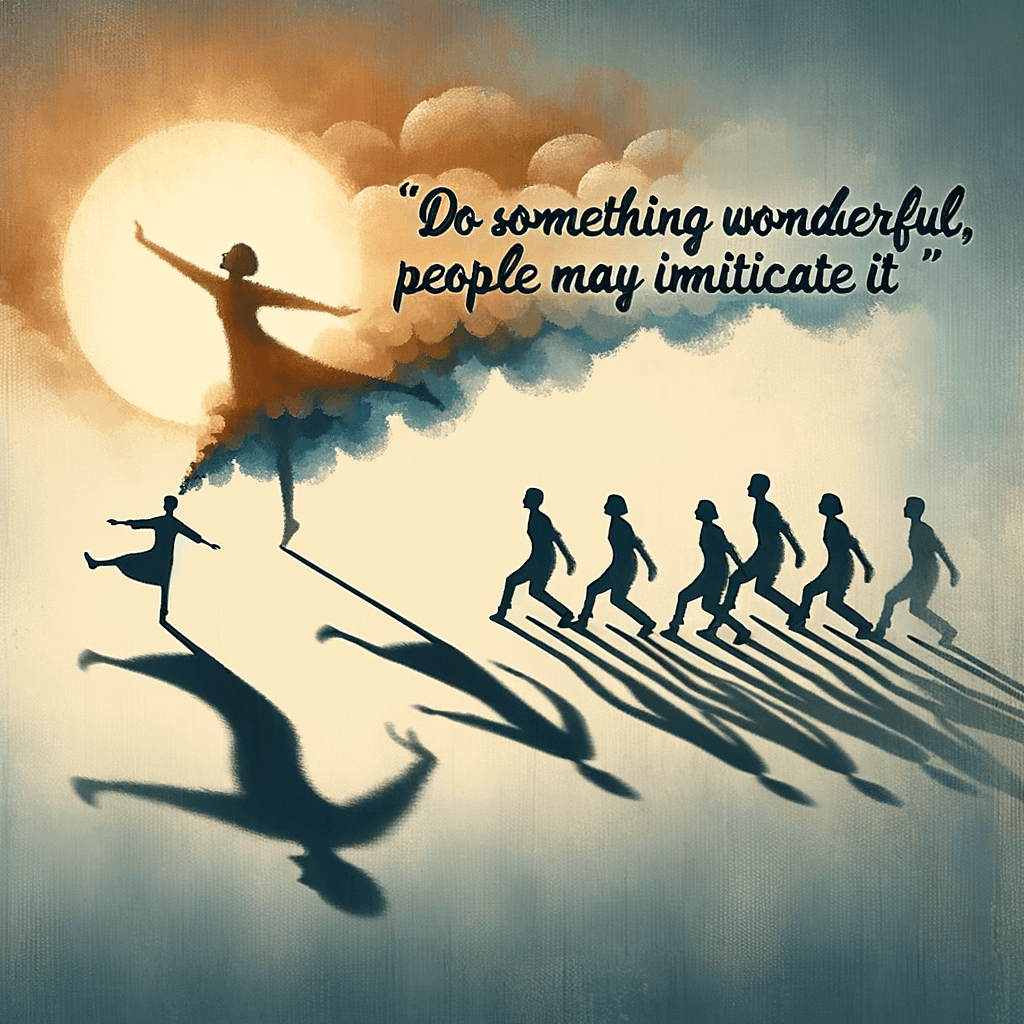
Do something wonderful, people may imitate it. — Albert Schweitzer
—What lingers after this line?
Inspiration and Influence
This quote emphasizes the idea that positive actions can inspire others. When you do something wonderful, it can serve as a model for others to follow, spreading goodness and positive change.
Power of Example
It highlights the impact of leading by example. Your actions speak louder than words, and when people see you doing something admirable, they may be motivated to replicate your behavior.
Ripple Effect
The quote suggests a ripple effect where one person's good deeds can influence a larger group. By doing something wonderful, you can indirectly cause a chain reaction of positive actions.
Encouragement to Act
This serves as encouragement to take initiative and act meaningfully. Knowing that your actions can inspire others adds a layer of responsibility and motivation to strive for excellence.
Legacy and Impact
Albert Schweitzer, a renowned theologian, philosopher, and physician, was deeply committed to humanitarian work. His quote reflects the idea that one's legacy can be shaped by the positive actions they undertake, leaving a lasting impact on future generations.
One-minute reflection
Why might this line matter today, not tomorrow?
Related Quotes
6 selectedExample is leadership. — Albert Schweitzer
Albert Schweitzer
Albert Schweitzer’s terse claim—“Example is leadership”—collapses the distance between message and method. He is not saying that example supports leadership; he is saying it constitutes it.
Read full interpretation →If you can't be a good example, then you'll just have to be a horrible warning. — Catherine the Great
Catherine the Great
Catherine the Great’s line draws a blunt moral boundary: we influence others whether we intend to or not. If we cannot—or will not—model admirable behavior, then our failures may still teach, but in the harsher form of c...
Read full interpretation →Teach by example: the life you lead will be the lesson others follow. — Frederick Douglass
Frederick Douglass
Frederick Douglass’s line insists that instruction is never only verbal; it is embodied. People may forget what is preached, yet they remember what is practiced—especially when actions repeat consistently over time.
Read full interpretation →Each person must live their life as a model for others. — Rosa Parks
Rosa Parks
This quote emphasizes the importance of personal responsibility in setting a positive example for others. It suggests that one's actions and behavior can influence and inspire those around them.
Read full interpretation →Be the type of person you want to meet. — Anonymouse
Anonymouse
This quote encourages individuals to reflect on their own qualities and behaviors by considering what traits they value in others. It promotes the idea that personal growth begins with self-examination.
Read full interpretation →Setting an example is not the main means of influencing another, it is the only means. — Albert Einstein
Albert Einstein
This quote highlights that the most effective way to guide or influence others is through personal action and behavior rather than just words or instruction. People are more likely to be persuaded or inspired by what the...
Read full interpretation →More From Author
More from Albert Schweitzer →The interior joy we feel when we have done a good deed is the nourishment the soul requires. — Albert Schweitzer
At first glance, Schweitzer’s sentence seems simple, yet it carries a profound claim: doing good does not merely help others, it also feeds something essential within us. The ‘interior joy’ he describes is not shallow pl...
Read full interpretation →The only ones among you who will be really happy are those who will have sought and found how to serve. — Albert Schweitzer
Albert Schweitzer’s claim reframes happiness as an outcome rather than a possession: it arrives not by chasing pleasure directly, but by orienting life toward service. By saying “the only ones,” he draws a sharp boundary...
Read full interpretation →Success is not the key to happiness. Happiness is the key to success. If you love what you are doing, you will be successful. - Albert Schweitzer
This quote emphasizes that happiness is a more vital pursuit than success. Unlike the conventional belief that success brings happiness, it suggests that true happiness leads to success.
Read full interpretation →Success is not the key to happiness. Happiness is the key to success. If you love what you are doing, you will be successful. - Albert Schweitzer
This quote suggests that having a sense of happiness and well-being is more critical to achieving success than the pursuit of success itself. When one finds joy in their work or endeavors, success naturally follows.
Read full interpretation →