
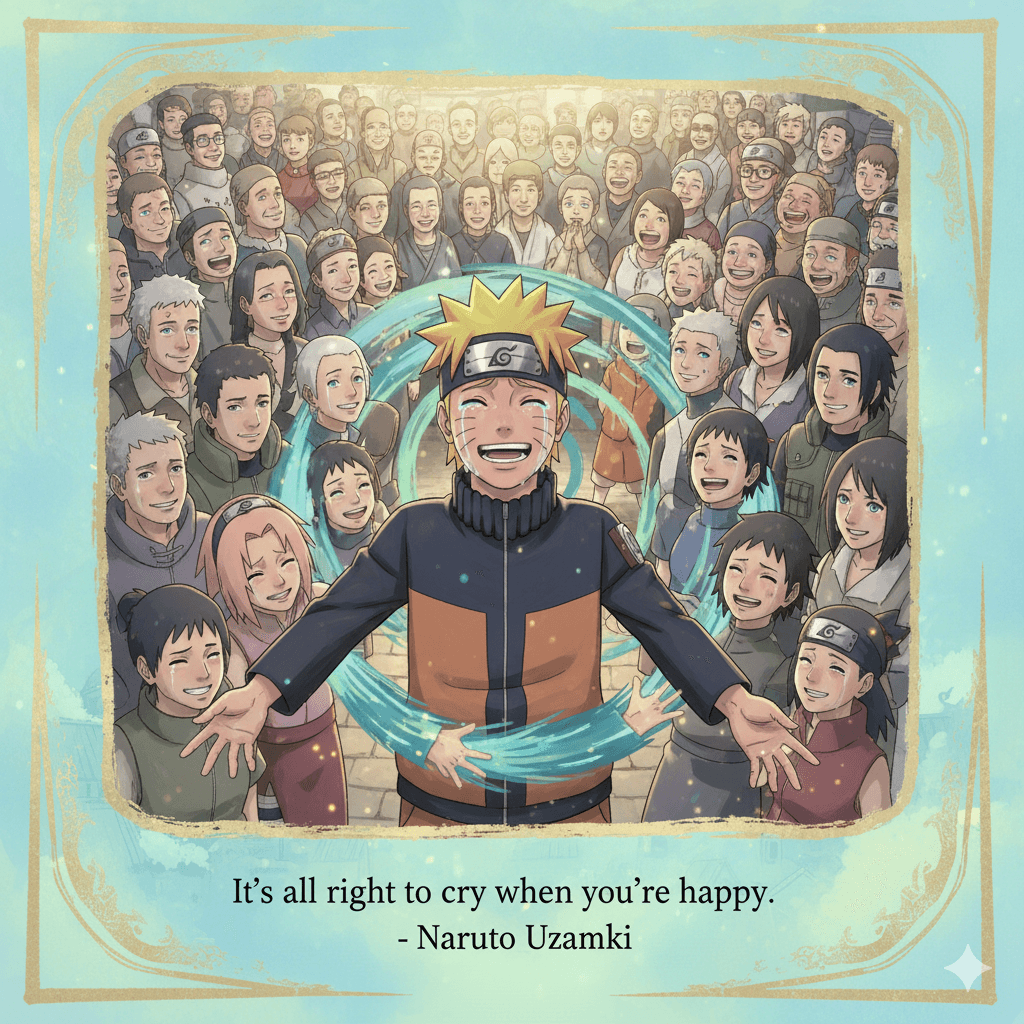
It’s all right to cry when you’re happy. - Naruto Uzumaki
—What lingers after this line?
Embracing Emotion’s Paradox
At first glance, “It’s all right to cry when you’re happy” feels contradictory, yet Naruto’s line names a common human truth: powerful emotions rarely arrive in neat boxes. Joy often carries traces of relief, awe, and remembered struggle, so tears become a natural overflow rather than a sign of weakness. By granting permission to feel fully, the quote reframes tears as part of happiness, not its failure. In doing so, it opens a doorway from self-judgment to self-acceptance—an especially vital shift for anyone taught to keep a stiff upper lip.
A Leaf Village Lesson
Naruto models this insight in pivotal moments. After defeating Pain, he’s lifted by a cheering crowd and visibly wells up as the Hidden Leaf finally acknowledges him (Naruto Shippuden, ep. 175 “Hero of the Hidden Leaf”). Later, when he meets his mother Kushina, his tears mingle with astonishment and long-denied belonging (episodes 246–249). These scenes show that joy is not merely triumph; it’s the relief of being seen and loved. Thus, the story gently demonstrates how happy tears honor the journey that made the happiness possible.
The Science of Happy Tears
Psychology describes “dimorphous expressions,” where positive feelings spark seemingly opposite displays like crying or squeezing (Aragón et al., Psychological Science, 2015). Paradoxical as they appear, such expressions help regulate overwhelming arousal, restoring emotional balance. Moreover, tears can activate caregiving responses and strengthen social bonds, a function Darwin anticipated in The Expression of the Emotions in Man and Animals (1872). In other words, crying when delighted is not a glitch—it’s a built-in stabilizer and a social signal that deepens connection.
Vulnerability and Heroism
Cultural norms often discourage men and boys from crying, conflating stoicism with strength. Yet research on masculine norms links suppression to stress and interpersonal strain (e.g., Levant, 2011). Naruto quietly rejects this script: his courage includes public vulnerability, showing teammates—and viewers—that openness coexists with grit. As Brené Brown argues, vulnerability is not the opposite of bravery but its pathway (Daring Greatly, 2012). Consequently, the series updates heroism: resilience is measured not by dry eyes, but by a heart that stays available.
Cultural Signals of Shared Joy
Across cultures, people cry at weddings, reunions, and last-second victories, signaling to others that a moment matters. In Japan, ideals of gaman (endurance) coexist with visible tears at Kōshien high school baseball finals, where athletes weep from relief and pride—tears that invite communal empathy. Such displays, far from embarrassing, serve as social glue, clarifying values and belonging. Thus, happy tears translate private elation into a public language of meaning, much like Naruto’s celebrations turn a solitary struggle into a village story.
Resilience Through Release
If tears regulate intense joy, they also prevent the costly buildup of suppressed emotion; research on expressive suppression shows downstream strain on both mood and relationships (Gross, 1998). Practically, permission helps: name the feeling (“I’m relieved and proud”), breathe to ride the wave, and, when safe, let the tears fall. Share the moment with someone you trust or capture it in a note or photo to anchor its meaning. In this light, Naruto’s simple sentence becomes a resilient habit: let joy move through you, and it will move you forward.
Recommended Reading
As an Amazon Associate, we earn from qualifying purchases.
One-minute reflection
What feeling does this quote bring up for you?
Related Quotes
6 selectedOriginally, chakra was a power that was meant to connect people to each other. - Naruto Uzumaki
Naruto Uzumaki
Naruto’s line recalls the earliest teaching of Hagoromo Ōtsutsuki, the Sage of Six Paths, who spread chakra among people to help them understand one another. He called this practice Ninshū—a way to link hearts, not to ov...
Read full interpretation →I’m not gonna run away, I never go back on my word! That’s my nindō: my ninja way. - Naruto Uzumaki
Naruto Uzumaki
At the outset, Naruto’s declaration—never running away and never breaking his word—emerges from isolation. As an orphan shunned for the Nine-Tails within him, he crafts a promise sturdy enough to anchor a drifting identi...
Read full interpretation →What shames us, what we most fear to tell, does not set us apart from others; it binds us together if only we can take the risk to speak it. — Brené Brown
Brené Brown
At first glance, Brené Brown’s insight appears paradoxical: the very experiences we hide for fear of rejection are often the ones that make us most recognizable to others. Shame convinces people that their pain, failures...
Read full interpretation →The hardest thing about loving someone deeply is letting them see your vulnerabilities. — Catherine Gilbert Murdock
Catherine Gilbert Murdock
At first glance, Murdock’s insight seems to define love as an act of devotion toward another person. Yet the quote quickly turns inward: the hardest part is not simply feeling deeply, but allowing that feeling to expose...
Read full interpretation →To love at all is to be vulnerable. Love anything and your heart will be wrung and possibly broken. If you want to make sure of keeping it intact, you must give it to no one. — C.S. Lewis
C.S. Lewis
C.S. Lewis begins with a stark truth: to love anything at all is to accept vulnerability.
Read full interpretation →Let yourself be gutted. Let it open you. Start there. — Cheryl Strayed
Cheryl Strayed
At first glance, Cheryl Strayed’s words sound brutal, yet their force lies in invitation rather than destruction. To be “gutted” is to be stripped of pretense, certainty, and emotional armor; however, Strayed immediately...
Read full interpretation →More From Author
More from Naruto Uzumaki →Originally, chakra was a power that was meant to connect people to each other. - Naruto Uzumaki
Naruto’s line recalls the earliest teaching of Hagoromo Ōtsutsuki, the Sage of Six Paths, who spread chakra among people to help them understand one another. He called this practice Ninshū—a way to link hearts, not to ov...
Read full interpretation →I’m not gonna run away, I never go back on my word! That’s my nindō: my ninja way. - Naruto Uzumaki
At the outset, Naruto’s declaration—never running away and never breaking his word—emerges from isolation. As an orphan shunned for the Nine-Tails within him, he crafts a promise sturdy enough to anchor a drifting identi...
Read full interpretation →