
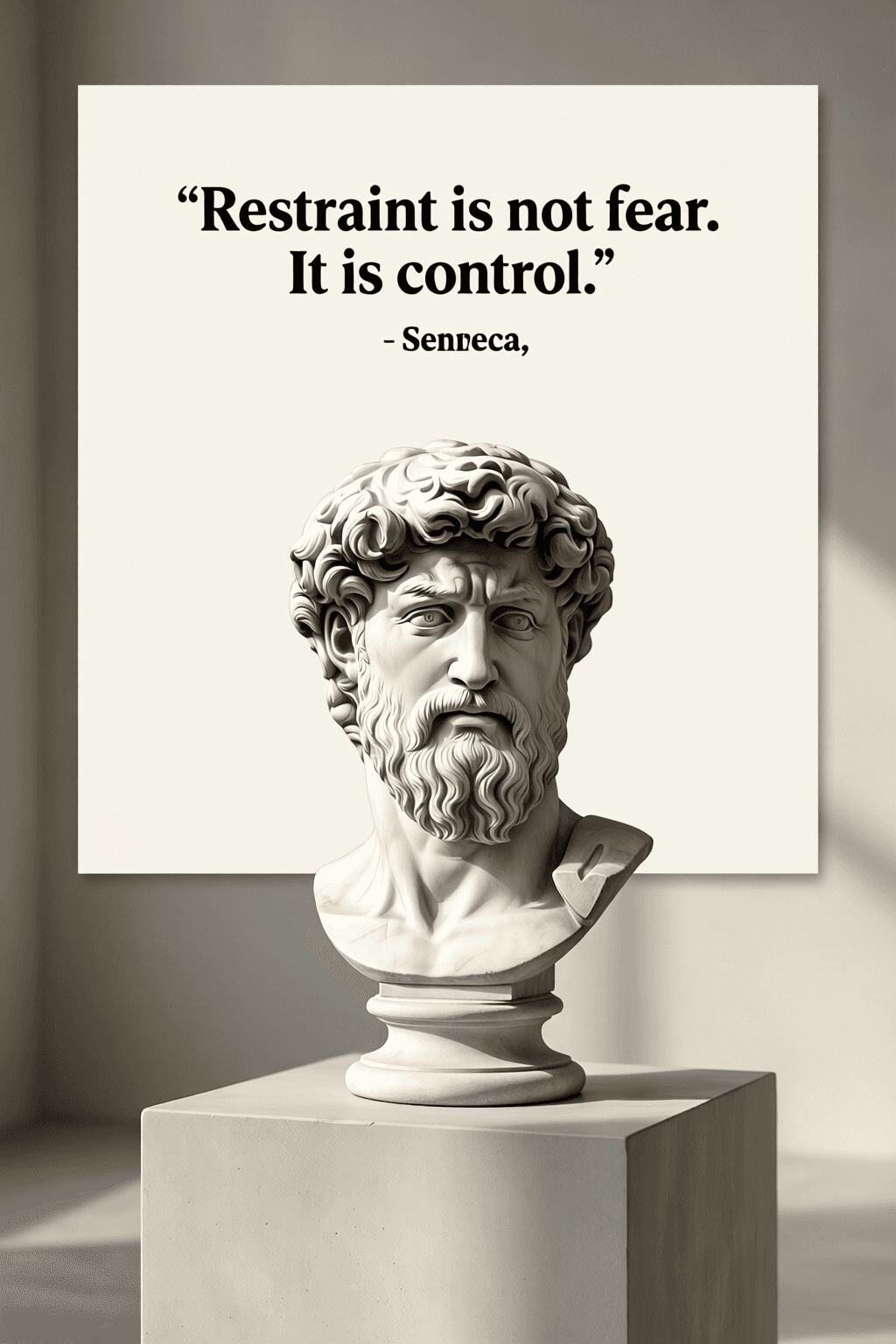
Restraint is not fear. It is control. — Seneca
—What lingers after this line?
A Stoic Distinction
At first glance, Seneca’s line separates two behaviors that can look similar from the outside: stepping back and shrinking away. Fear retreats because it feels overpowered, whereas restraint pauses because it possesses command over impulse. In that sense, the quote expresses a central Stoic idea: true power is not the freedom to do whatever one feels, but the ability to govern oneself before action begins. Seneca’s moral essays, especially the Letters to Lucilius (c. AD 65), repeatedly return to this theme of inner sovereignty. For him, the person who can absorb provocation without immediately reacting is not weak but disciplined. Thus, restraint becomes evidence of mastery, a deliberate act rather than a frightened omission.
The Discipline of Inner Rule
From that foundation, the quote broadens into a philosophy of character. Control is harder than impulse because instinct is immediate, while judgment requires effort. Anyone can lash out in anger, boast in triumph, or indulge in appetite; the rarer achievement is to choose proportion over excess. Seneca therefore reframes restraint as active labor, not passive hesitation. This view aligns with Epictetus’s Enchiridion (c. AD 125), which teaches that freedom begins by mastering what lies within one’s own power. Seen this way, restraint is not the absence of emotion but the ordering of it. A person may feel rage, desire, or panic and still refuse to become their servant.
Courage Without Display
Moreover, Seneca challenges the common assumption that boldness must always be visible. Many cultures admire dramatic assertion, yet Stoicism values a quieter courage: the capacity to remain measured when spectacle would be easier. A commander who avoids a reckless battle, a judge who withholds a premature verdict, or a friend who chooses silence over cruelty may appear inactive, but each demonstrates a steadier form of bravery. History offers many such examples. Marcus Aurelius, in his Meditations (c. AD 180), praises patience and self-command more than theatrical dominance. In this light, restraint is courageous precisely because it resists the temptation to prove oneself through noise, force, or immediate reaction.
Restraint in Conflict
This insight becomes especially clear in moments of confrontation. Fear can make a person avoid conflict because they dread consequences; restraint, by contrast, can engage conflict intelligently by refusing to escalate it. The difference lies in motive. One seeks escape at any cost, while the other seeks the right response, even under pressure. A familiar example appears in diplomacy and law, where withholding retaliation often preserves long-term stability. Thucydides’ History of the Peloponnesian War (5th century BC) repeatedly shows how unchecked pride and anger push states toward ruin. Seneca’s point therefore extends beyond personal ethics: whether in politics or private life, control protects judgment when emotion threatens to seize command.
Modern Psychological Relevance
Seen through a contemporary lens, Seneca’s insight remains remarkably current. Psychologists often describe self-regulation as a core marker of emotional maturity, since the ability to delay reaction supports better decisions, healthier relationships, and reduced regret. In everyday life, this might mean not sending the furious message, not answering insult with insult, or not confusing every urge with a need. Walter Mischel’s delay-of-gratification research, popularized through the Stanford marshmallow experiments (1970s), suggests that restraint can serve long-term goals more effectively than impulsive action. Although Stoicism is ancient, it anticipates this modern finding: control is not suppression for its own sake, but intelligent stewardship of one’s energy and choices.
Strength Expressed Through Measure
Finally, Seneca’s statement invites a redefinition of strength itself. If fear is being ruled by what threatens us, then control is refusing to surrender our agency to circumstance. Restraint becomes the visible sign that a person’s center holds. They may act later, speak carefully, or decline to indulge a passing urge—not because they are intimidated, but because they are free enough to choose. That is why the quote endures. It restores dignity to moderation in an age that often mistakes intensity for authenticity. By Seneca’s measure, the strongest person is not the one who reacts most forcefully, but the one who remains master of himself.
Recommended Reading
As an Amazon Associate, we earn from qualifying purchases.
One-minute reflection
What feeling does this quote bring up for you?
Related Quotes
6 selectedIf you would live your life with ease, you must learn to command your impulses rather than be governed by them. — Seneca
Seneca
At its core, Seneca’s statement argues that ease in life does not come from controlling circumstances, but from governing oneself. The Stoic philosopher redirects attention inward, suggesting that peace depends less on l...
Read full interpretation →Strength lies in restraint. — Seneca
Seneca
At first glance, Seneca’s line seems simple, yet it overturns a common assumption: that strength must be loud, forceful, or visibly dominant. Instead, he suggests that genuine power reveals itself most clearly when a per...
Read full interpretation →The senses have been conditioned by attraction to the pleasant and aversion to the unpleasant. Do not be ruled by them. — Bhagavad Gita
Bhagavad Gita
At its heart, this line from the Bhagavad Gita warns that human perception is rarely neutral. The senses constantly pull us toward what feels pleasant and push us away from what feels unpleasant, creating a cycle of crav...
Read full interpretation →What you don't react to reveals your strength. — Thibaut
Thibaut
At first glance, Thibaut’s line shifts our attention away from dramatic action and toward restraint. Strength, in this view, is not proven only by what we confront loudly, but by what we decline to let disturb us.
Read full interpretation →If you can quit for a day, you can quit for a lifetime. — Benjamin Alire Sáenz
Benjamin Alire Sáenz
At first glance, Benjamin Alire Sáenz reduces an enormous challenge to a single, manageable unit: one day. That shift matters because lifelong change often feels too abstract to grasp, whereas twenty-four hours can be fa...
Read full interpretation →You cannot command things, but you can command yourself. — Michael D. Pollock
Michael D. Pollock
At first glance, Michael D. Pollock’s line draws a sharp boundary between the outer world and the inner one.
Read full interpretation →More From Author
More from Seneca →What progress have I made? I have begun to be a friend to myself. — Seneca
At first glance, Seneca’s line shifts the idea of progress away from status, wealth, or public praise and toward an inner achievement. To say, “I have begun to be a friend to myself,” suggests that real development start...
Read full interpretation →What you do today is the most important thing, for you are trading a day of your life for it. — Seneca
At its core, Seneca’s line reframes time as something spent rather than merely passed. Each day is not an abstract unit on a calendar but a portion of life irreversibly traded for whatever fills it.
Read full interpretation →If you really want to escape the things that harass you, what you're needing is not to be in a different place but to be a different person. — Seneca
Seneca’s remark shifts the idea of escape away from geography and toward character. At first glance, we often imagine that a new city, job, or routine will free us from anxiety, resentment, or restlessness.
Read full interpretation →Authentic power is not about controlling the world around you, but governing the inner landscape of your own reactions. — Seneca
At first glance, Seneca overturns the usual definition of power. Rather than equating strength with influence, status, or command over others, he locates true authority within the self.
Read full interpretation →