
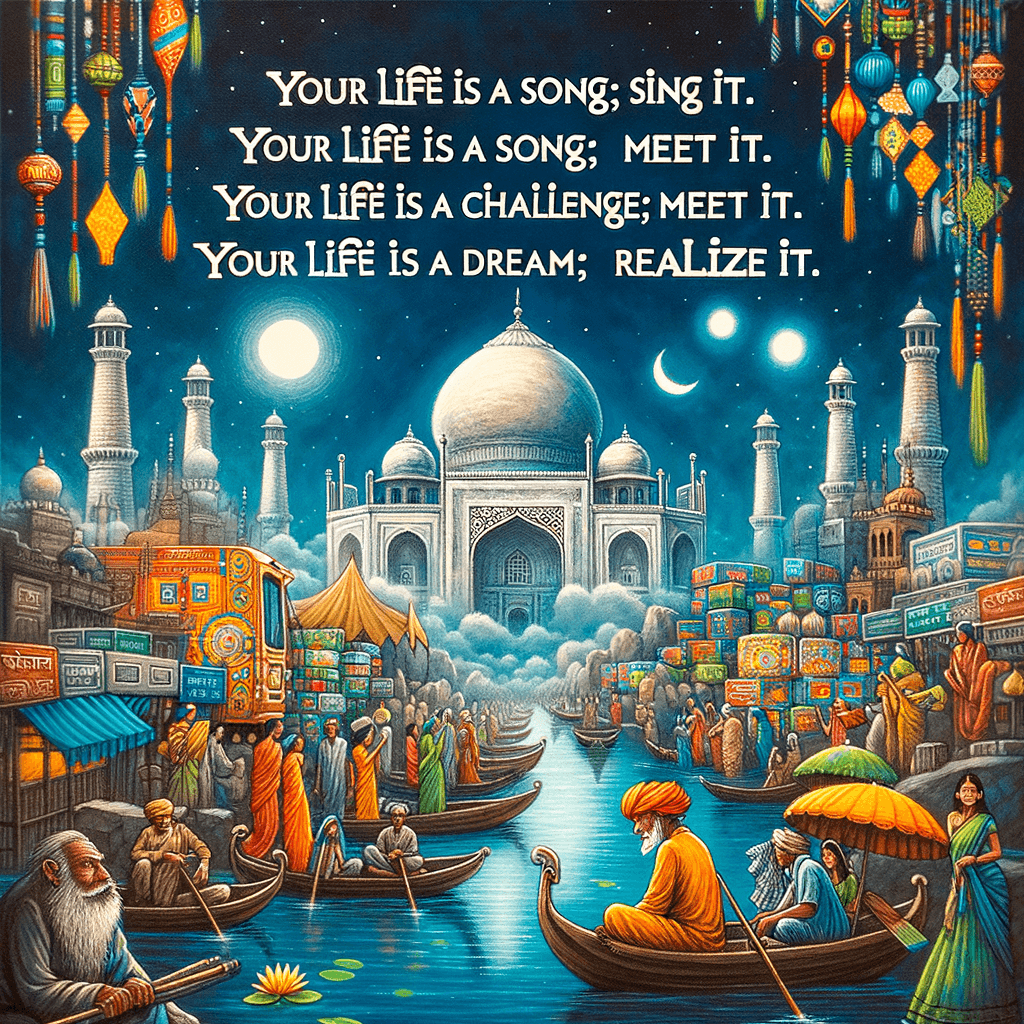
Your life is a song; sing it. Your life is a challenge; meet it. Your life is a dream; realize it. — Sai Baba, India.
—What lingers after this line?
Embracing Life's Journey
This quote highlights the importance of actively engaging with life. By metaphorically singing your life, it encourages individuals to express themselves freely and enjoy the experiences that come their way.
Facing Challenges
The notion of life as a challenge suggests that difficulties are inevitable, yet it is essential to confront them with courage and resilience. This part of the quote inspires people to rise to the occasion when faced with obstacles.
Realizing Dreams
Seeing life as a dream emphasizes the importance of aspirations and goals. It suggests that one should not only dream but also take actionable steps to turn those dreams into reality, making the most of one’s potential.
Holistic Perspective on Life
The combination of these three elements—song, challenge, and dream—provides a holistic view of life. It encourages a balance of joy, resilience, and ambition, promoting a well-rounded approach to living.
Sai Baba's Teachings
Sai Baba, a revered spiritual leader in India, focused on the values of love, compassion, and self-realization. His teachings often incorporated these themes, urging individuals to live a fulfilling and purposeful life.
One-minute reflection
Why might this line matter today, not tomorrow?
Related Quotes
6 selectedTo be courageous is to act with the heart. — Molière
Molière
Molière’s line suggests that courage is not merely the absence of fear, but the decision to move despite it. By connecting courage with the heart, he frames bravery as an emotional and moral act rather than a simple disp...
Read full interpretation →Be who you are and say what you feel, because those who mind don't matter, and those who matter don't mind. — Bernard M. Baruch
Bernard M. Baruch
Baruch’s quote begins with a simple but demanding instruction: be yourself and speak honestly. At its core, the line argues that authenticity is not merely a personality trait but an act of courage, especially in a world...
Read full interpretation →The best people possess a feeling for beauty, the courage to take risks, the discipline to tell the truth, the capacity for sacrifice. — Ernest Hemingway
Ernest Hemingway
Hemingway’s line presents goodness not as politeness or success, but as a demanding inner code. The “best people” are those who combine sensitivity, bravery, honesty, and self-denial—qualities that do not always coexist...
Read full interpretation →If you are not willing to look stupid, nothing great is ever going to happen to you. — Julia Cameron
Julia Cameron
Julia Cameron’s remark begins with a hard truth: many people do not fail because they lack talent, but because they fear embarrassment. In that sense, ‘looking stupid’ becomes shorthand for being seen trying, stumbling,...
Read full interpretation →You don't have to bully yourself out of feeling fear. You just have to move while it's still there. — Annie Wright
Annie Wright
At its core, Annie Wright’s quote challenges the common belief that courage begins only after fear has disappeared. Instead, it reframes fear as something that can accompany action rather than prevent it.
Read full interpretation →For what matters in life is not whether we receive a round of applause; what matters is whether we have the courage to venture forth despite the uncertainty of acclaim. — Amor Towles
Amor Towles
At its core, Amor Towles shifts attention away from public approval and toward private resolve. The quote argues that a life’s value is not determined by applause—those visible signs of recognition—but by the willingness...
Read full interpretation →More From Author
More from Sai Baba, India. →