
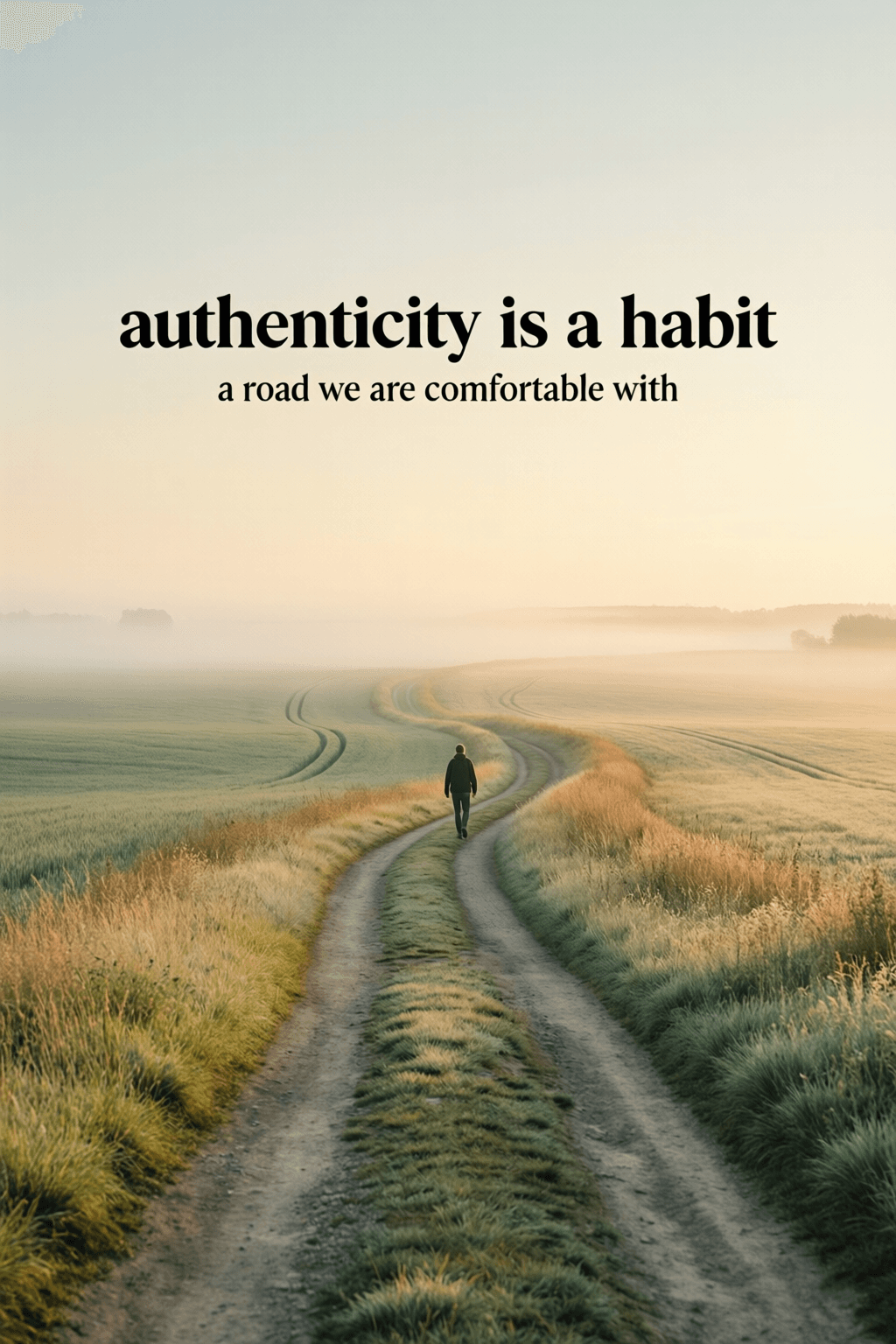
Authenticity is a habit. It is a road we are comfortable with. — Ai Weiwei
—What lingers after this line?
Authenticity Beyond a Single Moment
At first glance, Ai Weiwei’s statement shifts authenticity away from dramatic self-revelation and toward repetition. By calling it a habit, he suggests that being genuine is not an occasional act of courage but a pattern of conduct formed over time. In this view, authenticity is less about declaring who we are once and more about steadily behaving in ways that match our convictions. This framing matters because it makes authenticity practical. Rather than treating it as a rare personal breakthrough, Ai presents it as something built through ordinary decisions—what we say, what we refuse, and how consistently we align our public and private selves.
The Meaning of a Familiar Road
From there, the image of a road adds movement and continuity. A road is not a destination but a route repeatedly traveled, and Ai Weiwei’s phrase “we are comfortable with” implies that truthfulness becomes easier through use. What first feels risky or exposed can, through repetition, become natural, even instinctive. In that sense, comfort does not mean complacency. Instead, it suggests moral familiarity: the more often people choose honesty over performance, the less foreign authenticity feels. Over time, the road becomes recognizable because one has walked it enough to trust its direction.
Character Formed Through Repetition
This idea closely echoes Aristotle’s Nicomachean Ethics (4th century BC), where virtue is formed by repeated action rather than abstract intention alone. Just as one becomes just by doing just acts, Ai implies that one becomes authentic by practicing authenticity. Character, then, is not merely possessed; it is rehearsed into being. Consequently, the quote resists modern pressures to brand the self as a fixed identity. It points instead to discipline. Authenticity is not spontaneous self-expression in every moment, but a cultivated reliability between belief and behavior.
Ai Weiwei’s Life as Evidence
Seen in light of Ai Weiwei’s own career, the quote gains additional force. His art and public activism—from the aftermath of the 2008 Sichuan earthquake to works such as Remembering (2009)—show a repeated willingness to confront power through truth-telling. In that context, authenticity is not a slogan but a practiced stance maintained despite personal cost. Therefore, the phrase “a road we are comfortable with” can also suggest endurance. Comfort here may arise not from ease, but from long familiarity with speaking plainly. Ai’s example shows how authenticity becomes durable when it is exercised under pressure rather than preserved only in safe circumstances.
Resistance to Performance Culture
Moreover, the quote speaks sharply to contemporary life, where identity is often curated for approval. Social media rewards polish, speed, and impression management, making sincerity feel vulnerable or inefficient. Against that backdrop, Ai Weiwei’s words propose a counterpractice: authenticity grows when people repeatedly choose truth over image. As a result, the habit of authenticity becomes quietly radical. It asks individuals to resist tailoring every thought for applause and instead develop a stable inner compass. The road may begin as an act of resistance, but with time it becomes the way one naturally walks through the world.
A Discipline of Inner Alignment
Finally, Ai Weiwei’s insight offers a hopeful conclusion: authenticity is learnable. If it is a habit, then it can be strengthened; if it is a road, then it can be re-entered even after straying from it. The quote removes the mystique surrounding “being real” and replaces it with a discipline of returning, again and again, to what one actually believes. In this way, authenticity is neither perfection nor permanent self-certainty. Rather, it is the ongoing practice of alignment—living so that one’s actions increasingly resemble one’s values. That steady return is what turns sincerity from an aspiration into a way of life.
Recommended Reading
As an Amazon Associate, we earn from qualifying purchases.
One-minute reflection
What feeling does this quote bring up for you?
Related Quotes
6 selectedIf you want to be free, be as you are. Authenticity is the only currency that doesn't lose value. — Ai Weiwei
Ai Weiwei
Ai Weiwei’s statement opens with a striking condition: freedom is not merely granted by laws or institutions, but discovered in the courage to remain fully oneself. In this sense, “be as you are” is less a passive descri...
Read full interpretation →Quietly persist. The world is loud, but your work only needs to be true. — Anne Lamott
Anne Lamott
Anne Lamott’s line begins with a simple imperative: “Quietly persist.” At once, it rejects the idea that meaningful work must announce itself to be real. Instead, she points toward a steadier form of effort, one rooted i...
Read full interpretation →Fitting in is one of the greatest barriers to belonging. Belonging doesn't require us to change who we are; it requires us to be who we are. — Brené Brown
Brené Brown
At the heart of Brené Brown’s statement is a crucial distinction: fitting in is about adaptation, while belonging is about acceptance. When people try to fit in, they often study the room, edit themselves, and perform wh...
Read full interpretation →You don't need a formal invitation to be exactly who you are. — Brené Brown
Brené Brown
At its heart, Brené Brown’s statement rejects the quiet habit of waiting for approval before living honestly. It suggests that authenticity is not something granted by family, institutions, or social circles; rather, it...
Read full interpretation →By choosing to be yourself, you have already won the most important battle. — Anne Lamott
Anne Lamott
At its core, Anne Lamott’s statement reframes victory in deeply personal terms. Rather than measuring success by status, approval, or comparison, she suggests that the most important win happens the moment a person stops...
Read full interpretation →The most radical act of courage is to be truly seen, to step out from behind our carefully curated walls and offer our authentic selves to the world. — Glennon Doyle
Glennon Doyle
Glennon Doyle’s quote reframes courage not as conquest or spectacle, but as the quiet, risky decision to be known. At its core, it suggests that the bravest act is not hiding our flaws behind polished identities, but all...
Read full interpretation →More From Author
More from Ai Weiwei →You don't need a formal license to be an artist; you only need the courage to claim your own perspective. — Ai Weiwei
Ai Weiwei’s statement immediately dismantles the idea that artistic legitimacy must be granted by institutions, critics, or official credentials. Instead, he shifts the center of gravity inward: what makes someone an art...
Read full interpretation →If you want to be free, be as you are. Authenticity is the only currency that doesn't lose value. — Ai Weiwei
Ai Weiwei’s statement opens with a striking condition: freedom is not merely granted by laws or institutions, but discovered in the courage to remain fully oneself. In this sense, “be as you are” is less a passive descri...
Read full interpretation →The artist's job is not to succumb to despair, but to find the light in the cracks. Art is the act of bringing your internal world into the light for others to share. — Ai Weiwei
At its core, Ai Weiwei’s statement defines art not as surrender, but as resistance. Despair may be an honest response to injustice, loss, or confusion; however, the artist’s task is to move beyond mere collapse and searc...
Read full interpretation →Speak your work into being and then make it true with your hands — Ai Weiwei
Ai Weiwei’s imperative begins with a vow: say what you will make. Speech, in this view, is not mere description but orientation—a compass that points the body toward work.
Read full interpretation →