
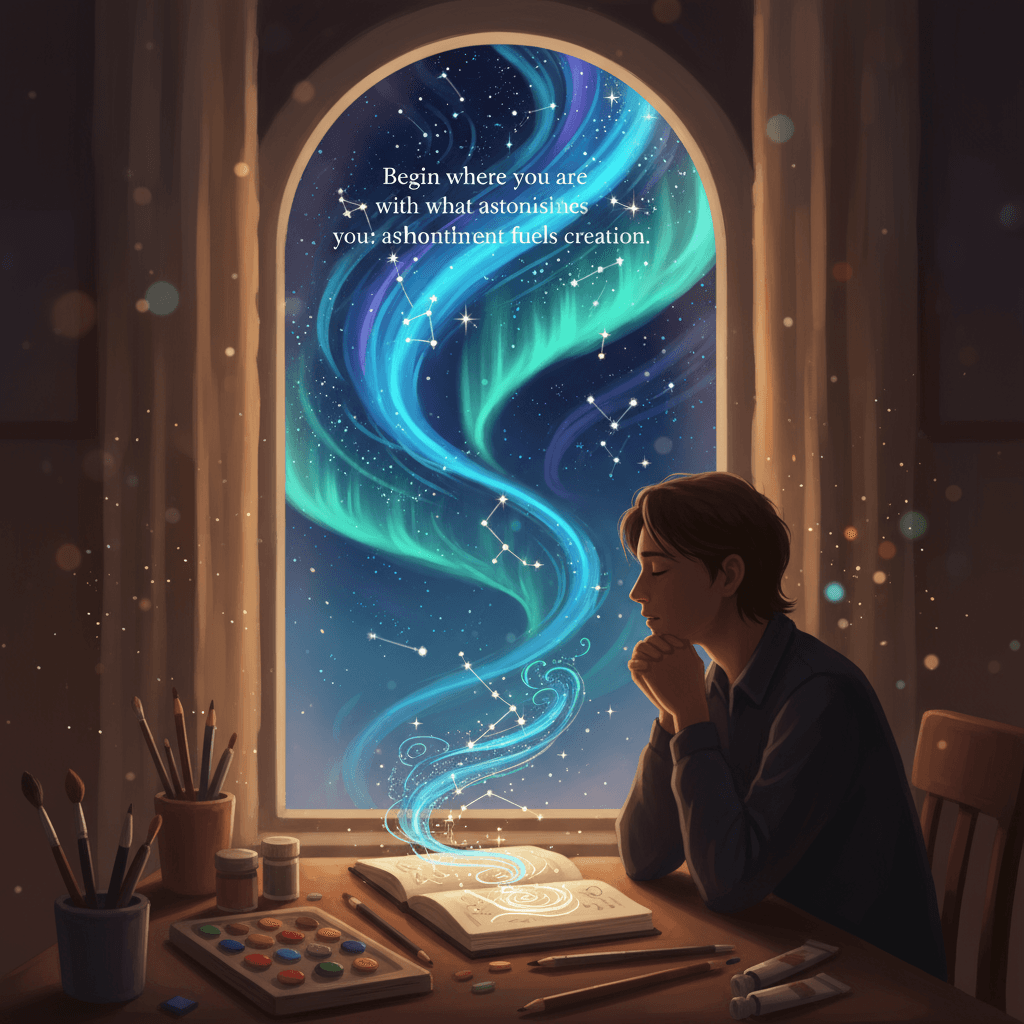
Begin where you are with what astonishes you; astonishment fuels creation. — E.E. Cummings
—What lingers after this line?
Starting Where You Stand
E.E. Cummings invites us to begin not with grand plans but with the immediacy of our own surroundings. His poems often transmute everyday sights into linguistic fireworks—think of the springtime “puddle-wonderful” in “in Just-” (1923)—showing how attention to the near-at-hand births invention. Thus, astonishment is not an abstraction; it is the quickening felt when the ordinary suddenly opens into strangeness. In this spirit, starting where you are means admitting you already occupy fertile ground. Rather than waiting for ideal conditions, Cummings implies that the creative spark is embedded in present textures—streetlight on rain, the oddity of a neighbor’s routine, the unasked question at your desk.
Wonder’s Lineage in Art and Science
If Cummings roots creativity in immediacy, history echoes the same impulse. Mary Oliver’s “Instructions for living a life: Pay attention. Be astonished. Tell about it.” (“Sometimes,” Red Bird, 2008) traces a three-step arc from noticing to making. Likewise, Einstein’s remark that “the most beautiful thing we can experience is the mysterious” connects awe to discovery. Artists and scientists have long treated astonishment as method. Leonardo’s notebooks swarm with observations of water eddies and bird flight; Darwin’s “I think” sketch (Notebook B, 1837) crystallizes awe into evolutionary insight. Across disciplines, wonder is both the compass and the engine.
What Awe Does to the Mind
Beyond lineage, psychology clarifies why astonishment fuels creation. Studies on awe show it reduces self-focus and expands cognitive flexibility. Rudd, Vohs, and Aaker (Psychological Science, 2012) found awe dilates time perception, giving people a sense of spaciousness to explore ideas. Dacher Keltner and Paul Piff (Journal of Personality and Social Psychology, 2015) reported that awe promotes a “small self,” which can loosen rigid mental frames and open novel associations. Moreover, Barbara Fredrickson’s broaden-and-build theory (2001) suggests positive emotions widen attention and repertoires for action. In short, wonder primes the brain to notice patterns, forge unusual links, and venture beyond habitual grooves.
Constraints as Catalysts
Carrying this into practice, “begin where you are” also means honoring constraints. Twyla Tharp’s The Creative Habit (2003) describes “the box,” a humble container of clippings and notes that limits scope while making starts inevitable. Seamus Heaney’s “Digging” (Death of a Naturalist, 1966) turns a family spade into a poetic tool, proving that local materials can cut deep. Formal limits likewise liberate. Shakespeare’s sonnets, hip‑hop sampling, and the strictures of haiku all demonstrate how boundaries concentrate astonishment into form. As Anne Lamott’s Bird by Bird (1994) insists, even a “shitty first draft” is a small, workable fence inside which creativity can roam.
Designing From Lived Problems
Extending this logic, design thinking translates astonishment into solutions by starting with concrete contexts. Tim Brown’s Change by Design (2009) argues that empathy—close observation of real users—sparks better ideas than abstract brainstorming. James Dyson’s bagless vacuum began when he noticed a sawmill’s cyclone separator and wondered, Why not in a vacuum? (Against the Odds, 1997). In each case, curiosity about the immediate world becomes a prototype. Consequently, the creative question shifts from “What should I make?” to “What here puzzles or delights me enough to test?” The answer is not distant; it is already under your fingertips.
Training Attention to Find Astonishment
To sustain this capacity, cultivate practices that sharpen seeing. Keep a “wonder journal” and write ten precise descriptions of one scene without adjectives. Take a “curiosity walk” on the same block for a week; changing light becomes a laboratory. Simone Weil’s claim that “attention, taken to its highest degree, is the same as prayer” (Gravity and Grace, 1947) reframes noticing as devotion. As Rilke advises in Letters to a Young Poet (1903), “learn to love the questions themselves.” By lingering with questions—Why this pattern? What if reversed?—astonishment is invited back, and with it, the willingness to experiment.
From Private Spark to Shared Making
Finally, astonishment matures when shared. Austin Kleon’s Show Your Work! (2014) encourages publishing process, not just polish—turning curiosity into community momentum. Ira Glass’s well-known “taste gap” advice reassures novices that early attempts may lag behind their standards, yet persistence bridges that gap. Thus the loop closes: begin where you are, be astonished, make something, and then let others’ astonishment refine it. In this ongoing exchange, Cummings’ imperative becomes a practice—one that turns the nearness of the world into the next act of creation.
One-minute reflection
What's one small action this suggests?
Related Quotes
6 selectedImperfection inspires invention, imagination, and creativity. — Mary Sharratt
Mary Sharratt
Mary Sharratt’s insight begins with a reversal of ordinary expectations: imperfection is not merely something to fix, but something that awakens possibility. When a plan fails, a surface cracks, or an idea refuses to fit...
Read full interpretation →Don't think. Thinking is the enemy of creativity. It's self-conscious, and anything self-conscious is lousy. — Ray Bradbury
Ray Bradbury
At first glance, Ray Bradbury’s line sounds almost rebellious: “Don’t think. Thinking is the enemy of creativity.” Yet his target is not intelligence itself, but the paralyzing kind of self-awareness that makes an artist...
Read full interpretation →You can be cautious or you can be creative, but there's no such thing as a cautious creative. — George Lois
George Lois
George Lois draws a sharp line between two mindsets: caution protects what already exists, while creativity risks making something new. At first glance, the statement sounds absolute, yet that severity is exactly its poi...
Read full interpretation →Almost always, the creative dedicated minority has made the world better. — Martin Luther King, Jr.
Martin Luther King Jr.
Martin Luther King, Jr. distills a sweeping historical truth into a single sentence: progress is often driven not by the passive majority but by a small, committed group willing to imagine a better order.
Read full interpretation →What keeps life fascinating is the constant creativity of the soul. — Deepak Chopra
Deepak Chopra
At its core, Deepak Chopra’s line suggests that life stays interesting not because the world is fixed and exciting on its own, but because the inner self continually reinterprets it. The phrase “creativity of the soul” p...
Read full interpretation →We are born makers. We move what we're learning from our heads to our hearts through our hands. — Brené Brown
Brené Brown
Brené Brown’s line begins with a striking claim: making is not a hobby added onto life, but part of our basic human design. To say “we are born makers” suggests that creativity is native to us, whether we are cooking, bu...
Read full interpretation →More From Author
More from E. E. Cummings →The hardest battle is being nobody but yourself in a world that wants you to be everyone else. — e. e. cummings
e. e.
Read full interpretation →Celebrate the imperfect stroke; it teaches more than the faultless line. — E. E. Cummings
Cummings’ line reframes imperfection as an active teacher rather than a defect to erase. The “imperfect stroke” suggests a mark made in motion—evidence of effort, risk, and choice—while the “faultless line” can imply cau...
Read full interpretation →Compose motion from silence; even quiet choices become music. — E. E. Cummings
Cummings’ line begins by treating silence not as emptiness, but as material—something you can shape into motion. Instead of waiting for noise, inspiration, or permission, the speaker suggests beginning wherever you are,...
Read full interpretation →Dare to be odd, then build the world that honors your strange truth. — E. E. Cummings
E. E.
Read full interpretation →