
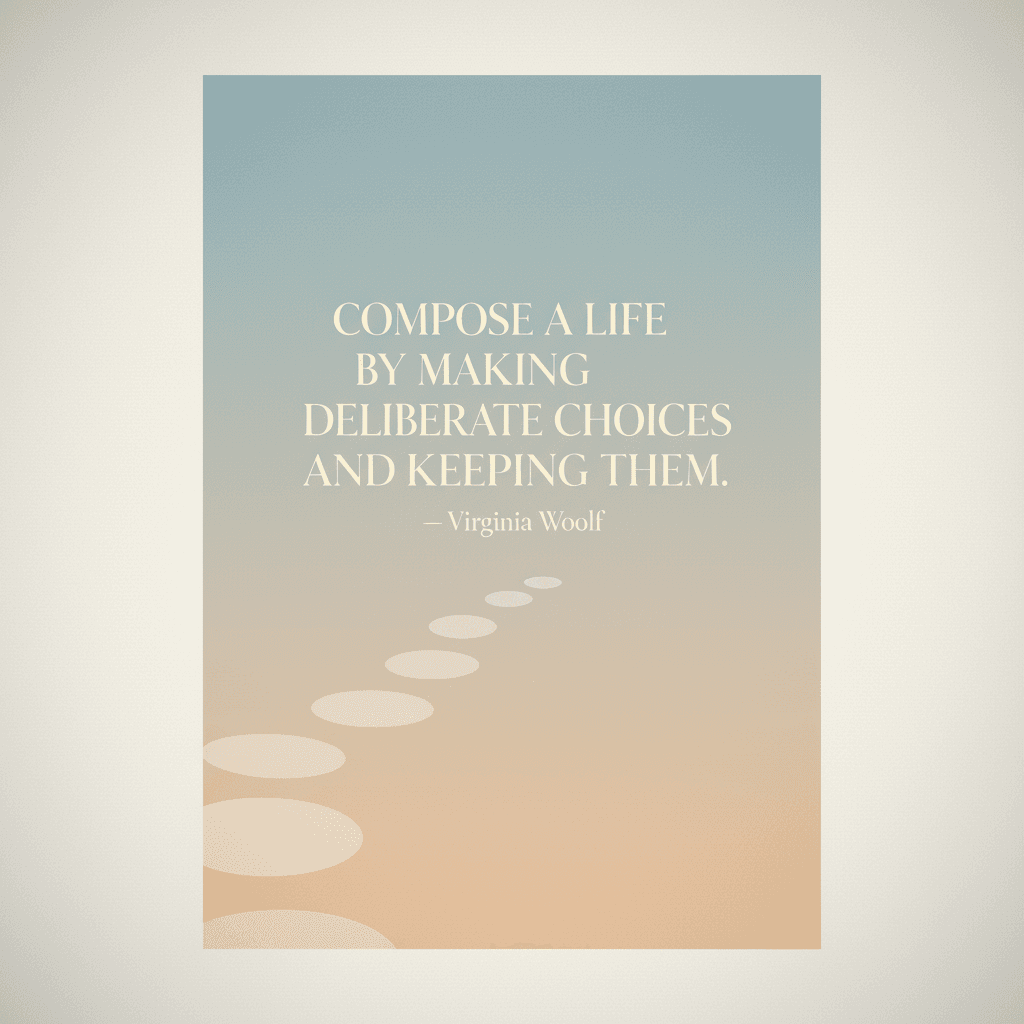
Compose a life by making deliberate choices and keeping them. — Virginia Woolf
—What lingers after this line?
Life as Composition
To begin, Woolf’s invitation to compose a life treats living as an art rather than a sequence of accidents. Composition implies intention: selecting themes, arranging scenes, and revising until the piece holds together. In her essays and diaries, Woolf returns to this craft metaphor, suggesting that the quality of a day depends on what we attend to and what we refuse. A Room of One’s Own (1929) argues that space and income are not mere conveniences but conditions that allow deliberate choices to crystallize into work. In the same spirit, composing a life means choosing its tempo and motifs, then remaining faithful to them long enough for meaning to accumulate. Without this steadiness, days remain fragments. With it, ordinary routines become a style—an identifiable signature—rather than scattered notes.
From Impulse to Deliberation
From there, the question becomes what counts as a deliberate choice. Aristotle called this prohairesis, a reasoned selection of means in service of ends (Nicomachean Ethics, Book III). It is not a mood or a reflex but a decision anchored to a value—health, truth, care, beauty—and then tested against reality. Deliberation clarifies trade-offs and allows refusal; saying yes acquires force only when no is possible. This lens also clarifies Woolf’s artistry. To the Lighthouse (1927) dwells on the quiet hinge-moments when a character chooses a direction and, by extension, a self. Each small selection—what to read, whom to visit, when to write—tilts the life’s trajectory. Thus, deliberate choices are less grand resolutions than patient calibrations that accumulate into identity.
Keeping Choices Through Habit
Consequently, the second half of Woolf’s counsel—keeping choices—requires mechanisms, not just resolve. William James observed that habit saves higher faculties for higher tasks, by automating the actions our values have already endorsed (Principles of Psychology, 1890). When the path is grooved, fidelity becomes easier than defection. Modern research refines this intuition. Peter Gollwitzer’s work on implementation intentions shows that if-then plans (if it is 7 a.m., then I sit to write) markedly increase follow-through, because they bind an abstract choice to a concrete cue (1999). In practice, one edits the environment and calendar so the default favors the decision already made. Habit does not cheapen agency; it preserves it by reducing friction at the moment of action.
Designing Commitments and Environments
In turn, kept choices often rely on gentle constraints. The oldest story is Odysseus tying himself to the mast so he can hear the Sirens without steering toward them (Homer’s Odyssey). Contemporary versions include precommitment contracts or automatic payroll savings, such as Thaler and Benartzi’s Save More Tomorrow program, which increases contributions over time with prior consent (2004). These designs translate conviction into structure. By placing the healthy food at eye level, silencing notifications during deep work, or making the gym a standing appointment, we don’t ask willpower to win fresh battles. Instead, we let architecture, defaults, and small frictions keep the choice we already trust.
Protecting Energy From Decision Fatigue
At the same time, choices are easier to keep when the day conserves cognitive energy. Decision fatigue shows how judgment degrades after many choices; famously, parole rulings grew harsher before breaks and improved after them, implying a resource cost to deciding (Danziger, Levav, and Avnaim-Pesso, 2011). The lesson is not cynicism but design. By front-loading important decisions, batching trivial ones, and using routines and checklists, we shield our best hours for our highest commitments. A simple cadence—review on Sunday, plan on Monday, ship by Friday—reduces noise. When energy is protected, fidelity stops feeling heroic and starts feeling normal.
Fidelity With Room to Revise
Finally, keeping choices does not forbid revision; it forbids drift. Woolf’s manuscripts reveal disciplined fidelity to a vision alongside relentless redrafting. The point is to renegotiate commitments deliberately, in light of new evidence, not abandon them through boredom or fear. Keeping a decision for a season—long enough to gather honest feedback—prevents perpetual restarting. Thus, the art is steadiness with periodic recalibration: hold the course, update the map. Over time, this marriage of intention and endurance composes not only projects and careers but a recognizable life—one that reads, as Woolf might say, like a sentence with clarity, cadence, and care.
One-minute reflection
Where does this idea show up in your life right now?
Related Quotes
6 selectedIntentional living is the art of making our own choices before others' choices make us. — Richie Norton
Richie Norton
Richie Norton’s quote frames intentional living as an active rather than passive way of being. At its core, it argues that a meaningful life is shaped by deliberate decisions made in advance, not by drifting along with e...
Read full interpretation →Curate your days like a gallery—display what nourishes and remove what dims. — Virginia Woolf
Virginia Woolf
Woolf’s line echoes her lifelong attention to rooms, rhythms, and light—the settings where a mind can breathe. In A Room of One’s Own (1929), she argues that creative life needs deliberate space and resources; by extensi...
Read full interpretation →Clutter is not just the stuff on your floor; it's anything that stands between you and the life you want to be living. — Peter Walsh
Peter Walsh
At first glance, Peter Walsh’s quote seems to address physical mess, yet it quickly expands into something much broader. Clutter, in his view, is not merely a pile of objects on the floor; rather, it is any obstacle—mate...
Read full interpretation →Do the work of naming the highest, eulogy-worthy priorities in your life. Then do the work of putting them at the center of your life, every day. — Brooke McAlary
Brooke McAlary
Brooke McAlary’s quote begins with a difficult but clarifying task: identifying the priorities so important they would belong in your eulogy. In other words, she asks us to look beyond errands, ambitions, and social nois...
Read full interpretation →Without commitment, you'll never start. Without consistency, you'll never finish. — Denzel Washington
Denzel Washington
At its core, Denzel Washington’s quote divides success into two essential stages: beginning and finishing. Commitment is the force that gets a person past hesitation, doubt, and distraction, while consistency is what car...
Read full interpretation →Discipline is not about suppressing your emotions; it is about honoring your commitments even when your emotions are tired. — Josh Waitzkin
Josh Waitzkin
At first glance, discipline is often mistaken for emotional repression, as if strength requires numbing oneself. Josh Waitzkin’s line corrects that misunderstanding by presenting discipline as fidelity rather than force:...
Read full interpretation →More From Author
More from Virginia Woolf →We are not here to fit into a mold, but to break the ones that keep our most honest work hidden. — Virginia Woolf
At its core, Virginia Woolf’s statement rejects the quiet pressure to adapt ourselves to preexisting expectations. To “fit into a mold” suggests becoming legible, acceptable, and predictable at the cost of what is most i...
Read full interpretation →There is a kind of victory in good sense about not wanting to be everything at once. — Virginia Woolf
Virginia Woolf’s line turns an apparent restraint into a form of triumph. Rather than treating ambition without boundaries as admirable, she suggests that good sense lies in refusing the exhausting wish to be everything...
Read full interpretation →The artist is a sort of emotional archivist, recording the truth of a moment before it slips away into the digital noise. — Virginia Woolf
At its core, the quote imagines the artist as someone who rescues experience from disappearance. A feeling, a gesture, or a passing atmosphere can fade almost as soon as it arrives; therefore, the artist’s work becomes a...
Read full interpretation →Clarity is the counterbalance of complexity. - Virginia Woolf
Virginia Woolf’s remark frames thought and expression as a delicate balance rather than a simple choice. Complexity is often unavoidable because reality is layered, contradictory, and difficult to reduce; yet without cla...
Read full interpretation →