
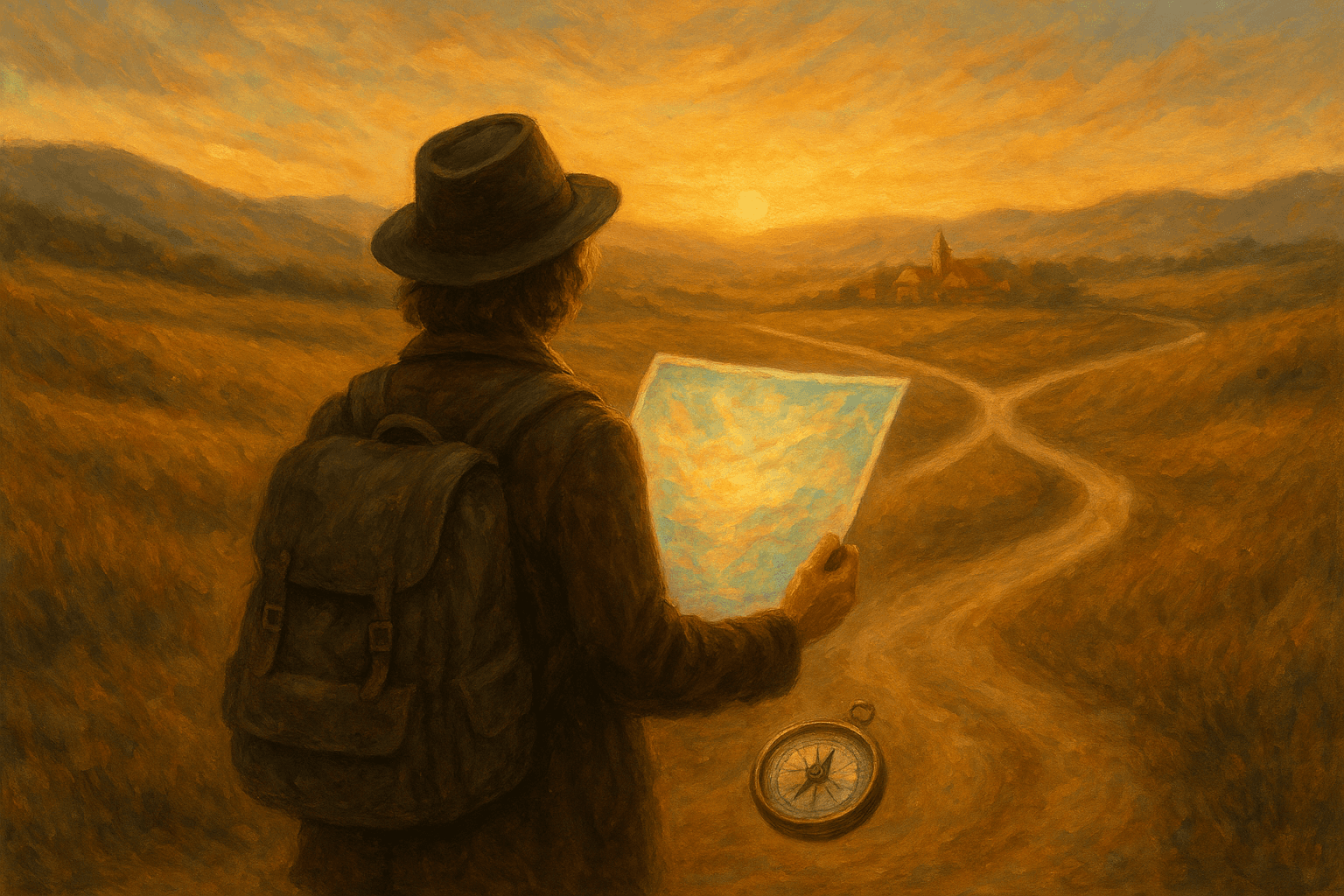
Hold beauty as a map and work as your compass; the two will lead you home. — Elizabeth Barrett Browning
—What lingers after this line?
Beauty as an Inner Guiding Map
Elizabeth Barrett Browning’s line invites us first to see beauty not as decoration, but as orientation. To “hold beauty as a map” is to let what is noble, true, and radiant in life sketch the contours of our direction. Beauty here can mean stirring music, moral courage, or a landscape that quiets the mind—any experience that awakens wonder and a sense of rightness. Just as a map outlines possible paths, these moments of beauty trace what feels deeply aligned with our better selves. Instead of wandering aimlessly through career choices, relationships, and ambitions, we begin to navigate by asking: does this choice echo the kind of beauty—ethical, emotional, or aesthetic—that most moves me?
Work as the Compass of Daily Action
Yet Browning immediately balances this vision with something more rugged: “work as your compass.” A compass does not show the whole landscape; it gives a steady, practical orientation—north, south, where to take the next step. Work in this sense is not merely a job, but any sustained effort to bring beauty’s vision into concrete form. While the map of beauty shows where our heart wants to go, work keeps us from drifting into daydreams, continuously reorienting us amid distractions, doubt, and setbacks. In this way, daily discipline and craft refine our direction, ensuring that our admiration for beauty turns into lived commitment rather than passive longing.
The Creative Tension Between Vision and Effort
When we place these images together, a fruitful tension emerges: beauty without work risks remaining fantasy, while work without beauty can harden into empty grind. Browning’s pairing suggests that a meaningful life arises where vision and effort continually converse. Artists like Vincent van Gogh, whose letters reveal an intense search for beauty in fields and faces, relied on relentless labor—thousands of studies and revisions—to translate that vision onto canvas. Similarly, anyone who feels drawn to justice, learning, or craftsmanship needs both an inspiring picture of what is good and the patient, compass-like habit of returning to the task. Through this interplay, aspiration stops being abstract and slowly becomes embodied reality.
Finding ‘Home’ as a State of Alignment
All of this, Browning claims, will “lead you home.” Home here need not mean a physical house; rather, it points to a condition of inner rightness, a place where your values, talents, and actions feel in conversation instead of in conflict. Philosophers from Aristotle’s *Nicomachean Ethics* (c. 4th century BC) to modern virtue ethicists argue that flourishing comes when what we love and what we do reinforce each other. In this sense, following beauty’s map while steering by the compass of work guides us toward a life that feels inhabited from within—not borrowed from fashion or expectation. Home becomes the point where your deepest sense of meaning and your daily efforts finally coincide.
Living the Quote in Ordinary Moments
Translating this ideal into ordinary days begins with small choices. We can ask which books, places, or conversations reliably stir a feeling of beauty and let those shape our long-range map. Then, using work as our compass, we commit to modest, repeatable actions: an hour of practice, an honest conversation, a carefully completed task. Over time, these iterations refine both our sense of what is truly beautiful and our capacity to serve it. Just as sailors continually consult both chart and compass to stay on course, we return again and again to what moves us and to what we can do next. Gradually, the path traced by these linked decisions becomes recognizable as our own—and, as Browning suggests, it begins to feel like coming home.
One-minute reflection
What's one small action this suggests?
Related Quotes
6 selectedWork harder than you think you did yesterday. — Alex Elle
Alex Elle
Alex Elle’s line begins with a simple but demanding invitation: measure yourself against who you were yesterday, not against the noise of everyone else’s progress. By framing effort as something that can expand daily, th...
Read full interpretation →To love beauty is to see light. — Victor Hugo
Victor Hugo
Victor Hugo’s line suggests that beauty is not merely something pleasing to the eye; it is a way of perceiving the world more clearly. To love beauty is to become receptive to illumination, as if the soul gains a new sou...
Read full interpretation →The beauty of a finely worked object points to the beauty of the craftsmanship. — Paul Klee
Paul Klee
Paul Klee’s statement begins with a simple but powerful observation: a beautiful object does not merely please the eye; it points beyond itself to the intelligence, patience, and skill that shaped it. The object becomes...
Read full interpretation →Most people work just hard enough not to get fired and get paid just enough money not to quit. — George Carlin
George Carlin
George Carlin’s line works because it compresses an uncomfortable workplace truth into a clean exchange: employees give just enough effort to remain employed, while employers give just enough compensation to retain labor...
Read full interpretation →Work is not a punishment for man; it is his reward and his strength, his glory and his pleasure. — George Sand
George Sand
George Sand’s statement begins by overturning a familiar complaint: that work is merely a burden imposed on human life. Instead, she recasts labor as something affirmative, even dignifying.
Read full interpretation →Roses do not bloom hurriedly; for beauty, like any masterpiece, takes time to blossom. — Matshona Dhliwayo
Matshona Dhliwayo
At its heart, Matshona Dhliwayo’s quote reminds us that true beauty cannot be forced. A rose does not rush toward bloom, nor does it apologize for the time required to unfold.
Read full interpretation →More From Author
More from Elizabeth Barrett Browning →Light tomorrow with today. — Elizabeth Barrett Browning
This quote emphasizes the significance of what we do today in shaping our future. Our present actions and decisions have the power to create a brighter tomorrow.
Read full interpretation →Gather your scattered hopes and bind them into a single brave step. — Elizabeth Barrett Browning
Browning’s line urges a shift from diffusion to direction: instead of letting aspirations tug at us from every side, she invites us to braid them into a single act. Hopes, on their own, can be luminous yet paralyzing—too...
Read full interpretation →Turn affection into action and let kindness be visible work. — Elizabeth Barrett Browning
Browning’s injunction moves love from the private warmth of emotion to the public arena of effort. Affection, she implies, is not complete until it takes the shape of labor that others can see and benefit from.
Read full interpretation →