
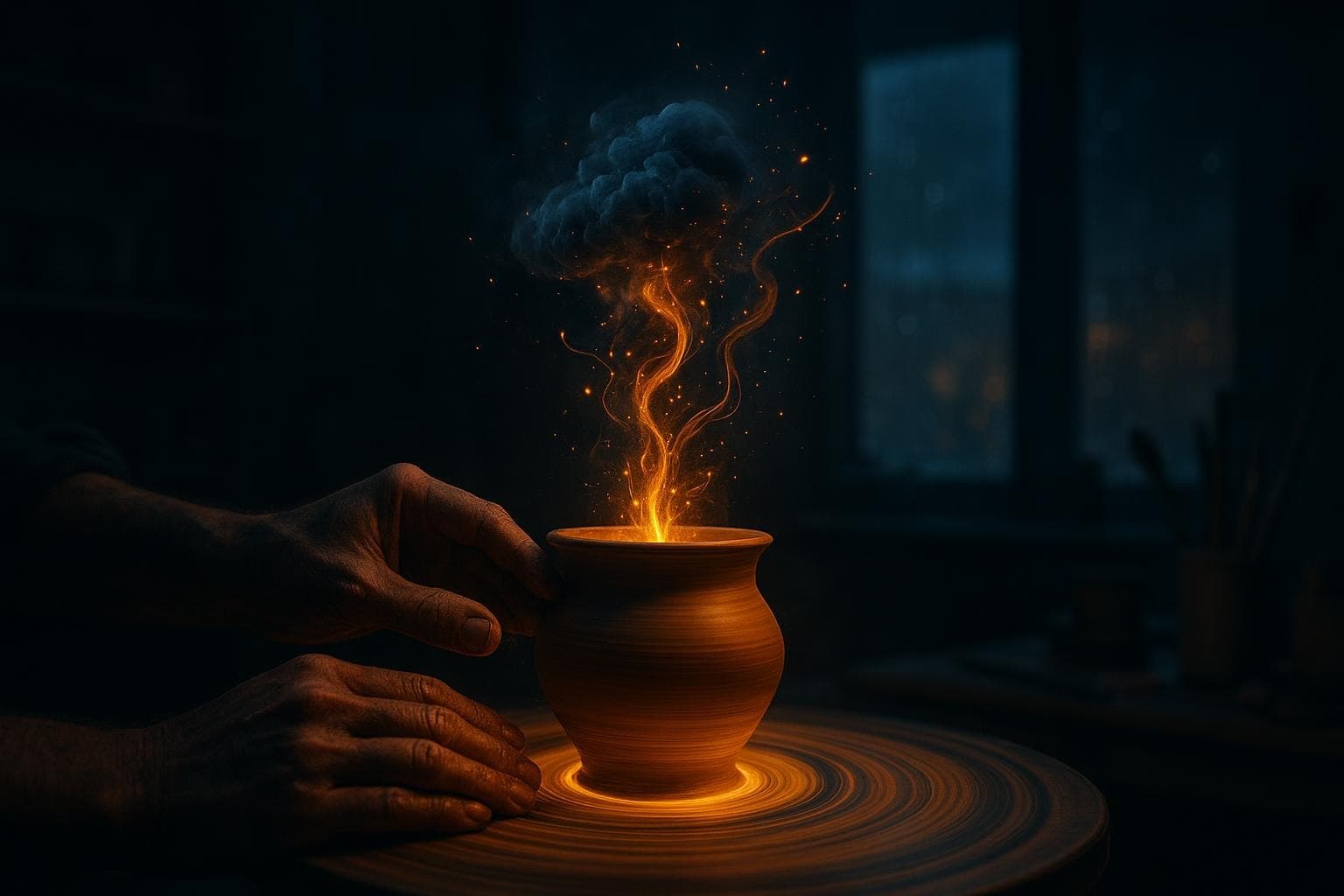
Let the inner tempest power your craft instead of stalling it. — Pablo Picasso
—What lingers after this line?
The Storm as a Source, Not a Sentence
Picasso’s line reframes emotional turbulence as raw material rather than a verdict against productivity. Instead of treating anxiety, grief, restlessness, or anger as proof that one “can’t work,” he suggests these forces can be converted into motion on the canvas, page, or stage. In this sense, the inner tempest becomes fuel—unrefined, volatile, but potent. From the outset, the quote implies a choice: the same intensity that can freeze a creator in self-protective hesitation can also press them into decisive making. The craft does not require calm so much as contact with what is real, and storms are often where reality speaks loudest.
Why Turmoil Often Becomes Creative Paralysis
Even so, turmoil frequently stalls work because it narrows attention and raises the stakes in the mind. When the nervous system is activated, the brain prioritizes safety and control; creative risks—drafting badly, experimenting, being seen—can feel like threats. That is why a tempest can turn into perfectionism, procrastination, or endless preparation. Yet Picasso’s phrasing—“instead of stalling it”—signals that the blockage is not the emotion itself but the loop it creates: feeling becomes rumination, rumination becomes avoidance, and avoidance confirms the fear. Recognizing that pattern is the pivot that allows the storm to be used rather than endured.
Transmutation: Converting Feeling Into Form
Once the stall is identified, the next step is transmutation: giving the inner weather a shape. Art history is crowded with examples of this conversion, as when Edvard Munch’s “The Scream” (1893) turns dread into a visual icon, or when Sylvia Plath’s “Ariel” (1965) renders psychic intensity in compressed, electrified language. The emotion does not vanish; it becomes legible. In practical terms, this means asking what the tempest “sounds” like in rhythm, what it “looks” like in color and contrast, or what it “does” in narrative pressure. By translating sensation into decisions—line, cut, tempo, metaphor—the storm starts powering the work through concrete craft choices.
Discipline as a Lightning Rod
However, power needs a conduit. Without some structure, inner intensity can scatter into fragments or burn out. That is where discipline functions like a lightning rod: it does not suppress the storm, but it directs it safely into a path that can be repeated. Hemingway’s practice of stopping while still knowing what comes next, described in “A Moveable Feast” (1964), exemplifies how routine can harness volatile inspiration. Picasso’s implication is that craft is the transformer between feeling and output. Small constraints—time limits, a fixed medium, a daily quota—reduce the burden of choice and give emotion somewhere to go. Paradoxically, boundaries can make the tempest more usable, not less.
Working With the Tempest, Not Performing It
A subtle risk follows: mistaking intensity for authenticity and turning suffering into a required performance. Picasso’s line doesn’t romanticize pain; it warns against letting it stall you, not against seeking calm when it’s available. The goal is not to glorify chaos but to keep making even when the inner climate is rough. This distinction matters because the craft benefits from honest contact with feeling, while the persona of the “tortured artist” often benefits only the ego. When the tempest becomes material, it gains distance; it is observed, shaped, edited. In that shift—from being possessed by the storm to composing with it—creative agency returns.
A Practical Way to Begin: The First Small Mark
Finally, the quote offers a deceptively simple prescription: begin while the storm is present. A useful approach is to take the smallest action that can carry emotional charge—one sentence of unfiltered draft, a rough sketch, a single musical phrase—then iterate. Many creators find that once the first mark exists, the mind stops demanding perfect conditions and starts responding to the work on the table. In that way, the tempest becomes kinetic. You may not feel better before you start, but you often start to feel different because you started. Picasso’s counsel ultimately points to momentum: let the inner weather move through your hands, and the craft becomes not a casualty of your intensity, but its durable expression.
One-minute reflection
What's one small action this suggests?
Related Quotes
6 selectedSilence is the loudest scream. - Anonymous
Unknown
This quote suggests that silence can convey intense emotions more powerfully than words. The absence of sound can be a potent expression of inner turmoil or despair.
Read full interpretation →No passion is more powerful than that of the creative artist. — Fernando Pessoa
Fernando Pessoa
Fernando Pessoa’s bold claim positions the creative artist’s passion above all others, suggesting it commands a force unique in its depth and intensity. Unlike fleeting enthusiasms, the artistic drive stems from an inter...
Read full interpretation →Every act of creation is first an act of destruction. — Pablo Picasso
Pablo Picasso
This quote highlights the inherent connection between creation and destruction. It suggests that in order to create something new, old structures or ideas often need to be dismantled or abandoned.
Read full interpretation →It is not the language of painters but the language of nature which one should listen to. — Pablo Picasso
Pablo Picasso
At first glance, Picasso’s remark challenges the authority of artistic convention. By contrasting ‘the language of painters’ with ‘the language of nature,’ he suggests that art should not merely imitate established techn...
Read full interpretation →The chief enemy of creativity is good sense. — Pablo Picasso
Pablo Picasso
At first glance, Picasso’s claim sounds like a provocation against reason itself. Yet his point is subtler: ‘good sense’ often means the habits, rules, and social expectations that keep people from taking imaginative ris...
Read full interpretation →The artist is a receptacle for emotions that come from all over the place: from the sky, from the earth, from a scrap of paper, from a passing shape, from a spider's web. — Pablo Picasso
Pablo Picasso
At the heart of Picasso’s remark is a striking redefinition of creativity: the artist is not merely a maker, but a receiver. Rather than inventing emotion from nothing, the artist absorbs impressions that drift in from t...
Read full interpretation →More From Author
More from Pablo Picasso →It is not the language of painters but the language of nature which one should listen to. — Pablo Picasso
At first glance, Picasso’s remark challenges the authority of artistic convention. By contrasting ‘the language of painters’ with ‘the language of nature,’ he suggests that art should not merely imitate established techn...
Read full interpretation →The chief enemy of creativity is good sense. — Pablo Picasso
At first glance, Picasso’s claim sounds like a provocation against reason itself. Yet his point is subtler: ‘good sense’ often means the habits, rules, and social expectations that keep people from taking imaginative ris...
Read full interpretation →The artist is a receptacle for emotions that come from all over the place: from the sky, from the earth, from a scrap of paper, from a passing shape, from a spider's web. — Pablo Picasso
At the heart of Picasso’s remark is a striking redefinition of creativity: the artist is not merely a maker, but a receiver. Rather than inventing emotion from nothing, the artist absorbs impressions that drift in from t...
Read full interpretation →Computers are useless. They can only give you answers. — Pablo Picasso
Pablo Picasso’s jab—“Computers are useless. They can only give you answers.”—is less a literal dismissal than a provocation about what humans value.
Read full interpretation →