
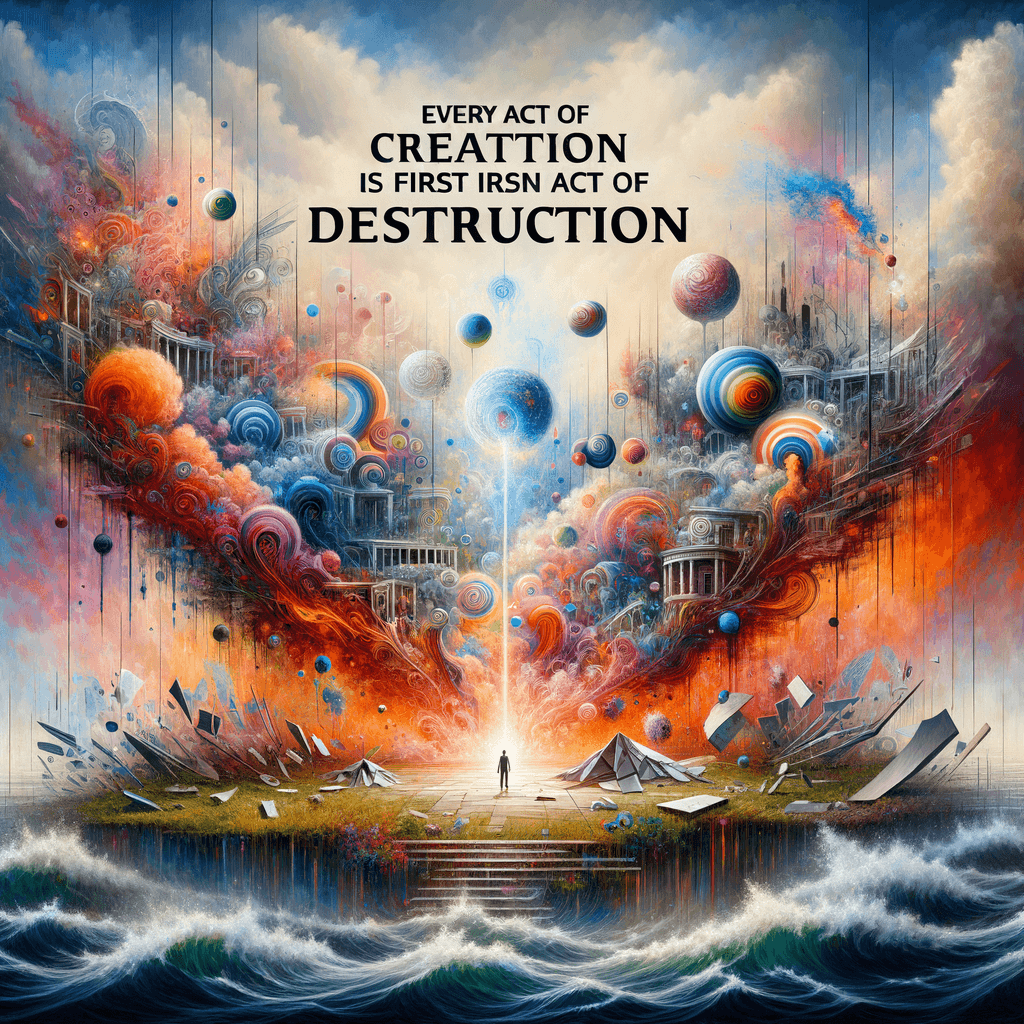
Every act of creation is first an act of destruction. — Pablo Picasso
—What lingers after this line?
Creative Process
This quote highlights the inherent connection between creation and destruction. It suggests that in order to create something new, old structures or ideas often need to be dismantled or abandoned.
Transformation
Creation involves transformation, where existing forms or concepts must be destroyed to make room for innovation and new perspectives.
Artistic Innovation
In the context of art, Picasso implies that breaking with traditional techniques or styles is necessary for avant-garde and original art to emerge.
Philosophical Insight
From a philosophical standpoint, this quote reflects the cyclical nature of existence, where destruction and creation are two sides of the same coin, essential for progress and change.
Modern Art Movement
Picasso, as a pioneer of the modern art movement, often challenged existing norms and revolutionized the art world by breaking away from conventional representations, thereby embodying his own words.
One-minute reflection
Why might this line matter today, not tomorrow?
Related Quotes
6 selectedBuilding a future means tearing down the present. — Mahmoud Darwish
Mahmoud Darwish
Mahmoud Darwish’s statement, 'Building a future means tearing down the present,' captures the sometimes unsettling truth that progress often requires letting go of existing structures. Just as a gardener clears old growt...
Read full interpretation →Turn disappointment into notes for a new song and begin to sing it loud. — Hafez
Hafez
Hafez invites us to do more than endure; he urges us to transmute. Turning disappointment into notes implies a deliberate alchemy: raw feeling becomes structure, and structure becomes song.
Read full interpretation →The chief enemy of creativity is good sense. — Pablo Picasso
Pablo Picasso
At first glance, Picasso’s claim sounds like a provocation against reason itself. Yet his point is subtler: ‘good sense’ often means the habits, rules, and social expectations that keep people from taking imaginative ris...
Read full interpretation →Art is the lie that enables us to realize the truth. - Pablo Picasso
Pablo Picasso
This quote suggests that art, though it may present an altered reality or an illusion, helps us to understand deeper truths about the world and ourselves. It acknowledges the transformative power of art in revealing hidd...
Read full interpretation →Art is the lie that enables us to realize the truth. - Pablo Picasso
Pablo Picasso
This quote introduces a paradoxical idea that art, while being a form of deception or illusion, helps us understand deeper truths about life, humanity, and the world.
Read full interpretation →Let the inner tempest power your craft instead of stalling it. — Pablo Picasso
Pablo Picasso
Picasso’s line reframes emotional turbulence as raw material rather than a verdict against productivity. Instead of treating anxiety, grief, restlessness, or anger as proof that one “can’t work,” he suggests these forces...
Read full interpretation →More From Author
More from Pablo Picasso →It is not the language of painters but the language of nature which one should listen to. — Pablo Picasso
At first glance, Picasso’s remark challenges the authority of artistic convention. By contrasting ‘the language of painters’ with ‘the language of nature,’ he suggests that art should not merely imitate established techn...
Read full interpretation →The chief enemy of creativity is good sense. — Pablo Picasso
At first glance, Picasso’s claim sounds like a provocation against reason itself. Yet his point is subtler: ‘good sense’ often means the habits, rules, and social expectations that keep people from taking imaginative ris...
Read full interpretation →The artist is a receptacle for emotions that come from all over the place: from the sky, from the earth, from a scrap of paper, from a passing shape, from a spider's web. — Pablo Picasso
At the heart of Picasso’s remark is a striking redefinition of creativity: the artist is not merely a maker, but a receiver. Rather than inventing emotion from nothing, the artist absorbs impressions that drift in from t...
Read full interpretation →Computers are useless. They can only give you answers. — Pablo Picasso
Pablo Picasso’s jab—“Computers are useless. They can only give you answers.”—is less a literal dismissal than a provocation about what humans value.
Read full interpretation →