
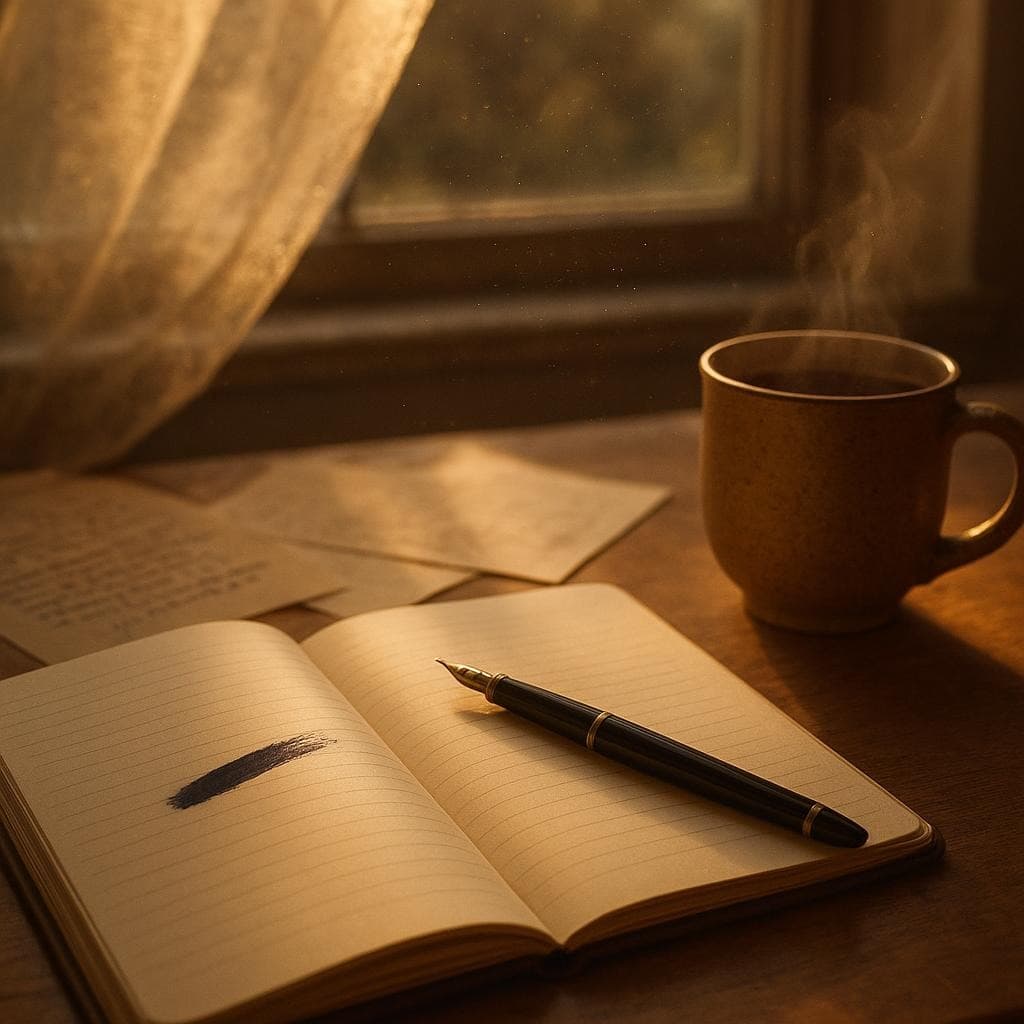
Begin the poem of your life with one bold line, then write without fear. — Emily Dickinson
—What lingers after this line?
A Life Framed as a Poem
Emily Dickinson’s line treats a human life as something authored rather than merely endured. By calling it “the poem of your life,” she implies that identity is shaped through choices, patterns, and revisions—much like stanzas built over time. The metaphor also suggests that meaning is not found all at once; it accumulates, line by line, as we keep showing up to the page. From there, her instruction becomes an invitation to agency: if life is a poem, then you are not only the subject but also the composer. That shift matters, because it moves the reader from passive reflection to active creation, preparing the ground for her next imperative—beginning.
The Power of the First Bold Line
The “first bold line” is less about perfect content than decisive initiation. In practice, beginnings determine momentum: a single clear commitment—declaring what you value, what you refuse, or what you’ll pursue—can organize subsequent decisions. This is why manifestos, vows, and even simple personal rules often function like first lines: they set tone and direction before details appear. Moreover, Dickinson’s insistence on boldness hints that timid openings often become timid lives. Starting strongly is a way of making room for your own voice, especially when external expectations are loud. Once that opening line is down, the blankness is broken, and the next task is to continue.
Writing Without Fear as a Daily Practice
“Then write without fear” turns courage into process rather than a single heroic act. Fear tends to demand guarantees—approval, certainty, immunity from regret—yet writing, like living, rarely supplies them. Dickinson’s sequence matters: after a bold start, you keep going even while doubt persists, trusting that clarity is often produced by motion, not by waiting. This resonates with how many artists and thinkers describe their work: first draft, first attempt, first conversation—imperfect but real. Anne Lamott’s Bird by Bird (1994) popularized the idea of “shitty first drafts,” capturing the same spirit Dickinson implies: permission to proceed without needing to be flawless.
Courage Over Perfectionism
Fear often disguises itself as standards. Perfectionism can sound like virtue, but it frequently operates as avoidance: if the work must be immaculate, it can never be finished, shared, or risked. Dickinson’s counsel implicitly rejects that bargain. By foregrounding boldness and fearlessness, she favors aliveness over polish—an orientation that makes growth possible. Seen this way, the poem of your life isn’t judged by whether every line impresses; it’s measured by whether it is genuinely yours. The willingness to be seen, misunderstood, or revised later becomes a form of integrity, because it refuses to let imagined criticism govern what you create.
Revisions, Regrets, and Self-Authorship
Even fearless writing includes revising, and Dickinson’s metaphor allows for that. A bold first line does not trap you; it simply begins you. As seasons change, you may edit priorities, reshape relationships, or redirect ambitions. Rather than reading those changes as failure, the poem metaphor reframes them as craft—returning to earlier lines with new understanding. In this light, regret can become material instead of a verdict. The past is not erased, but it can be integrated into a more honest draft. Dickinson’s guidance supports self-authorship: you keep the pen, you keep the page, and you keep the right to refine what your life is saying.
Making It Concrete: One Line to Start Today
To apply Dickinson’s idea, the first bold line can be simple and specific: “I will tell the truth kindly,” “I will make time for what matters,” or “I will stop living on pause.” The point is not to predict the entire poem but to anchor it. From that anchor, “write without fear” means taking the next small action that matches the line—sending the message, beginning the project, asking for help, ending what harms you. Over time, those actions become stanzas, and the stanzas become a voice. Dickinson’s instruction ultimately promises continuity: once you start boldly and refuse to be governed by fear, the page fills—sometimes messy, often surprising, but unmistakably alive.
One-minute reflection
What feeling does this quote bring up for you?
Related Quotes
6 selectedYour life is your epic tale; dare to write the chapters that inspire others to dream. — Unknown
Unknown
This quote emphasizes the importance of viewing one's life as a story worth telling. Each individual's experiences and choices contribute to a unique narrative that can inspire and resonate with others.
Read full interpretation →You don't need a formal license to be an artist; you only need the courage to claim your own perspective. — Ai Weiwei
Ai Weiwei
Ai Weiwei’s statement immediately dismantles the idea that artistic legitimacy must be granted by institutions, critics, or official credentials. Instead, he shifts the center of gravity inward: what makes someone an art...
Read full interpretation →Do not let the fear of being misunderstood keep you from producing the work you were born to manifest. Authenticity is the only currency that lasts. — Jean-Michel Basquiat
Michel Basquiat
At its core, Basquiat’s statement is a call to keep making what feels necessary, even when recognition is uncertain. Fear of being misunderstood can become a quiet form of self-censorship, persuading artists, thinkers, a...
Read full interpretation →Art is what we call it when the human soul shows up. — Seth Godin
Seth Godin
Seth Godin’s line reframes art as a moment of arrival: art happens when something distinctly human becomes visible through what we make. In this view, technique and output matter, but they are secondary to presence—the f...
Read full interpretation →Write your courage into the ordinary hours; the page will remember and reward you. — Langston Hughes
Langston Hughes
Hughes frames courage not as a single grand gesture but as something we “write” into the most unremarkable parts of life—the ordinary hours that tend to blur together. In that phrasing, bravery becomes a habit of attenti...
Read full interpretation →Paint your days with fearless colors. — Yoko Ono
Yoko Ono
Yoko Ono’s line reads like a simple instruction, yet it carries an expansive challenge: treat your daily life as a canvas and yourself as the painter. Rather than waiting for rare, dramatic moments to feel alive, it asks...
Read full interpretation →More From Author
More from Emily Dickinson →I know nothing in the world that has as much power as a word. Sometimes I write one, and I look at it, until it begins to shine. — Emily Dickinson
Emily Dickinson’s statement begins with a bold claim: among worldly things, few rival the power of a word. Rather than treating language as a neutral tool, she presents it as an active force that can move thought, alter...
Read full interpretation →The soul should always stand ajar, ready to welcome the roving experience. — Emily Dickinson
Emily Dickinson’s image of the soul standing “ajar” transforms inner life into a threshold rather than a fortress. Instead of sealing ourselves against surprise, she suggests that wisdom begins with a kind of deliberate...
Read full interpretation →Plant a question, harvest a path — Emily Dickinson
Emily Dickinson’s line, “Plant a question, harvest a path,” turns curiosity into agriculture: inquiry becomes a seed placed deliberately into the soil of experience. The image implies patience and faith, because planting...
Read full interpretation →Write the day you want to live into existence through honest action. — Emily Dickinson
Emily Dickinson’s line treats “the day you want to live” not as a wish but as something you can author. The verb “write” makes the future feel like a page that responds to a steady hand—shaped by choices, drafts, and rev...
Read full interpretation →