
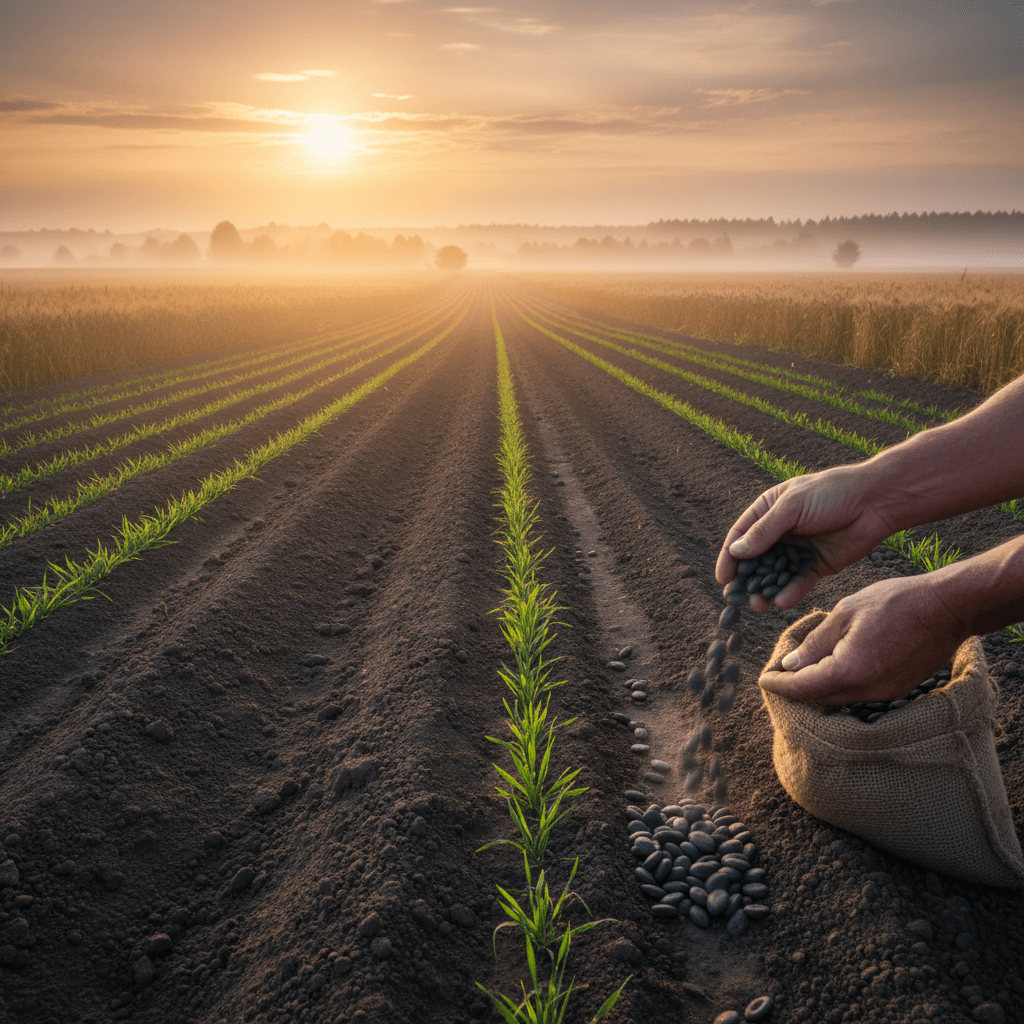
Plant bold seeds today; the harvest will outlast doubt. — Maya Angelou
—What lingers after this line?
The Call to Courageous Beginnings
At the outset, Angelou’s image of “bold seeds” reframes courage as a practice of initiation: we choose to plant despite uncertain weather and imperfect soil. The urgency of “today” rejects procrastination, while “bold” distinguishes principled risk from reckless impulse. Planting is commitment in miniature—an act that trusts the future enough to invest in it. Moreover, the promise that the “harvest will outlast doubt” suggests that results, once realized, render skepticism irrelevant. The work becomes its own rebuttal. Thus the line invites us to move from hesitation to sowing, knowing that audacity married to care can produce outcomes that speak longer and louder than our fears.
Time and the Mathematics of Accumulation
In turn, harvests depend on time’s quiet multipliers. Walter Mischel’s marshmallow experiments (1972) linked delayed gratification to long-run advantages, showing how patience amplifies modest beginnings. Likewise, Benjamin Franklin’s The Way to Wealth (1758) explains compounding with homespun clarity: “Money makes money, and the money that money makes, makes more.” Socially, advantages accrue through the Matthew effect—Robert K. Merton (1968) observed how early gains attract further opportunity. Seeds, then, are small but strategically placed bets on compounding. Initial returns seem trivial; cumulative effects transform landscapes. Doubt thrives in the short run, when shoots are fragile and invisible beneath the soil. Yet, given seasons and stewardship, the arithmetic of accumulation steadily converts tiny increments into enduring outcomes.
Turning Uncertainty into Actionable Plans
To move from patience to method, we can structure boldness. Peter Gollwitzer’s research on implementation intentions (1999) shows that “if–then” plans—“If it’s 7 a.m., then I write for 30 minutes”—significantly raise follow-through. Similarly, Richard Thaler and Shlomo Benartzi’s Save More Tomorrow program (2004) uses precommitment to overcome inertia, proving that design beats willpower. These tools do not erase doubt; they route around it by translating intention into routines that survive fluctuating moods. In practice, bold seeds are planted through calendar blocks, small deadlines, and public commitments that make retreat costlier than progress. Thus systems become trellises: they guide growth upward while the roots thicken quietly below.
Lives That Proved the Metaphor
History offers living footnotes to Angelou’s claim. After years of childhood silence, Maya Angelou transformed trauma into testimony; I Know Why the Caged Bird Sings (1969) seeded a cultural harvest of empathy and truth-telling that outlasted early skepticism. Likewise, Wangari Maathai’s Green Belt Movement (founded 1977) began with village tree plantings and scaled to tens of millions of trees, earning a Nobel Peace Prize in 2004; her memoir Unbowed (2006) shows how small, repeated acts can reshape both ecologies and civic life. In both cases, the early work was easy to dismiss—too local, too fragile, too ambitious. Yet as roots deepened and canopies spread, critics lost their grip; outcomes eclipsed doubt.
Designing Seeds with Leverage
Extending the metaphor, not all seeds have equal yield. High-leverage plantings include skills, relationships, and health—assets that compound across domains. Carol Dweck’s Mindset (2006) shows how beliefs about learning shape trajectories; adopting a growth mindset turns failure into fertilizer. For ideas, Everett Rogers’ Diffusion of Innovations (1962) advises starting with early adopters—plant where the soil is ready—then nurturing social proof to reach the mainstream. In essence, choose seeds that spawn seeds: projects that generate capabilities, networks, and credibility, each of which lowers the cost of the next courageous planting. Design determines how far a single action can propagate.
Tending the Field: Feedback and Resilience
Ultimately, harvests endure when we pair grit with adaptation. Angela Duckworth’s Grit (2016) emphasizes sustained effort toward long-term aims, while W. Edwards Deming’s PDSA cycle (Out of the Crisis, 1986) embeds learning: plan, do, study, adjust. These practices convert setbacks into soil amendments rather than reasons to abandon the field. Regular reviews, simple metrics, and candid post-mortems keep us honest about what is growing and what is failing to germinate. As feedback prunes our approach, doubt loses its footing; evidence supplants anxiety. By the time the field ripens, the work has rewritten the story—showing that bold seeds, once tended, produce a harvest large enough to silence uncertainty.
Recommended Reading
As an Amazon Associate, we earn from qualifying purchases.
One-minute reflection
What does this quote ask you to notice today?
Related Quotes
6 selectedHealing is not about erasing the past, but about finding the strength to carry it with a lighter hand. — Maya Angelou
Maya Angelou
At its core, Maya Angelou’s insight rejects the comforting but false idea that recovery requires a clean slate. Instead, she frames healing as a change in relationship to memory: the past remains, yet it no longer crushe...
Read full interpretation →I can be changed by what happens to me, but I refuse to be reduced by it. — Maya Angelou
Maya Angelou
Maya Angelou begins with a disarming admission: experience alters us. To be “changed” by what happens is not weakness but evidence of being awake to reality—loss, joy, injustice, and love all leave traces.
Read full interpretation →I can be changed by what happens to me, but I refuse to be reduced by it. — Maya Angelou
Maya Angelou
Maya Angelou’s line begins by admitting a truth that’s hard to deny: experience alters us. Loss, betrayal, joy, and hardship leave marks, reshaping how we think and what we expect.
Read full interpretation →I can be changed by what happens to me. But I refuse to be reduced by it. — Maya Angelou
Maya Angelou
Maya Angelou’s line begins by admitting a truth that is almost unavoidable: experiences leave marks. Loss, injustice, love, and disappointment all reshape how a person thinks and feels, and pretending otherwise can becom...
Read full interpretation →Resilience is not just enduring the storm; it is learning to harvest the rain to nourish the roots you've already planted. — Elizabeth Edwards
Elizabeth Edwards
At first glance, Elizabeth Edwards rejects the common image of resilience as simple endurance. To ‘endure the storm’ suggests gritting one’s teeth and waiting for suffering to pass, yet her metaphor quickly moves further...
Read full interpretation →It does not matter what you bear, but how you bear it. — Seneca
Seneca
At its heart, Seneca’s remark shifts attention away from suffering itself and toward character. Misfortune, pain, and limitation are often beyond human control, yet our response remains a moral choice.
Read full interpretation →More From Author
More from Maya Angelou →A sense of belonging is the best medicine for the human heart; it is the feeling that we are part of something larger than ourselves. — Maya Angelou
Maya Angelou’s insight begins with a simple but profound truth: emotional healing rarely happens in isolation. By calling belonging “the best medicine,” she suggests that the heart is restored not only through comfort, b...
Read full interpretation →Do not mistake my silence for weakness. I am simply observing, listening, and gathering the strength to move with intention. — Maya Angelou
At first glance, silence is often misread as passivity, yet this quote immediately overturns that assumption. The speaker insists that quietness is not a sign of fear or frailty but a deliberate choice.
Read full interpretation →To be at home in one's own skin is the ultimate sanctuary. — Maya Angelou
Maya Angelou’s words recast home as something deeper than walls, geography, or possession. To be “at home in one’s own skin” means living without chronic self-rejection, inhabiting one’s body and identity with a sense of...
Read full interpretation →Family is the one thing that never changes in a world of constant shifts; it is the anchor we carry even when we are miles apart. — Maya Angelou
At the heart of Maya Angelou’s reflection is a contrast between instability and endurance. The world moves through relocations, losses, ambitions, and reinventions, yet family, in its deepest sense, remains a continuing...
Read full interpretation →