
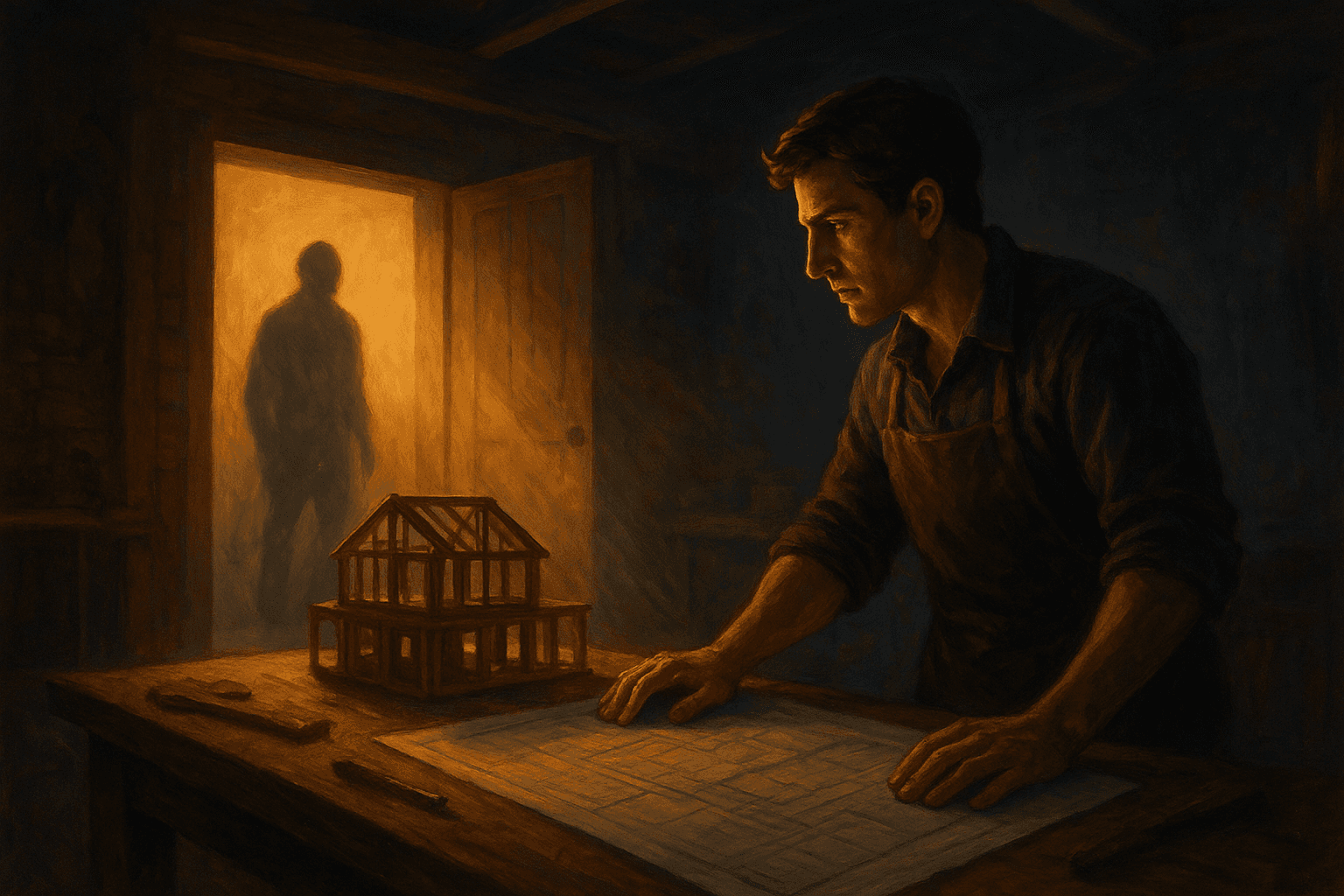
When doubt knocks, invite it to see what you're building — Victor Hugo
—What lingers after this line?
Reframing Doubt as a Visitor
Victor Hugo’s image of doubt knocking at the door immediately turns an internal feeling into an external visitor. Rather than picturing doubt as a storm that breaks in, he imagines it as something that politely announces itself. This shift is crucial: if doubt is a guest rather than an invader, we retain the power to choose our response. Instead of barricading ourselves in fear, we can decide to open the door, look doubt in the face, and engage with it on our own terms.
From Defensive Hiding to Open Showing
Once doubt is personified, Hugo’s invitation to “see what you’re building” reverses our usual instinct to hide unfinished work. Creators, leaders, and ordinary people alike often conceal their in-progress efforts, fearing judgment or failure. By contrast, Hugo suggests that the healthiest response is transparency: bring doubt into the workshop, show it the blueprints, and let it walk around the scaffolding. In doing so, we move from a defensive crouch to an open stance, transforming anxiety into a kind of impromptu inspection tour.
Doubt as an Informal Quality Inspector
Viewed this way, doubt becomes less a saboteur and more an uninvited but useful auditor. Just as engineers perform stress tests on bridges before opening them, honest doubt can expose weak joints in our plans and ideas. The philosopher René Descartes used systematic doubt in his *Meditations* (1641) to strip away unreliable beliefs and discover what could truly be trusted. Likewise, when we calmly walk doubt through what we are building, its criticisms can highlight structural flaws we might otherwise ignore.
Protecting Vision While Welcoming Questions
However, welcoming doubt does not mean granting it the authority to demolish our vision. Hugo’s phrase “what you’re building” affirms that a project, dream, or conviction already exists in embryo. The task, then, is to let doubt question the methods and materials without surrendering the underlying purpose. Entrepreneurs pitching skeptical investors or scientists facing peer review do something similar: they listen carefully to probing questions yet hold fast to the core problem they are trying to solve. In this balance, doubt sharpens execution rather than erasing intention.
Cultivating Courageous Transparency in Growth
Ultimately, the quote urges a posture of courageous transparency toward our own uncertainty. Instead of waiting until everything is perfect before exposing our efforts, we allow doubt to accompany us while the work is still rough. This attitude mirrors modern growth mindsets, which treat mistakes as feedback rather than final verdicts. By inviting doubt in, showing it our half-built bridges and unpainted walls, we convert it from a voice of pure fear into a partner in refinement—and in doing so, we keep building when others might quietly give up.
One-minute reflection
What feeling does this quote bring up for you?
Related Quotes
6 selectedSelf-mastery rarely looks impressive. It simply holds. — James Clear
James Clear
James Clear’s observation begins by stripping self-mastery of glamour. It is not usually a heroic moment, a public triumph, or a dramatic display of willpower.
Read full interpretation →When I hear somebody sigh, 'Life is hard,' I am always tempted to ask, 'Compared to what?' — Sydney J. Harris
Sydney J. Harris
Sydney J. Harris’s remark begins with an ordinary expression of fatigue: “Life is hard.” Yet his response, “Compared to what?” quietly turns complaint into inquiry.
Read full interpretation →Don't fight the challenges. Just find a new way to stand. — Germany Kent
Germany Kent
Germany Kent’s words begin with a quiet reversal of instinct: instead of treating every challenge as an enemy to defeat, she invites us to reconsider our posture toward difficulty. The emphasis is not on surrender, but o...
Read full interpretation →Optimist: someone who figures that taking a step backward after taking a step forward is not a disaster, it's more like a cha-cha. — Robert Brault
Robert Brault
Robert Brault’s line begins with a witty redefinition: an optimist is not someone who denies backward motion, but someone who interprets it differently. Instead of treating a setback as proof of failure, the optimist see...
Read full interpretation →A mind grows by staying with difficulty long enough for the experience to change it. — Mary Catherine Bateson
Mary Catherine Bateson
Mary Catherine Bateson’s observation begins with a quiet but demanding truth: the mind does not grow merely by encountering difficulty, but by remaining with it. Challenge becomes transformative only when we resist the u...
Read full interpretation →When you are friends with your storm, you dance, instead of getting blown away. — Michael Bassey Johnson
Michael Bassey Johnson
Michael Bassey Johnson’s line begins with a striking reversal: the storm is not merely an enemy to survive, but a force one can learn to understand. In this sense, the storm may represent grief, fear, conflict, uncertain...
Read full interpretation →More From Author
More from Victor Hugo →To love beauty is to see light. — Victor Hugo
Victor Hugo’s line suggests that beauty is not merely something pleasing to the eye; it is a way of perceiving the world more clearly. To love beauty is to become receptive to illumination, as if the soul gains a new sou...
Read full interpretation →Build bridges with your will, and let hope walk across them. — Victor Hugo
Victor Hugo’s image begins with a practical insistence: the future doesn’t simply arrive; it is constructed. By saying “build bridges with your will,” he treats willpower as a kind of engineering—an intentional effort to...
Read full interpretation →Forge a path with words and work, and let beauty follow in your wake. — Victor Hugo
Victor Hugo’s line, “Forge a path with words and work, and let beauty follow in your wake,” begins by uniting two worlds often held apart: artistic expression and disciplined effort. Instead of treating beauty as somethi...
Read full interpretation →Hold fast to the idea that small acts of bravery stitch the fabric of a freer tomorrow. — Victor Hugo
Imagine freedom as a fabric: resilient yet always at risk of fraying. Small acts of bravery are the stitches that prevent it from unraveling, and holding fast to this idea keeps our hands steady at the needle.
Read full interpretation →