
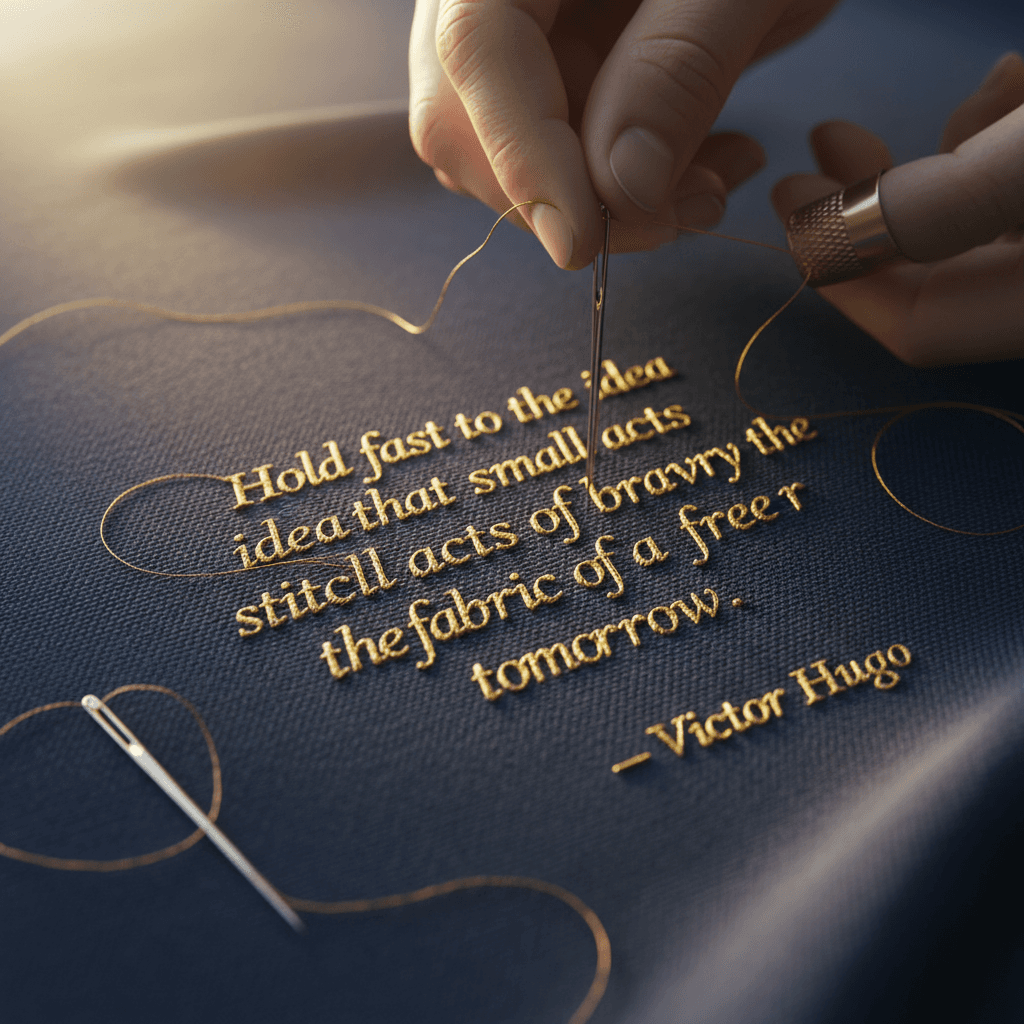
Hold fast to the idea that small acts of bravery stitch the fabric of a freer tomorrow. — Victor Hugo
—What lingers after this line?
The Stitching Power of Everyday Courage
Imagine freedom as a fabric: resilient yet always at risk of fraying. Small acts of bravery are the stitches that prevent it from unraveling, and holding fast to this idea keeps our hands steady at the needle. A polite but firm dissent in a meeting, a neighbor stepping in to de-escalate a conflict, a voter showing up on a rainy Tuesday—each is slight on its own, yet collectively they reinforce the cloth. In this view, courage is not a rare blaze but a daily craft, accumulating strength through repetition and care. History shows how such stitches, layered and interlinked, can alter the entire weave.
History’s Quiet Catalysts of Change
Consider Rosa Parks’s refusal in Montgomery (1955), a simple no that helped catalyze a citywide boycott and a national reimagining of rights. Likewise, the Greensboro sit-ins (1960), begun by four students at a lunch counter, turned modest stools into platforms for structural change. Václav Havel’s essay The Power of the Powerless (1978) describes a greengrocer who quietly removes a propaganda sign—an act small in motion, monumental in meaning. These choices did not rely on spectacle; rather, they signaled a new pattern others could follow. As threads invite more threads, these gestures became seams that held a freer order together. Hugo’s fiction, in turn, dramatizes how such moral stitches reshape destinies.
Hugo’s Pages and the Ethics of the Small
In Les Misérables (1862), Bishop Myriel’s mercy—gifting candlesticks instead of condemnation—reorients Jean Valjean’s life, implying that quiet compassion can redirect history. Later, Valjean’s decision to spare Javert and his rescue of Marius are intimate, person-to-person braveries whose ripples exceed their scale. Even Gavroche’s audacity at the barricade shows how courage can be both ordinary and luminous. Hugo suggests that liberty grows from choices made in cramped rooms and dim streets, long before any anthem is sung. To understand how these modest acts expand into wide social change, psychology clarifies the mechanics by which small wins build momentum.
Psychology of Small Wins and Self-Efficacy
Teresa Amabile and Steven Kramer’s The Progress Principle (2011) shows that small wins amplify motivation, transforming effort into sustained movement. Albert Bandura’s self-efficacy theory (1977) adds that successful micro-actions recalibrate our belief in what we can do next—courage begets courage through feedback loops. BJ Fogg’s Tiny Habits (2019) echoes this: tiny, consistent behaviors reshape identity first, outcomes second. In combination, these findings explain why a single act of speaking up today makes tomorrow’s act likelier and bolder. When multiplied across a neighborhood or workplace, such micro-bravery becomes shared confidence—a bridge from personal resolve to collective will. Civic life, accordingly, treats these habits as the threads of social trust.
Weaving Social Fabric and Trust
Robert Putnam’s Bowling Alone (2000) warns that thinner social ties weaken democratic capacity, while rebuilding trust—through clubs, meetings, and mutual aid—restitches civic strength. Jane Jacobs’s observations in The Death and Life of Great American Cities (1961) highlight everyday guardianship, the “eyes on the street” that keep communities safe. Micro-bravery—introducing yourself to a neighbor, attending a council session, calling out a small injustice—fortifies the informal norms that protect liberty when laws lag. As trust accumulates, coordination becomes easier and collective risks become shared ventures. Therefore, the path from solitary resolve to public freedom runs through the mundane, repeated courage of showing up.
Practicing Brave Stitches Each Day
Start where stakes are real but manageable: challenge a harmful joke, file that needed report, invite a quieter colleague to speak, or volunteer for a thankless civic task. Vote in local elections, support independent media, and teach children to ask honest questions. Safety matters, so calibrate risks, pair up, and use established channels when possible. What counts is continuity: one modest stitch after another, aligned with others’ stitches, creating a pattern stronger than any single seam. By holding fast to the belief that small braveries matter, we consent to the slow, patient work by which tomorrow’s freedom is quietly, decisively made.
One-minute reflection
Where does this idea show up in your life right now?
Related Quotes
6 selectedBravery often looks like ordinary work continued with a steady heart. — bell hooks
bell hooks
bell hooks shifts the image of bravery away from cinematic heroics and toward persistence. In her framing, courage isn’t reserved for emergencies or grand speeches; it appears in the daily choice to keep going, even when...
Read full interpretation →Collect tiny brave acts until they become a landscape. — Kenzaburō Ōe
Kenzaburō Ōe
Kenzaburō Ōe’s line, “Collect tiny brave acts until they become a landscape,” reframes courage not as a sudden, heroic explosion but as a slow accumulation of modest gestures. Rather than highlighting one grand sacrifice...
Read full interpretation →Brave acts are ordinary moments dressed in persistence — George Eliot
George Eliot
George Eliot’s line, “Brave acts are ordinary moments dressed in persistence,” challenges the familiar image of courage as rare and dramatic. Instead of picturing heroes on battlefields or in burning buildings, she invit...
Read full interpretation →Turn ordinary moments into offers of courage; the small invites become revolutions — bell hooks
bell hooks
bell hooks suggests that what appears mundane can actually be a threshold to transformation. A casual conversation, a shared meal, or a brief pause to listen might seem insignificant, yet these are the spaces where value...
Read full interpretation →To do anything at all is a feat worth celebrating. — D.C. Gonzalez
D.C. Gonzalez
This quote highlights the importance of recognizing and appreciating even the smallest accomplishments. Every action, no matter how minor, is a step forward and deserves recognition.
Read full interpretation →Adventure isn’t hanging on a rope off the side of a mountain. Adventure is an attitude that we must apply to the day to day obstacles of life. — John Amatt
John Amatt
Many people instinctively picture daring feats—scaling icy peaks or braving wild rapids—when they hear the word 'adventure.' John Amatt upends this traditional perspective, asserting that adventure isn’t reserved for adr...
Read full interpretation →More From Author
More from Victor Hugo →To love beauty is to see light. — Victor Hugo
Victor Hugo’s line suggests that beauty is not merely something pleasing to the eye; it is a way of perceiving the world more clearly. To love beauty is to become receptive to illumination, as if the soul gains a new sou...
Read full interpretation →Build bridges with your will, and let hope walk across them. — Victor Hugo
Victor Hugo’s image begins with a practical insistence: the future doesn’t simply arrive; it is constructed. By saying “build bridges with your will,” he treats willpower as a kind of engineering—an intentional effort to...
Read full interpretation →Forge a path with words and work, and let beauty follow in your wake. — Victor Hugo
Victor Hugo’s line, “Forge a path with words and work, and let beauty follow in your wake,” begins by uniting two worlds often held apart: artistic expression and disciplined effort. Instead of treating beauty as somethi...
Read full interpretation →When doubt knocks, invite it to see what you're building — Victor Hugo
Victor Hugo’s image of doubt knocking at the door immediately turns an internal feeling into an external visitor. Rather than picturing doubt as a storm that breaks in, he imagines it as something that politely announces...
Read full interpretation →