
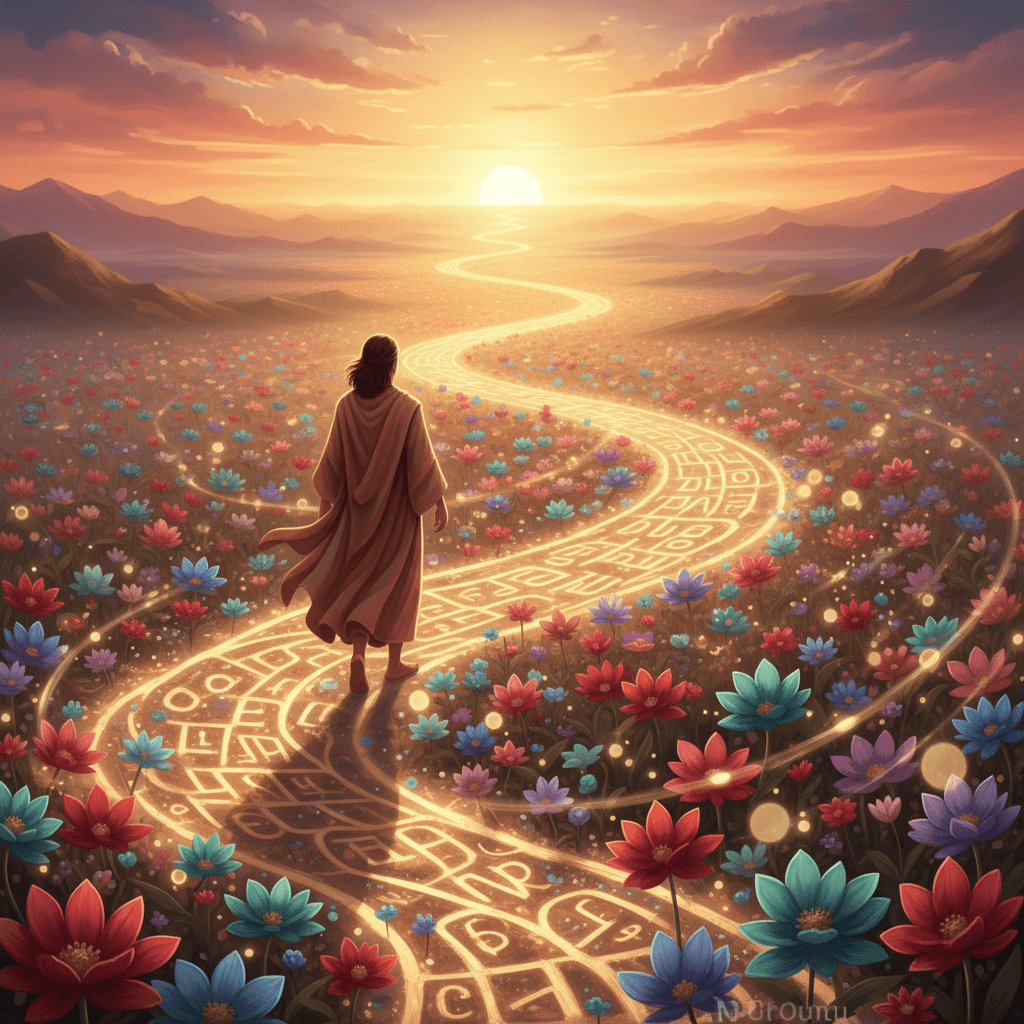
Forge a path with words and work, and let beauty follow in your wake. — Victor Hugo
—What lingers after this line?
From Poetry to Practice
Victor Hugo’s line, “Forge a path with words and work, and let beauty follow in your wake,” begins by uniting two worlds often held apart: artistic expression and disciplined effort. Instead of treating beauty as something we chase directly, Hugo suggests it is a natural consequence of a life shaped by deliberate language and sustained labor. In this way, he reframes beauty not as an ornament added at the end, but as the trace left behind by purposeful action.
Words as Tools of Creation
To “forge a path with words” implies that language is not merely descriptive; it is generative. Just as in Genesis the world is spoken into being, or as in Martin Luther King Jr.’s speeches that reshaped civil rights consciousness, words carve new routes through shared reality. Transitioning from this idea, Hugo hints that careful, courageous speech—whether in writing, conversation, or public discourse—can clear the underbrush of confusion and fear, opening a way forward for others to walk.
Work as the Anvil of Intention
Yet Hugo does not stop at language; he yokes words to work. This combination suggests that vision without effort is fantasy, while effort without vision risks becoming mechanical. In the same spirit, Michelangelo’s letters reveal years of grueling labor behind the apparent ease of the Sistine Chapel. Thus, as we move from speech to action, Hugo reminds us that daily, often unseen work is the anvil on which lofty intentions are hammered into durable form.
Beauty as a Byproduct, Not a Target
From here, Hugo’s counsel becomes counterintuitive: “let beauty follow in your wake.” Instead of obsessively engineering perfection, he urges a focus on integrity of process—honest words, diligent work—and trusts that beauty will emerge as a secondary effect. This echoes the way classic craftsmen built cathedrals in medieval Europe, carving intricate details even in places few would ever see. Their priority was devotion and skill; the splendor that resulted was, in essence, a fortunate consequence.
Living a Trail-Forming Life
Finally, to leave beauty in one’s wake is to live as a kind of trailblazer whose passage improves what comes after. Teachers who encourage curiosity, engineers who design humane cities, or neighbors who speak kindly all embody Hugo’s principle in small yet tangible ways. By moving from individual expression to communal impact, the quote invites us to treat each sentence and each task as part of a larger path. Walk it with clarity and effort, Hugo implies, and others will find something beautiful where you have been.
One-minute reflection
Why might this line matter today, not tomorrow?
Related Quotes
6 selectedThere is no must in art because art is free. — Wassily Kandinsky
Wassily Kandinsky
At its core, Kandinsky’s statement rejects the idea that art must obey fixed obligations. By saying there is no ‘must’ in art, he frees creation from rigid formulas, academic demands, and social expectation.
Read full interpretation →Often what the artist expresses is unconscious, but we can learn to decode the story by collaboratively finding the pieces to the puzzle that create new possibilities for innovation. — Ben Okri
Ben Okri
At the heart of Ben Okri’s statement is the idea that art often says more than the artist consciously intends. A poem, painting, or song may carry hidden fears, cultural memories, or emotional truths that emerge without...
Read full interpretation →I think that when you create something, you leave a part of yourself in it. — Henri Matisse
Henri Matisse
At its core, Matisse’s reflection suggests that making anything—a painting, a poem, a song, even a room—inevitably transfers something inward into outward form. Creation is not merely the arrangement of materials; rather...
Read full interpretation →There is a deep peace that comes from creating something that didn't exist before. It is your way of telling the universe that you were here, and you felt something. — Maya Angelou
Maya Angelou
At its heart, Maya Angelou’s reflection suggests that creation is not merely productive but restorative. To make something that did not exist before—a poem, a garden, a melody, even a repaired room—is to experience a rar...
Read full interpretation →The creative act is not an escape from reality, but a way to encounter it more deeply. — bell hooks
bell hooks
At first glance, creative work can look like withdrawal: a painter disappears into a studio, a writer vanishes into pages, a musician closes the door and listens inward. Yet bell hooks reverses that assumption.
Read full interpretation →The best use of imagination is creativity. The worst use of imagination is anxiety. — Deepak Chopra
Deepak Chopra
Deepak Chopra frames imagination as a neutral force whose value depends on its direction. In one sense, imagination is the mind’s simulator: it can invent possibilities that do not yet exist, letting us rehearse outcomes...
Read full interpretation →More From Author
More from Victor Hugo →To love beauty is to see light. — Victor Hugo
Victor Hugo’s line suggests that beauty is not merely something pleasing to the eye; it is a way of perceiving the world more clearly. To love beauty is to become receptive to illumination, as if the soul gains a new sou...
Read full interpretation →Build bridges with your will, and let hope walk across them. — Victor Hugo
Victor Hugo’s image begins with a practical insistence: the future doesn’t simply arrive; it is constructed. By saying “build bridges with your will,” he treats willpower as a kind of engineering—an intentional effort to...
Read full interpretation →When doubt knocks, invite it to see what you're building — Victor Hugo
Victor Hugo’s image of doubt knocking at the door immediately turns an internal feeling into an external visitor. Rather than picturing doubt as a storm that breaks in, he imagines it as something that politely announces...
Read full interpretation →Hold fast to the idea that small acts of bravery stitch the fabric of a freer tomorrow. — Victor Hugo
Imagine freedom as a fabric: resilient yet always at risk of fraying. Small acts of bravery are the stitches that prevent it from unraveling, and holding fast to this idea keeps our hands steady at the needle.
Read full interpretation →