
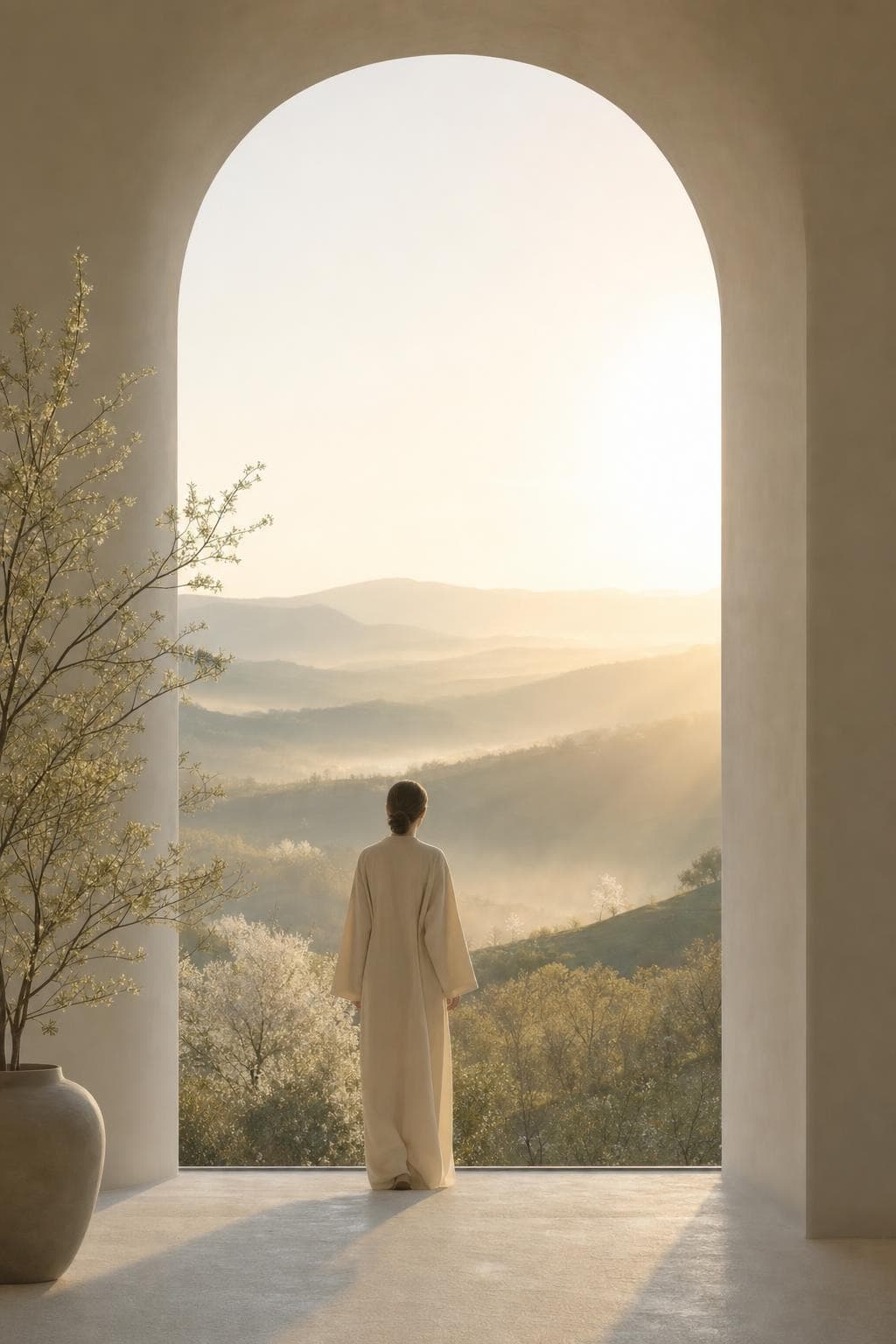
To love beauty is to see light. — Victor Hugo
—What lingers after this line?
Beauty as Illumination
Victor Hugo’s line suggests that beauty is not merely something pleasing to the eye; it is a way of perceiving the world more clearly. To love beauty is to become receptive to illumination, as if the soul gains a new source of light through wonder, tenderness, and attention. In this sense, beauty does not decorate life from the outside—it reveals what might otherwise remain hidden.
Hugo’s Romantic Vision
This idea fits naturally within the Romantic imagination, where beauty often served as a bridge between the visible and the spiritual. Hugo, in works such as Les Misérables (1862), repeatedly presents moments of grace amid darkness: a bishop’s mercy, a child’s innocence, or a glimpse of moral courage. Moving from the quote into his broader writing, we see that beauty is not limited to landscapes or faces; it can also appear as compassion, sacrifice, and human dignity.
Light as Moral Awakening
From there, the metaphor of light deepens into an ethical meaning. Light has long symbolized truth, goodness, and awakening, from Plato’s Republic (c. 375 BC), where the sun represents knowledge, to Christian imagery of divine radiance. Hugo’s phrase belongs to this tradition, implying that the love of beauty can guide people out of indifference and into a more humane awareness of others.
The Discipline of Attention
Yet Hugo’s insight also depends on attention: beauty must be loved before it can illuminate. A person rushing through life may pass a cathedral window, a kind gesture, or a morning sky without truly seeing any of them. By contrast, someone who pauses in reverence allows beauty to become transformative, turning ordinary perception into a quiet act of discovery.
Beauty Beyond Surface
Still, the quote should not be reduced to superficial charm. Hugo’s novels often find beauty in the poor, the wounded, and the morally struggling, reminding us that true beauty may appear beneath hardship. This transition from appearance to essence is crucial: to love beauty rightly is not to worship perfection, but to recognize light wherever humanity, truth, or tenderness breaks through.
A Hopeful Way of Seeing
Finally, Hugo’s words offer a hopeful philosophy of perception. In a world often shadowed by suffering, cynicism, and distraction, the love of beauty becomes an act of resistance. It teaches us to look again, to search for radiance in art, nature, and human goodness—and by seeing that light, to become a little more luminous ourselves.
One-minute reflection
What does this quote ask you to notice today?
Related Quotes
6 selectedThe beauty of a finely worked object points to the beauty of the craftsmanship. — Paul Klee
Paul Klee
Paul Klee’s statement begins with a simple but powerful observation: a beautiful object does not merely please the eye; it points beyond itself to the intelligence, patience, and skill that shaped it. The object becomes...
Read full interpretation →Roses do not bloom hurriedly; for beauty, like any masterpiece, takes time to blossom. — Matshona Dhliwayo
Matshona Dhliwayo
At its heart, Matshona Dhliwayo’s quote reminds us that true beauty cannot be forced. A rose does not rush toward bloom, nor does it apologize for the time required to unfold.
Read full interpretation →Gratitude is the closest thing to beauty manifested in an emotion. — Mindy Kaling
Mindy Kaling
At first glance, Mindy Kaling’s line suggests that beauty is not only something we see but something we feel. Gratitude becomes a kind of inward radiance, transforming an ordinary emotional response into something almost...
Read full interpretation →Forge a path with words and work, and let beauty follow in your wake. — Victor Hugo
Victor Hugo
Victor Hugo’s line, “Forge a path with words and work, and let beauty follow in your wake,” begins by uniting two worlds often held apart: artistic expression and disciplined effort. Instead of treating beauty as somethi...
Read full interpretation →Anything that is beautiful is beautiful just as it is. Praise forms no part of its beauty. — Marcus Aurelius
Marcus Aurelius
Marcus Aurelius argues that beauty does not depend on approval from others to become real. In this Stoic view, a flower, a sunset, or a noble action possesses its worth inherently; praise may acknowledge that worth, but...
Read full interpretation →The beauty of craftsmanship points to the beauty of the source of the craftsmanship. — Frank Lloyd Wright
Frank Lloyd Wright
Frank Lloyd Wright’s remark begins with a simple observation: when we encounter exquisite craftsmanship, we are moved not only by the object itself but also by the mind and spirit behind it. A finely joined chair, a care...
Read full interpretation →More From Author
More from Victor Hugo →Build bridges with your will, and let hope walk across them. — Victor Hugo
Victor Hugo’s image begins with a practical insistence: the future doesn’t simply arrive; it is constructed. By saying “build bridges with your will,” he treats willpower as a kind of engineering—an intentional effort to...
Read full interpretation →Forge a path with words and work, and let beauty follow in your wake. — Victor Hugo
Victor Hugo’s line, “Forge a path with words and work, and let beauty follow in your wake,” begins by uniting two worlds often held apart: artistic expression and disciplined effort. Instead of treating beauty as somethi...
Read full interpretation →When doubt knocks, invite it to see what you're building — Victor Hugo
Victor Hugo’s image of doubt knocking at the door immediately turns an internal feeling into an external visitor. Rather than picturing doubt as a storm that breaks in, he imagines it as something that politely announces...
Read full interpretation →Hold fast to the idea that small acts of bravery stitch the fabric of a freer tomorrow. — Victor Hugo
Imagine freedom as a fabric: resilient yet always at risk of fraying. Small acts of bravery are the stitches that prevent it from unraveling, and holding fast to this idea keeps our hands steady at the needle.
Read full interpretation →