
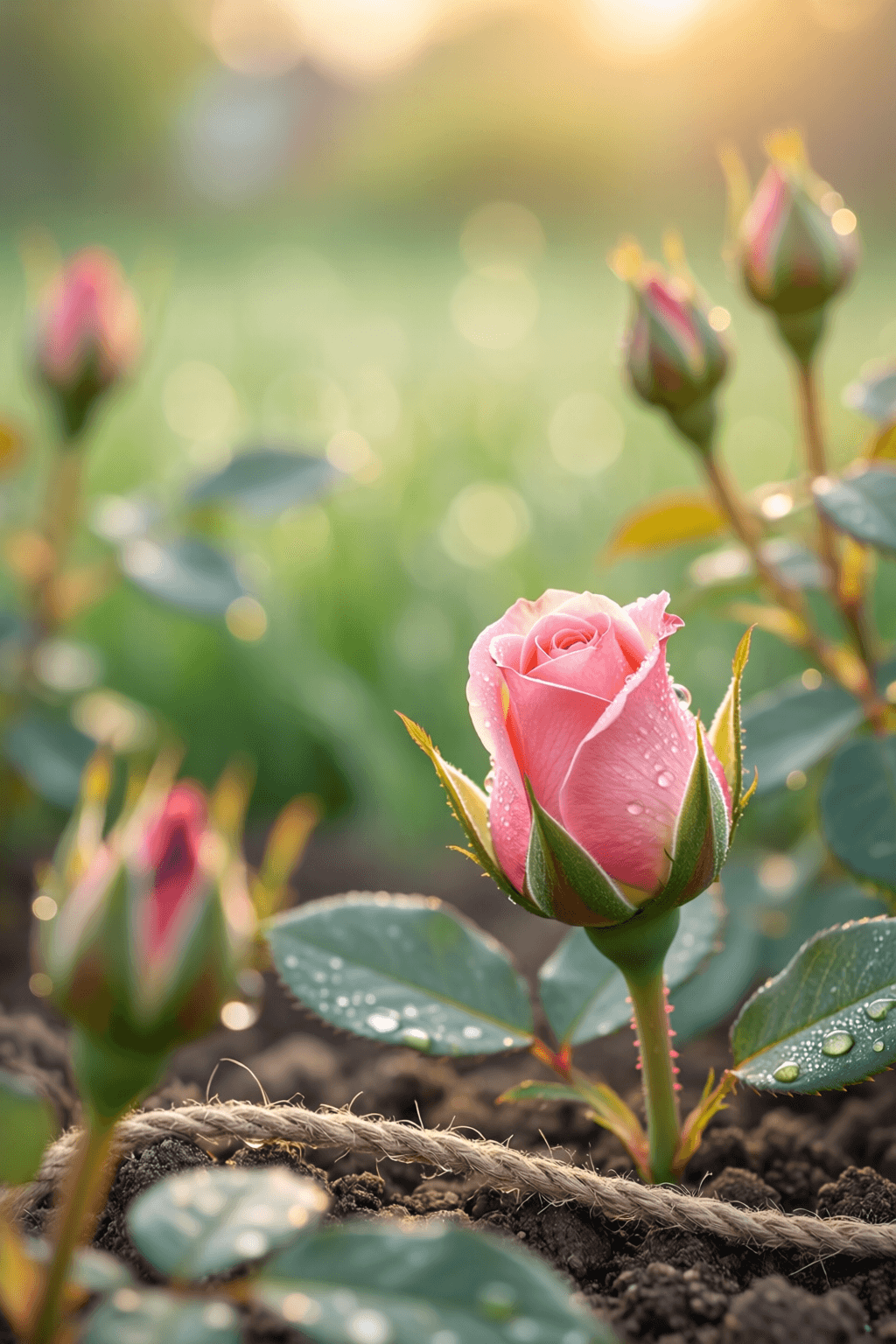
Roses do not bloom hurriedly; for beauty, like any masterpiece, takes time to blossom. — Matshona Dhliwayo
—What lingers after this line?
Patience as a Creative Law
At its heart, Matshona Dhliwayo’s quote reminds us that true beauty cannot be forced. A rose does not rush toward bloom, nor does it apologize for the time required to unfold. In the same way, anything meaningful—character, art, wisdom, or love—develops through stages that cannot be skipped without losing depth. This image of gradual blossoming gently challenges a culture obsessed with speed. We are often taught to value quick results, yet the rose suggests another law entirely: what becomes exquisite usually matures slowly. Thus, patience is not passive waiting, but faithful trust in a process.
The Rose as a Living Metaphor
More specifically, the rose serves as a powerful metaphor because its beauty is inseparable from its growth. Before the blossom appears, there are roots, thorns, stems, and tightly closed petals—parts of the journey that may seem plain or even harsh. Nevertheless, each stage contributes to the final elegance, making the flower’s bloom a culmination rather than a sudden event. In this way, Dhliwayo suggests that our unfinished phases are not failures. They are preparatory forms of beauty. Just as a gardener does not condemn a bud for being unopened, we too might learn to respect the hidden work of becoming.
Masterpieces Require Unseen Labor
From there, the comparison to a masterpiece broadens the quote beyond nature into human creation. Great works rarely appear in an instant; they emerge through revision, discipline, and endurance. Leonardo da Vinci’s Mona Lisa (c. 1503–1519), for example, was developed over years, and that prolonged attention is part of what gives it mystery and refinement. Consequently, the quote honors the invisible labor behind excellence. What the world admires in the finished form often rests on countless quiet hours of practice and persistence. Beauty, then, is not merely an appearance but the visible result of sustained devotion.
Growth in Human Life
The saying also speaks intimately to personal development. People often become discouraged when transformation feels slow, whether they are healing from loss, learning a craft, or building a meaningful life. Yet Dhliwayo’s image reassures us that slowness does not signal stagnation; often, it signals depth. Indeed, many of life’s finest qualities ripen gradually. Trust between friends, wisdom earned through hardship, and confidence shaped by experience all resemble roses more than machines. They cannot be manufactured on demand. Instead, they blossom through time, care, and repeated seasons of change.
A Quiet Rebuttal to Hurry
At the same time, the quote offers a subtle critique of modern impatience. Social expectations, productivity culture, and curated success stories can make delayed progress feel like inadequacy. However, the rose undermines that illusion by showing that natural timing is not weakness but design. This perspective echoes ancient thought as well. Ecclesiastes 3:1 states that there is ‘a season’ for everything, suggesting that fulfillment belongs to rhythm rather than haste. By embracing this idea, we begin to see that rushing beauty may distort it, while honoring time allows it to emerge fully.
Trusting the Bloom to Come
Ultimately, Dhliwayo leaves us with a hopeful lesson: becoming takes time, but time is not the enemy of beauty—it is its companion. The rose blooms because it is given room to grow, and masterpieces endure because they are shaped with care rather than urgency. Therefore, the quote invites a gentler way of living. Instead of measuring worth by speed, we can value steady unfolding. In doing so, we learn to trust that what is truly beautiful in us and in our work may still be forming, petal by petal.
Recommended Reading
As an Amazon Associate, we earn from qualifying purchases.
One-minute reflection
Where does this idea show up in your life right now?
Related Quotes
6 selectedBeautiful things aren't rushed. A garden, a book, a work of art… they grow with time, care, and heart. — Angelika Regossi
Angelika Regossi
At its core, Angelika Regossi’s reflection challenges the modern obsession with speed. By saying that beautiful things are not rushed, she reminds us that what truly matters often emerges slowly, through patience rather...
Read full interpretation →There is no road too long to the man who advances deliberately and without undue haste; there are no honors too distant to the man who prepares himself for them with patience. — Jean de La Bruyère
Jean de La Bruyère
At its core, La Bruyère’s line praises steady movement over restless speed. A long road feels intimidating only when seen all at once; once it is broken into deliberate steps, distance loses much of its power.
Read full interpretation →The ultimate mysteries are opened only to those who have immense patience. — Osho
Osho
Osho’s statement begins with a simple but demanding premise: the deepest truths do not yield to force. In this view, mystery is not a puzzle to be solved quickly but a reality that unfolds on its own terms.
Read full interpretation →Do you have the patience to wait until your mud settles and the water is clear? — Lao Tzu
Lao Tzu
Lao Tzu’s question frames patience not as passive delay but as an active kind of wisdom. The image of muddy water settling on its own suggests that confusion often clears not through force, but through restraint.
Read full interpretation →Gratitude is the closest thing to beauty manifested in an emotion. — Mindy Kaling
Mindy Kaling
At first glance, Mindy Kaling’s line suggests that beauty is not only something we see but something we feel. Gratitude becomes a kind of inward radiance, transforming an ordinary emotional response into something almost...
Read full interpretation →The wise do things slowly, because they love it. — David Fell
David Fell
At first glance, David Fell’s line seems to praise caution, yet it reaches further than mere hesitation. To do something slowly, in this view, is not to be indecisive but to be fully present.
Read full interpretation →More From Author
More from Matshona Dhliwayo →Today's tears water tomorrow's gardens. — Matshona Dhliwayo
At first glance, Matshona Dhliwayo’s line transforms grief into something unexpectedly fertile. Tears, usually seen as signs of pain or loss, become water for a future garden, suggesting that suffering is not merely endu...
Read full interpretation →Turning your back on the storm means turning your back on the rainbows that follow. — Matshona Dhliwayo
This quote emphasizes the importance of confronting challenges head-on. Avoiding or running away from difficulties may prevent one from experiencing the rewards and growth that come from overcoming them.
Read full interpretation →The strongest trees are rooted in the hardest ground. — Matshona Dhliwayo
This quote suggests that challenges and hardships make individuals stronger. Just like trees that grow in tough soil develop deeper roots, people who face adversity build resilience.
Read full interpretation →Stars don't beg the night to shine. — Matshona Dhliwayo
The quote suggests that greatness and beauty naturally reveal themselves without asking for permission or attention.
Read full interpretation →