
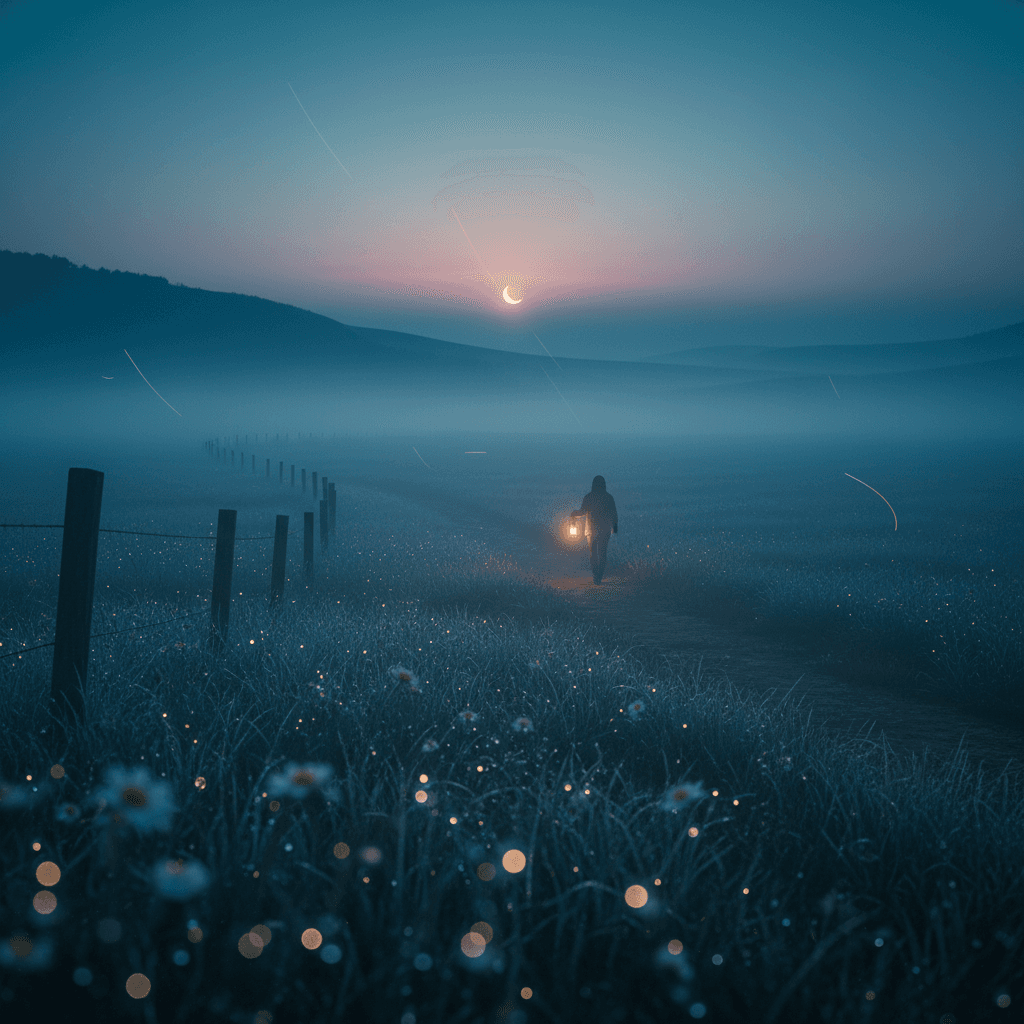
Call to action the curiosity that wakes you before dawn. — Emily Dickinson
—What lingers after this line?
The Quiet Imperative
The line urges us to do more than marvel; it asks us to enlist curiosity as a taskmaster. Dawn is not just a time on the clock but a threshold, when attention is unclaimed and questions sound louder than routine. If we do not act then, the day’s demands will, and the fragile spark fades. Thus, calling curiosity to action means converting a feeling into a first move. It might be one page, one question framed, one email sent, or a tiny experiment begun. The point is momentum. By starting while the world is still quiet, we let wonder set the agenda before busyness edits it down.
Dickinson’s Room, Courage on Paper
Emily Dickinson’s seclusion in Amherst yielded fierce productivity. Instead of waiting for permission, she created her own laboratory of language: scholars have cataloged her hand-stitched fascicles from the late 1850s and 1860s, small booklets where poems gathered themselves into constellations. Even her envelope poems—drafts scrawled on scraps—show an instinct to catch the fleeting and give it form. In that spirit, the dawn directive is less about heroics and more about habit. Dickinson’s example suggests that private discipline transforms stray curiosity into durable craft. The room, the page, the stitch: each is a modest action that compounds into a body of work.
Why Daybreak Helps the Mind
Curiosity prepares the brain to learn. Neuroscience studies indicate that curiosity states engage dopaminergic circuits and the hippocampus, enhancing memory for both the sought information and incidental details (Gruber et al., Neuron, 2014). Daybreak amplifies this advantage by lowering interference: fewer inputs compete for attention, making it easier to follow a question to its edge. Moreover, research on timing and creativity finds that people can be more insightful at their non-optimal hours, when mental control relaxes and distant associations surface (Wieth and Zacks, Thinking & Reasoning, 2011). For many, the early morning balances clarity with looseness—precisely the mix that lets curiosity roam and then land.
A Simple Dawn Protocol
Begin with capture: write the exact question that woke you, without judging its scale. Then probe for 20 to 30 minutes—sketch a hypothesis, test a tiny example, or read one focused source. Finally, commit to a next step due by noon, however small. This three-part loop turns a spark into a plan before distractions proliferate. Many creators ritualize the morning to similar effect. Julia Cameron’s Morning Pages (The Artist’s Way, 1992) channel unfiltered thoughts into fresh directions. Toni Morrison described writing before dawn to meet the day on her terms (Paris Review, 1993). The common thread is deliberate beginning, not immediate brilliance.
Gentle Guardrails, Not Grind
Calling curiosity to action does not sanction relentless hustle. Protect sleep, rotate early sessions with later ones if your chronotype demands, and cap the dawn sprint so it stays inviting. A short, consistent cadence beats sporadic marathons that sour the practice. Think of recovery as part of the work. A brief walk after the session consolidates ideas; a midday review catches what the morning missed. By treating dawn as a warm start rather than a proving ground, you preserve both curiosity and stamina.
From Private Spark to Shared Light
Curiosity matures when it leaves the room. Translate the morning’s page into a question posed to a colleague, a prototype shown to a friend, or a note that invites critique. Even a two-sentence summary shared with one person converts solitary wonder into communal inquiry. In this way, the dawn habit scales: small, repeated acts of outreach create a network of co-investigators. What began as a whisper before sunrise becomes, by evening, a conversation that moves the work—and the world—forward.
One-minute reflection
What does this quote ask you to notice today?
Related Quotes
6 selectedWake the artist inside by acting on a simple impulse to create or to care. — Emily Dickinson
Emily Dickinson
Emily Dickinson’s line treats “the artist inside” not as a credential or a career, but as a latent part of the self—quiet, private, and easily overlooked. In that sense, artistry becomes less about public recognition and...
Read full interpretation →Turn doubt into curiosity and every problem becomes a canvas — Emily Dickinson
Emily Dickinson
Doubt often arrives as friction, a pause that seems to halt motion. Yet, if we pivot from “Is this possible?” to “What might be possible here?”, doubt converts into the spark of inquiry.
Read full interpretation →Don't be intimidated by what you don't know. That can be your greatest strength. — Sara Blakely
Sara Blakely
At first glance, Sara Blakely’s quote sounds like a simple encouragement, yet it points to a deeper truth: ignorance is not always a weakness. When people are not trapped by assumptions about how things are “supposed” to...
Read full interpretation →Be a loner. That gives you time to wonder, to search for the truth. Have holy curiosity. Make your life worth living. — Albert Einstein
Albert Einstein
At first glance, Einstein’s advice to “be a loner” may sound like a rejection of society, yet his deeper point is about protecting the inner space where thought can mature. Solitude gives a person room to hear their own...
Read full interpretation →Sometimes, you have to find new angles on life to keep you interested. — John Travolta
John Travolta
John Travolta’s remark begins with a simple but revealing truth: interest in life is not always automatic; sometimes it must be actively rekindled. By suggesting that we ‘find new angles,’ he implies that boredom often c...
Read full interpretation →Perhaps the secret of living well is not in having all the answers but in pursuing unanswerable questions in good company. — Rachel Naomi Remen
Rachel Naomi Remen
Rachel Naomi Remen shifts the idea of a good life away from mastery and certainty. Instead of treating wisdom as the possession of final answers, she suggests that living well may depend on how we travel through mystery.
Read full interpretation →More From Author
More from Emily Dickinson →I know nothing in the world that has as much power as a word. Sometimes I write one, and I look at it, until it begins to shine. — Emily Dickinson
Emily Dickinson’s statement begins with a bold claim: among worldly things, few rival the power of a word. Rather than treating language as a neutral tool, she presents it as an active force that can move thought, alter...
Read full interpretation →The soul should always stand ajar, ready to welcome the roving experience. — Emily Dickinson
Emily Dickinson’s image of the soul standing “ajar” transforms inner life into a threshold rather than a fortress. Instead of sealing ourselves against surprise, she suggests that wisdom begins with a kind of deliberate...
Read full interpretation →Plant a question, harvest a path — Emily Dickinson
Emily Dickinson’s line, “Plant a question, harvest a path,” turns curiosity into agriculture: inquiry becomes a seed placed deliberately into the soil of experience. The image implies patience and faith, because planting...
Read full interpretation →Write the day you want to live into existence through honest action. — Emily Dickinson
Emily Dickinson’s line treats “the day you want to live” not as a wish but as something you can author. The verb “write” makes the future feel like a page that responds to a steady hand—shaped by choices, drafts, and rev...
Read full interpretation →