
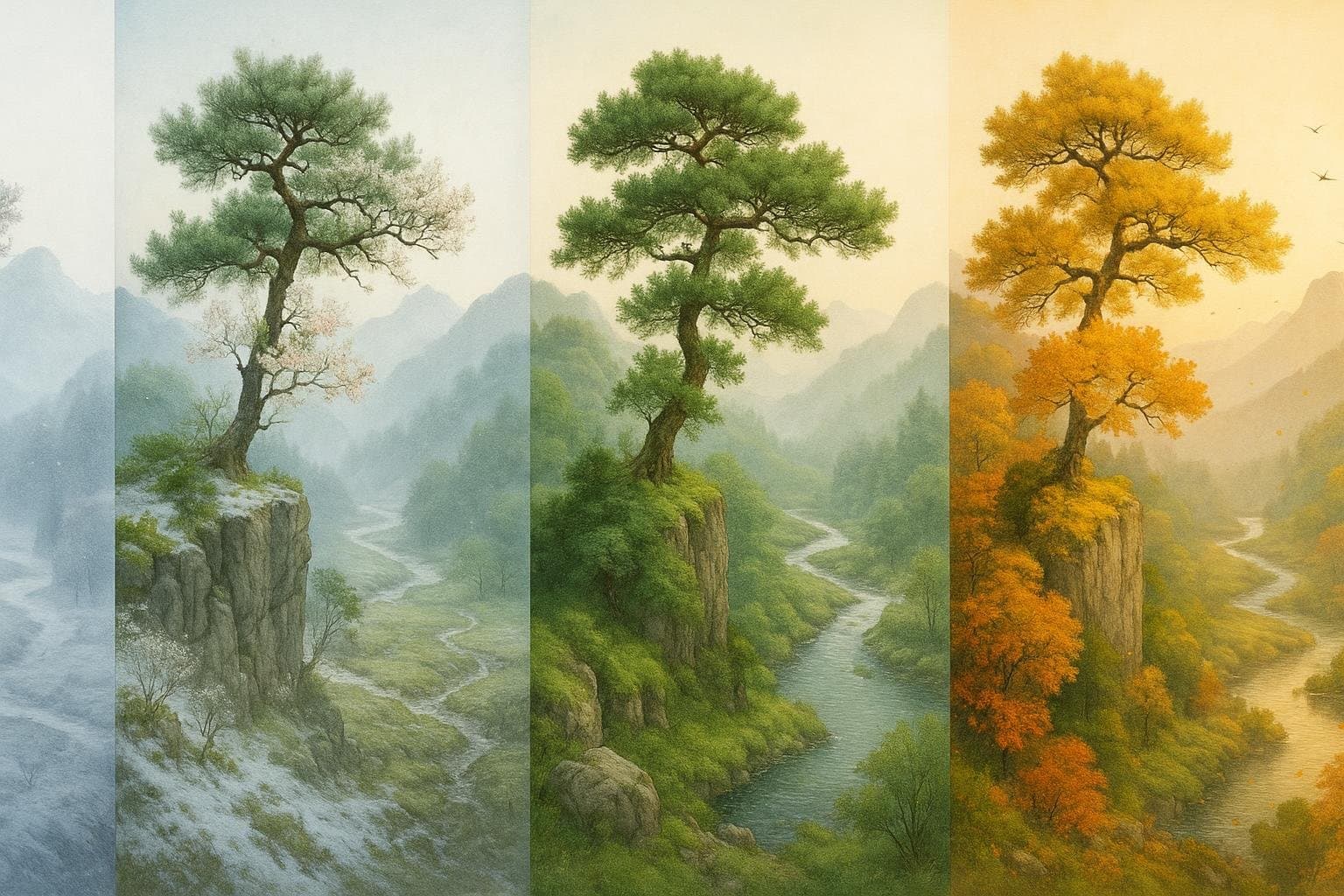
Practice patience as a form of active hope. — Wang Wei
—What lingers after this line?
Reframing Patience as Agency
At first glance, patience sounds passive, yet the injunction to practice it recasts waiting as work. To wait well is to align one’s actions with a horizon that has not arrived, refusing both panic and paralysis. In this light, hope becomes a verb: a disciplined stance that sustains steady effort when outcomes remain uncertain.
Wang Wei’s Chan-Inflected Stillness
Turning to Wang Wei, the Tang poet-painter steeped in Chan (Zen) sensibility, we see how quiet attention becomes generative. His famed poem often rendered as “Deer Enclosure” evokes a living hush: “Empty mountain—no one is seen; yet people’s voices are heard.” The scene suggests that stillness is not emptiness but receptive presence. By holding still, one hears more, and hearing more, one acts more fittingly. Thus patience is neither withdrawal nor delay; it is the clearing in which right action can appear.
Daily Drills for Active Hope
From this perspective, small rituals train the muscle of hopeful patience. Steeping tea without rushing, tending a garden through seasons, or drafting a letter before sending it all embody micro-waits that respect ripening. Moreover, setting a modest, repeatable cadence—thirty focused minutes on a long project each morning—anchors effort to time rather than mood. Through such practices, we transform waiting from idle pause into calibrated readiness.
Psychology of Waiting as a Skill
Modern research likewise frames patience as learnable. Walter Mischel’s The Marshmallow Test (2014) described how children improved delay-of-gratification by reframing temptations and shaping their environment. Later analyses nuanced the story, showing that context and trust matter; nevertheless, strategies like cue management and mental reframing reliably aid persistence. Similarly, Angela Duckworth’s Grit (2016) links sustained effort to long-term goals, suggesting that hope is not mere optimism but tenacity guided by meaning. In effect, patience operationalizes hope across time.
Hope Applied to Collective Change
Extending from the self to society, patience powers movements that outlast news cycles. Joanna Macy and Chris Johnstone’s Active Hope (2012) argues that hope is something we do: we choose our response, strengthen community, and keep showing up. Reforestation efforts, for instance, require years of tending before canopies close; policy advocacy often advances through incremental wins. By pacing action, groups protect morale, prevent burnout, and make room for emergent possibilities.
Artful Timing and the Courage to Wait
Finally, the arts illuminate patience as timing. In ink painting, one waits for washes to settle before adding strokes; in music, silence gives notes their contour. East Asian aesthetics call this fecund gap ma—the meaningful interval that shapes what follows. So too in life: the courageous pause before replying, the overnight rest before deciding, the season of groundwork before launch. Through such artful intervals, patience becomes hope in motion.
One-minute reflection
What does this quote ask you to notice today?
Related Quotes
6 selectedHope is an active hand offered, not a passive wish; reach and be reached — Desmond Tutu
Desmond Tutu
Desmond Tutu’s words recast hope from a hazy feeling into a tangible gesture. Rather than drifting in the realm of ‘maybe someday,’ hope becomes an outstretched hand, a deliberate move toward change.
Read full interpretation →Hope is not a lottery ticket you can sit on the sofa and clutch, feeling lucky. Hope is an ax you break down doors with in an emergency. — Rebecca Solnit
Rebecca Solnit
Rebecca Solnit overturns a familiar habit: treating hope like a lucky ticket we clutch while waiting for fortune. By recasting it as an ax, she turns hope from a passive feeling into an instrument for intervention.
Read full interpretation →Alone in a foreign land, I am a lonely stranger; every time during the festive season, my longing for my loved ones doubles. - Wang Wei
Wang Wei
The quote encapsulates the sense of alienation and loneliness one feels when they are away from their homeland, especially in a foreign environment where they might feel out of place.
Read full interpretation →The first step toward light is choosing to rise. — Wang Wei
Wang Wei
Wang Wei’s statement deftly employs light as a symbol for enlightenment, growth, or hope, while remaining in darkness signifies inertia or despair. By asserting that the journey toward light begins with a choice, he high...
Read full interpretation →“At leisure I hear osmanthus falling; In still night, the spring mountain lies silent.” — Wang Wei
Wang Wei
Wang Wei opens with a paradox: at leisure, he hears osmanthus falling. Petals do not normally make a sound; therefore, the line does not magnify noise so much as heighten quiet.
Read full interpretation →One moment of patience may ward off great disaster. One moment of impatience may ruin a whole life. — Chinese Proverb
Chinese Proverb
This proverb highlights how a brief moment of patience can prevent significant negative outcomes. Exercising patience can avert disasters or avoidable troubles.
Read full interpretation →More From Author
More from Wang Wei →Alone in a foreign land, I am a lonely stranger; every time during the festive season, my longing for my loved ones doubles. - Wang Wei
The quote encapsulates the sense of alienation and loneliness one feels when they are away from their homeland, especially in a foreign environment where they might feel out of place.
Read full interpretation →The first step toward light is choosing to rise. — Wang Wei
Wang Wei’s statement deftly employs light as a symbol for enlightenment, growth, or hope, while remaining in darkness signifies inertia or despair. By asserting that the journey toward light begins with a choice, he high...
Read full interpretation →“At leisure I hear osmanthus falling; In still night, the spring mountain lies silent.” — Wang Wei
Wang Wei opens with a paradox: at leisure, he hears osmanthus falling. Petals do not normally make a sound; therefore, the line does not magnify noise so much as heighten quiet.
Read full interpretation →