
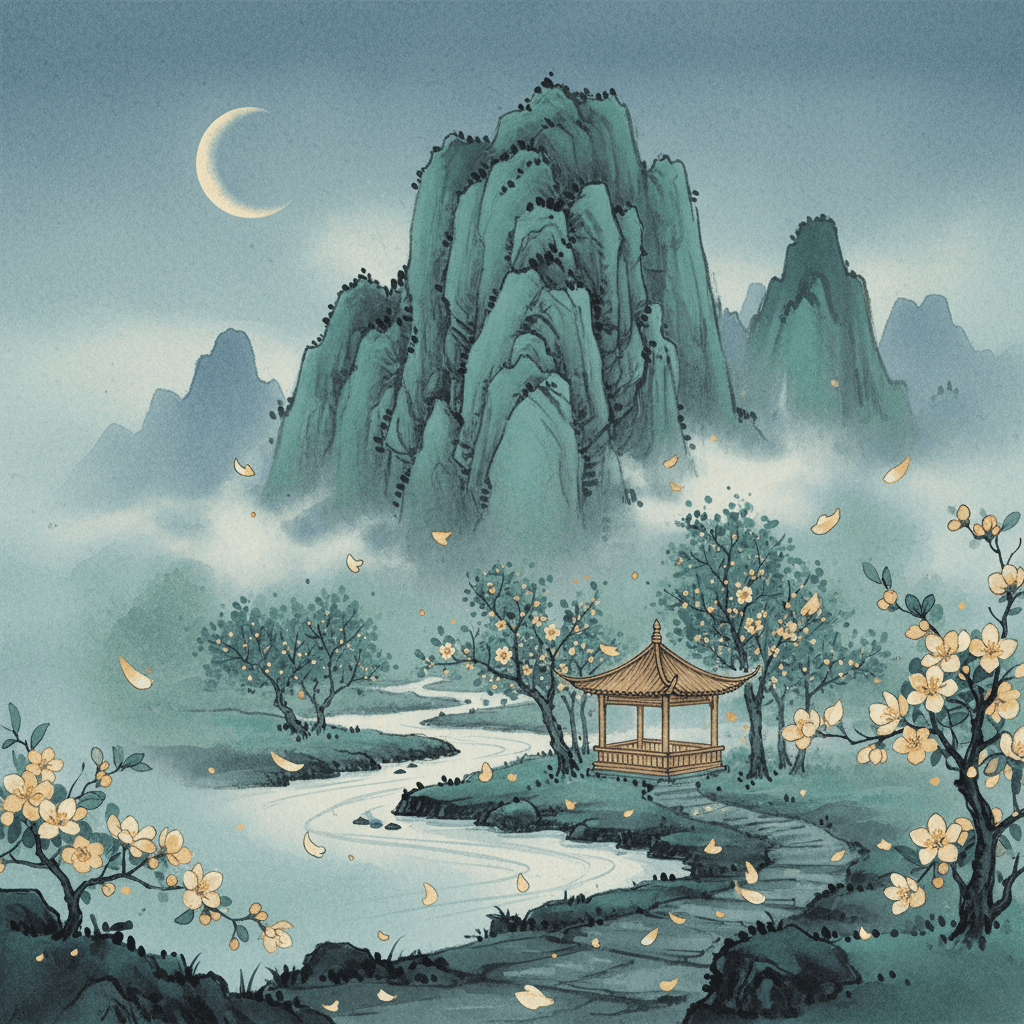
“At leisure I hear osmanthus falling; In still night, the spring mountain lies silent.” — Wang Wei
—What lingers after this line?
Listening to Petals, Hearing Silence
Wang Wei opens with a paradox: at leisure, he hears osmanthus falling. Petals do not normally make a sound; therefore, the line does not magnify noise so much as heighten quiet. The still night and empty spring mountain form a chamber where the barely audible becomes audible, and where attention itself completes the scene. In this way, the poem invites readers to inhabit a perception cleansed of urgency, one in which subtleties register as revelations.
Emptiness and the Chan Gaze
The second line’s emptiness (“the spring mountain lies silent”) pivots toward Chan (Zen) sensibility. In the Heart Sutra’s language, form is emptiness, and emptiness is form; Wang Wei’s verse enacts that reciprocity by letting absence carry meaning. Similarly, his “Deer Enclosure” begins, “Empty mountain: no one in sight—yet human voices are heard,” transforming vacancy into presence. Thus, the quiet is not negation but an active field of awareness that prepares us for the poem’s next, delicate disturbance.
What the Next Lines Reveal
The full poem, “Birds Calling in the Ravine,” continues: “The moon comes out, startling the mountain birds; now and then they cry in the spring ravine.” After establishing stillness, Wang Wei introduces motion and sound in flickers—moonrise, startled wings, occasional calls. Silence is not annulled; it becomes the background that makes each sound luminous. Consequently, the poem models a dynamic poise: tranquility that can host interruption without shattering, like ripples settling back into a clear pool.
Painting with Words, Leaving Blank Space
Wang Wei was also a master painter, and critics long noticed the kinship. Su Shi (c. 1080) praised him: “In savoring Wang Wei’s poems, there is painting in the poetry, and poetry in the painting.” Ink painting relies on reserved white space to suggest mist, distance, and breath. Likewise, these lines frame what is not said—the hush, the cool air, the unpainted slopes—so the few strokes that remain can resonate. Through this economy, atmosphere becomes the main subject.
Leisure as Practice, Not Passivity
The opening word “leisure” signals more than free time; it names a cultivated receptivity. Wang Wei’s Wang River Collection, composed with Pei Di (c. 750s), records a life of semi-reclusion where attention ripens through simplicity. In that tradition, to be idle is to be available—to mountain, moon, and the smallest fall of petals. Thus, the poem suggests an ethics of perception: by refusing hurry, one becomes capable of finer hearing and more merciful seeing.
Season, Scent, and the Question of ‘Gui’
Translators render gui hua as osmanthus, laurel, or cassia; while modern osmanthus blooms in autumn, the poem’s mountain is called spring. Rather than an error, many read this as layered seasonality or as a broader laurel family reference attested in Tang usage. Some versions simply say “flowers fall” to preserve the mood. In any case, the sensory core remains: a flower famed for fragrance is heard, not smelled—folding scent into sound, and season into timeless quiet.
One-minute reflection
What feeling does this quote bring up for you?
Related Quotes
6 selectedAlone in a foreign land, I am a lonely stranger; every time during the festive season, my longing for my loved ones doubles. - Wang Wei
Wang Wei
The quote encapsulates the sense of alienation and loneliness one feels when they are away from their homeland, especially in a foreign environment where they might feel out of place.
Read full interpretation →The first step toward light is choosing to rise. — Wang Wei
Wang Wei
Wang Wei’s statement deftly employs light as a symbol for enlightenment, growth, or hope, while remaining in darkness signifies inertia or despair. By asserting that the journey toward light begins with a choice, he high...
Read full interpretation →Practice patience as a form of active hope. — Wang Wei
Wang Wei
At first glance, patience sounds passive, yet the injunction to practice it recasts waiting as work. To wait well is to align one’s actions with a horizon that has not arrived, refusing both panic and paralysis.
Read full interpretation →From a distance, the mountains have color; up close, the water is silent. Though spring departs, the flowers remain; as people arrive, the birds are unperturbed.
Unknown
This quote highlights how perspective changes our perception of nature. From afar, the mountains appear vibrant and colorful, while up close, the calmness of the water becomes apparent.
Read full interpretation →In spring, one sleeps and does not notice dawn, Everywhere, one hears the songs of birds. Last night came the sound of wind and rain, How many flowers have fallen, one wonders.
Unknown
The poem starts with a sense of peace, depicting spring as a time when people rest so deeply that they do not notice the break of dawn. This highlights the tranquil and soothing nature of the season.
Read full interpretation →“Osmanthus blossoms fall from the moon, And heavenly fragrance drifts beyond the clouds.” — Song Zhiwen
Song Zhiwen
Song Zhiwen’s couplet condenses a cosmos into two gestures: blossoms descend from the moon, and scent slips past the clouds. An early Tang master (c.
Read full interpretation →More From Author
More from Wang Wei →Alone in a foreign land, I am a lonely stranger; every time during the festive season, my longing for my loved ones doubles. - Wang Wei
The quote encapsulates the sense of alienation and loneliness one feels when they are away from their homeland, especially in a foreign environment where they might feel out of place.
Read full interpretation →The first step toward light is choosing to rise. — Wang Wei
Wang Wei’s statement deftly employs light as a symbol for enlightenment, growth, or hope, while remaining in darkness signifies inertia or despair. By asserting that the journey toward light begins with a choice, he high...
Read full interpretation →Practice patience as a form of active hope. — Wang Wei
At first glance, patience sounds passive, yet the injunction to practice it recasts waiting as work. To wait well is to align one’s actions with a horizon that has not arrived, refusing both panic and paralysis.
Read full interpretation →