
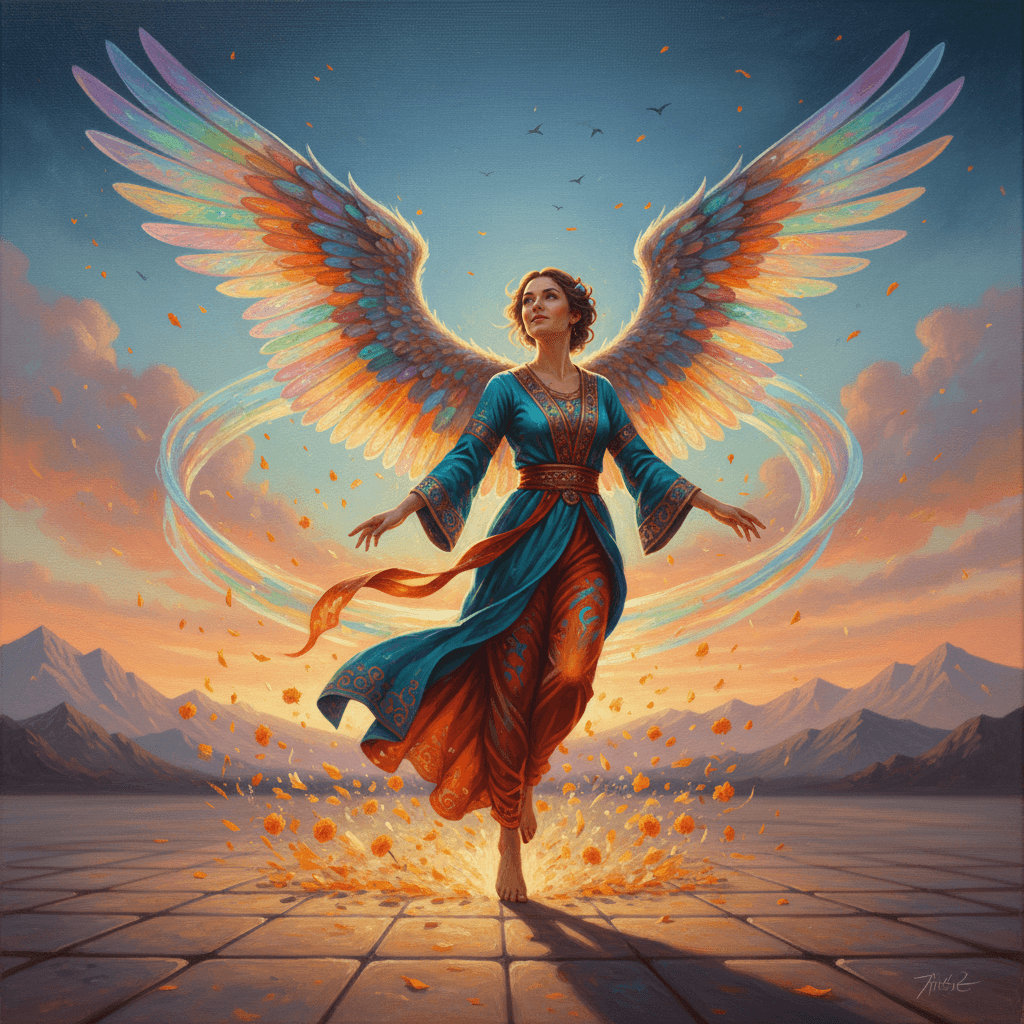
Feet, what do I need them for if I have wings to fly? — Frida Kahlo
—What lingers after this line?
A Vow of Transcendence
Frida Kahlo’s line turns a practical question—why feet?—into a manifesto: if imagination grants flight, the body’s limits need not define the soul’s range. Rather than deny pain, she reframes it, insisting that the mind can choose altitude over gravity. Thus, the metaphor of wings does not erase hardship; it relocates power, suggesting that creative vision can carry a person where legs cannot.
Pain’s Biographical Backdrop
To understand the audacity of this claim, we trace its roots. Kahlo survived polio at six and, at eighteen, a catastrophic 1925 bus collision that left her in recurring surgeries and prolonged immobilization. Decades later, infection led to the amputation of her right leg (1953). In her diary, she wrote, “Pies, ¿para qué los quiero si tengo alas pa’ volar?”—a line many place in that late, devastating period (Frida Kahlo, Diary, c. 1953). The sentence therefore reads as both defiance and tenderness toward herself, a compact of courage made under duress.
Painting as Functional Wings
Crucially, those wings were not abstract. Bedridden, she rigged a mirror to paint her reflection and converted pain into imagery. Works like The Broken Column (1944) render her spine as a shattered Ionic pillar, straps binding a wounded torso, yet eyes fixed forward. The Two Fridas (1939) doubles her identity, suturing private and public selves, while Self-Portrait with Thorn Necklace and Hummingbird (1940) uses a hovering bird as a talisman of life-force. In this way, technique becomes propulsion: the canvas is both runway and sky.
Beyond Surrealism, Toward Lived Reality
Although associated with Surrealists, Kahlo insisted, “I never painted dreams. I painted my own reality” (often attributed to remarks in 1938 when André Breton championed her). The wings, then, are not escapist fantasy but the musculature of self-definition—mestiza heritage, Tehuana dress, indigenous symbols, and intimate bodily truth in concert. By grounding flight in the factual textures of her world, she models autonomy: ascent built not on denial, but on radical honesty.
Disability, Agency, and the Politics of Mobility
Kahlo’s refrain also challenges the trope of ‘overcoming.’ Instead of erasing disability, she redesigns the terms of movement—most visibly in the red, ornamented prosthetic leg preserved at Museo Frida Kahlo, which transformed necessity into adornment. Disability scholar Rosemarie Garland-Thomson’s concept of the “misfit” (Hypatia, 2011) illuminates this move: when bodies and environments clash, one can adjust the world to fit. Kahlo’s art, wardrobe, and self-portraiture do precisely that, crafting social and aesthetic spaces where she moves—flies—on her own terms.
A Usable Blueprint for Resilience
Finally, the quote offers a method. Begin from what hurts, name it, and then convert it into a vehicle for meaning. The move resembles the alchemy of poets like Maya Angelou in Still I Rise (1978), where constraint becomes lift. In practice, wings may be a craft, a community, a cause—anything that reroutes energy from limitation to purpose. Kahlo’s voice reminds us that while not all bodies can run, every imagination can travel, and sometimes the most enduring journeys begin where the road ends.
One-minute reflection
Why might this line matter today, not tomorrow?
Related Quotes
6 selectedShifting the mind into lower gear can bring better health, inner calm, enhanced concentration and the ability to think more creatively. — Carl Honoré
Carl Honoré
Carl Honoré’s insight begins with a simple but countercultural claim: the mind often works better when it stops racing. In a world that rewards speed, multitasking, and constant responsiveness, shifting into a “lower gea...
Read full interpretation →In order to be open to creativity, one must have the capacity for constructive use of solitude. One must overcome the fear of being alone. — Rollo May
Rollo May
Rollo May’s insight begins with a quiet but demanding premise: creativity requires the ability to stand apart from constant noise, approval, and distraction. To be open to new ideas, a person must first become comfortabl...
Read full interpretation →The moment a man begins to talk about technique, that's proof that he is fresh out of ideas. — Dylan Thomas
Dylan Thomas
Dylan Thomas’s remark begins with a sharp suspicion: when an artist talks too much about technique, the living impulse behind the work may already be gone. Technique, in this sense, becomes a substitute language, a way o...
Read full interpretation →Imperfection inspires invention, imagination, and creativity. — Mary Sharratt
Mary Sharratt
Mary Sharratt’s insight begins with a reversal of ordinary expectations: imperfection is not merely something to fix, but something that awakens possibility. When a plan fails, a surface cracks, or an idea refuses to fit...
Read full interpretation →Don't think. Thinking is the enemy of creativity. It's self-conscious, and anything self-conscious is lousy. — Ray Bradbury
Ray Bradbury
At first glance, Ray Bradbury’s line sounds almost rebellious: “Don’t think. Thinking is the enemy of creativity.” Yet his target is not intelligence itself, but the paralyzing kind of self-awareness that makes an artist...
Read full interpretation →You can be cautious or you can be creative, but there's no such thing as a cautious creative. — George Lois
George Lois
George Lois draws a sharp line between two mindsets: caution protects what already exists, while creativity risks making something new. At first glance, the statement sounds absolute, yet that severity is exactly its poi...
Read full interpretation →More From Author
More from Frida Kahlo →I paint flowers so they will not die. — Frida Kahlo
Frida Kahlo’s line reads like a gentle spell: by painting flowers, she resists the most ordinary tragedy—things fading despite our care. A bouquet wilts, a season ends, a beloved moment slips away; the canvas, however, o...
Read full interpretation →I tried to drown my sorrows, but the bastards learned how to swim. — Frida Kahlo
Frida Kahlo’s line opens with the familiar promise of escape—“I tried to drown my sorrows”—and then snaps into a punchline that refuses sentimentality. The sudden insult, “the bastards,” is more than comic shock; it’s a...
Read full interpretation →I used to think I was the strangest person in the world, but there must be someone just like me who feels bizarre and flawed. — Frida Kahlo
Frida Kahlo’s reflection begins in a familiar loneliness: the belief that one’s inner life is uniquely strange, even irredeemably flawed. That kind of self-story can make ordinary differences feel like permanent exile.
Read full interpretation →Embrace risk as the price of progress; comfort keeps the clock of your life frozen. — Frida Kahlo
Frida Kahlo’s line frames progress as a purchase: you pay for it with risk. In that sense, “embrace” is not a motivational flourish but an instruction to stop treating uncertainty as an error and start treating it as a t...
Read full interpretation →