
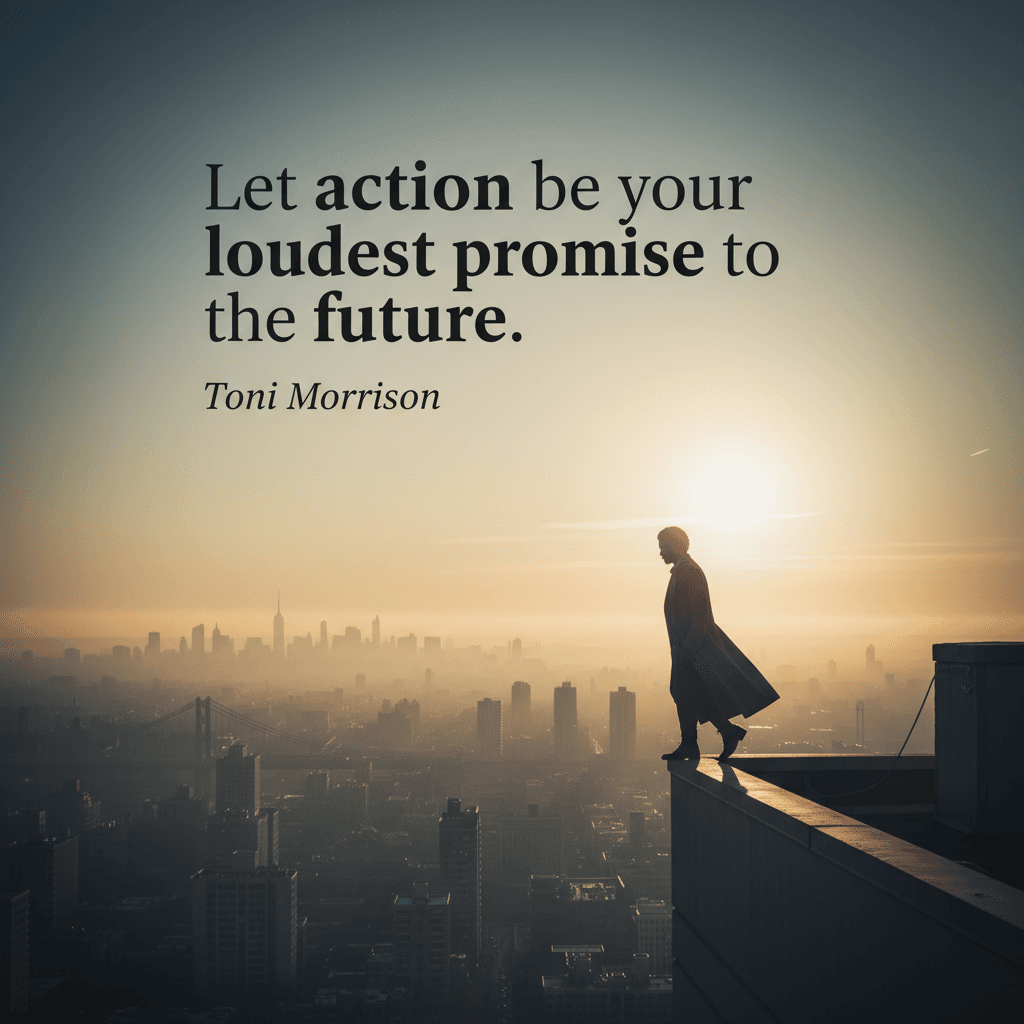
Let action be your loudest promise to the future. — Toni Morrison
—What lingers after this line?
From Intention to Tangible Commitment
Morrison’s line urges a recalibration of integrity: make behavior, not declarations, the bond you strike with tomorrow. In this view, action is not the proof after the promise; it is the promise itself. Her fiction often dramatizes how choices reverberate across generations; for instance, Beloved (1987) shows how a mother’s desperate act reshapes a family’s fate, signaling that futures are authored by what we do, not what we intend. Thus, the future hears footsteps, not forecasts—a point that prepares us to consider how this principle has played out beyond literature.
History Favors Deeds Over Declarations
This preference for deeds has decisive precedents in democratic movements. The Greensboro sit-ins (1960) turned constitutional ideals into visible practice; the Freedom Rides tested federal resolve; and the March on Washington (1963) transformed moral urgency into national attention. These acts gained legislative expression in the Civil Rights Act (1964). As John Lewis recounts in Walking with the Wind (1998), risk-bearing action created leverage that speeches alone could not. Moving from public squares to personal lives, the same logic governs credibility: our claims become compelling only when our conduct bears their weight.
The Psychology of Credibility
Social psychology explains why. Signaling theory holds that costly or effortful actions convey sincerity more reliably than words. Likewise, Robert Cialdini’s Influence (1984) notes that people infer commitment from consistent behavior, not aspiration. Complementing this, Peter Gollwitzer (1999) shows that forming “if-then” implementation intentions markedly increases follow-through, converting vague goals into executable moves. Taken together, these findings affirm Morrison’s intuition: trust accrues to those whose routines, not their rhetoric, forecast their tomorrow. Consequently, aligning your daily acts with your stated horizon becomes the practical grammar of promise.
Turning Promises Into Plans
Translating insight into habit requires structure. Begin by specifying the cue and the conduct—“If it is 7:00 a.m., I write the grant application,” or “When my paycheck clears, I auto-transfer 5% to the mutual-aid fund.” Such cue-linked commitments reduce friction and make fidelity measurable, converting hope into a schedule. Moreover, time-bounded milestones and visible checkpoints invite accountability partners to witness—not your pledge—but your pattern. In this way, aspiration is progressively embodied, and the future you intend becomes legible in today’s calendar.
Scaling Deeds to Public Policy
What holds for individuals also governs institutions: budgets and statutes are promises enacted. The UK Climate Change Act (2008) operationalized ambition through binding carbon budgets, turning climate concern into scheduled reductions. Similarly, the Paris Agreement (2015) converted global pledges into nationally determined contributions, inviting transparent reporting and iterative ratcheting. Because policies materialize priorities, they allow citizens to compare declared values with enacted trajectories. Thus, just as personal routines make character credible, public instruments make collective intention real.
Iteration, Accountability, and Repair
Action will misfire; keeping the promise means correcting course in public. Feedback loops—progress reports, independent audits, and candid retrospectives—translate mistakes into momentum. The South African Truth and Reconciliation Commission (1996) embodied this ethic: testimony, restitution, and conditional amnesty constituted visible repair rather than rhetorical regret. Likewise, in everyday work, small postmortems and next-step commitments ensure that failure becomes a forward step. In effect, accountability is the maintenance plan for promises made in motion.
Legacy and the Ethics of Tomorrow
Ultimately, Morrison’s imperative is ethical before it is strategic: act so the future can trust you. Hans Jonas’s The Imperative of Responsibility (1979) argues we must evaluate deeds by their long-range effects on human and planetary life, a view that resonates with the Haudenosaunee principle of considering the seventh generation. Planting trees you may never sit beneath becomes both a metaphor and a mandate. In closing, the surest pledge is the one you perform: let your deeds be the loudest promise the future hears.
One-minute reflection
What feeling does this quote bring up for you?
Related Quotes
6 selectedCourage is the daily practice of showing up for what matters. — Toni Morrison
Toni Morrison
Toni Morrison’s line shifts courage away from grand, cinematic heroics and into the realm of repetition. Rather than a single decisive moment, courage becomes something you rehearse—like a craft—through ordinary choices...
Read full interpretation →Commitment leads to action. Action brings your dream closer. — Marcia Wieder
Marcia Wieder
This quote highlights that commitment is the first essential step in achieving one's dreams. Without dedication, it is difficult to take meaningful action toward goals.
Read full interpretation →To act is to be committed, and to be committed is to be in love. — Jean-Paul Sartre
Paul Sartre
Sartre emphasizes that true action requires commitment. One cannot engage meaningfully in anything without dedicating themselves fully to it.
Read full interpretation →The way to do a great deal is to keep on doing a little. The way to do nothing at all is to be continually resolving that you will do everything. — C.H. Spurgeon
C.H. Spurgeon
Spurgeon’s statement begins with a practical paradox: great accomplishments are rarely born from dramatic bursts of effort, but from the steady repetition of small acts. By saying that “a great deal” is done by “doing a...
Read full interpretation →No matter how full a reservoir of maxims one may possess, if one has not taken advantage of every concrete opportunity to act, one's character may remain entirely unaffected. — William James
William James
At first glance, William James draws a sharp line between knowing and becoming. A person may store up countless moral sayings, noble principles, and wise resolutions, yet these remain largely ornamental if they never pas...
Read full interpretation →A garden is not made by singing 'Oh, how beautiful,' and sitting in the shade. — Rudyard Kipling
Rudyard Kipling
Kipling’s line immediately cuts through passive appreciation. Simply admiring a garden, however sincerely, does nothing to plant seeds, pull weeds, or carry water.
Read full interpretation →More From Author
More from Toni Morrison →The building of the architecture of a novel - the craft of it - is something I never tire of. — Toni Morrison
At its core, Toni Morrison’s remark celebrates not merely storytelling, but the deliberate construction behind it. By speaking of the “architecture of a novel,” she shifts attention from inspiration alone to design, sugg...
Read full interpretation →The role of art has never been to escape reality, but to help us understand it. — Toni Morrison
At first glance, art is often treated as a refuge from hardship, a private world where pain can be softened or forgotten. Toni Morrison overturns that expectation by arguing that art’s deeper purpose is not avoidance but...
Read full interpretation →The ability to endure is the discipline of the soul. — Toni Morrison
Toni Morrison’s line shifts endurance from a mere survival trait into a deliberate inner practice: a discipline cultivated in the soul. Rather than glorifying pain for its own sake, she suggests that the capacity to cont...
Read full interpretation →You are your best thing. — Toni Morrison
Toni Morrison’s line, “You are your best thing,” quietly overturns a common habit: looking outward for proof of worth. Instead of treating love, status, or achievement as the final measure, the quote plants value inside...
Read full interpretation →