
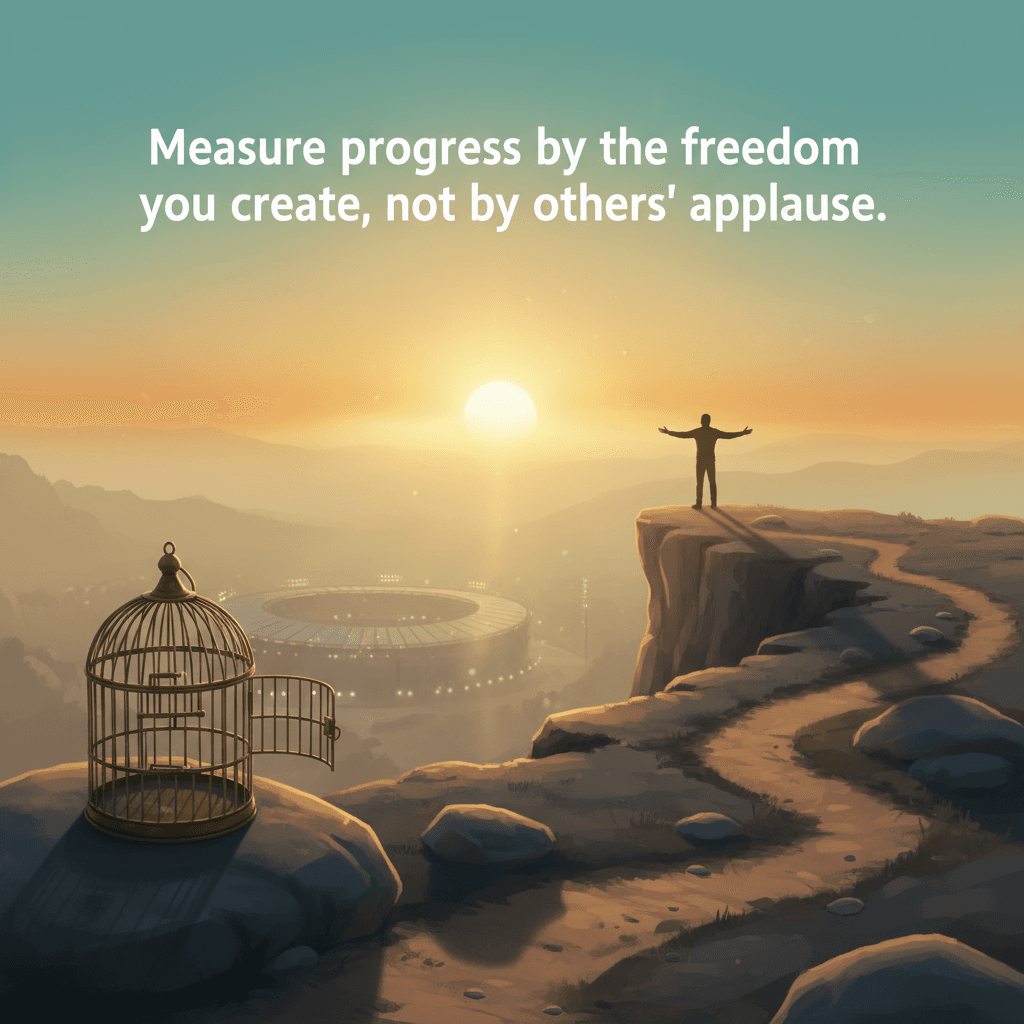
Measure progress by the freedom you create, not by others' applause. — Amartya Sen
—What lingers after this line?
Reframing Progress Through Capabilities
Amartya Sen’s challenge redirects our gaze from spectators to substantive change. Rather than tallying praise, he urges us to ask: do people have real opportunities to live the lives they value? This is the core of the capability approach, which Sen popularized in Development as Freedom (1999). Freedom here is not merely the absence of constraint; it is the presence of capability—health, education, mobility, voice, and security—that enables choice. Martha Nussbaum’s Creating Capabilities (2011) complements this view by outlining central human capabilities societies should secure. Thus, progress becomes less about optics and more about the expansion of lives people can actually lead.
The Seduction and Limits of Applause
However, applause is a noisy signal. It often measures charisma, conformity, or momentary spectacle, not durable improvements in agency. Goodhart’s Law—coined by economist Charles Goodhart (1975)—warns that when a measure becomes a target, it ceases to be a good measure. Praise can be gamed through vanity metrics, curated narratives, or coercive displays, creating an illusion of success. By contrast, freedom is harder to fake: if individuals can exit bad options, refuse unfair terms, or choose from multiple viable paths, then something genuine has improved, regardless of the crowd’s ovation.
Historical Lessons on Spectacle and Substance
History bears this out. Authoritarian regimes have staged mass adulation—from the Nuremberg rallies of the 1930s to contemporary personality cults—while shrinking civil and personal liberties. Public acclamation rose as freedoms collapsed. Conversely, freedom-expanding reforms often arrived before applause caught up. The extension of women’s suffrage—New Zealand (1893), the United States (1920), and beyond—frequently confronted derision before becoming civic common sense. These episodes reveal a pattern: applause can precede, lag, or diverge from genuine progress, whereas the yardstick of expanded capability remains constant.
From GDP to Freedom-Centered Metrics
Consequently, measurement must shift from outputs to options. Sen’s critique of GDP-only assessments inspired composite measures like the UNDP’s Human Development Index (1990 onward), which tracks health, education, and income. The Oxford Poverty and Human Development Initiative’s Multidimensional Poverty Index (Alkire & Foster, 2011) further disaggregates deprivations across schooling, nutrition, housing, and more. Meanwhile, indices such as Freedom House’s annual reports and the World Justice Project’s Rule of Law Index gauge civil liberties and institutional constraints. Together, these tools pivot evaluation toward what people are free and able to do.
Policies That Expand Choice and Agency
In practice, progress accelerates when interventions increase people’s range of feasible options. Randomized evaluations synthesized by J-PAL and studies like Banerjee and Duflo’s Poor Economics (2011) show that well-designed programs—conditional cash transfers (e.g., Mexico’s Progresa/Oportunidades), targeted health subsidies, or direct cash—can raise schooling, health, and financial resilience. The common thread is agency: cash or services that reduce binding constraints often outperform tightly scripted aid that presumes one “correct” path. By designing for choice rather than compliance, policy aligns with Sen’s freedom-first yardstick.
Organizational Metrics Beyond Vanity
At the organizational level, applause appears as downloads, likes, or press hits. A freedom-centered scorecard asks different questions: how many users can complete core tasks without assistance? How easily can they export their data, switch providers, or set meaningful defaults? What fraction of employees have flexible schedules, clear grievance channels, and equitable promotion pathways? Such metrics track reversibility, portability, and autonomy—signals that people are less trapped and more empowered. They are harder to inflate, yet far more predictive of durable impact.
A Personal Compass for Daily Work
Ultimately, Sen’s dictum scales down to the individual. Instead of seeking plaudits, assess whether your actions widen someone’s horizon—through clearer information, fewer arbitrary steps, or options that respect different needs. As with Berlin’s distinction between negative and positive liberty in Two Concepts of Liberty (1958), the aim is both to remove unjust barriers and to build enabling conditions. When dilemmas arise, choose the path that increases another person’s real options. Applause may follow—or not—but freedom created is progress either way.
One-minute reflection
What's one small action this suggests?
Related Quotes
6 selectedMeasure progress by the lives you move, not by the applause you collect. — Amartya Sen
Amartya Sen
Amartya Sen’s line asks us to swap a noisy yardstick for a humane one: instead of treating public approval as proof of achievement, we should look for tangible improvements in other people’s lives. In this view, standing...
Read full interpretation →Your home should lower your shoulders the moment you walk in. — Unknown (attributed to design philosophy/experts, but skipping as per rules: switching to:) The boundary to what we can accept is the boundary to our freedom. — Tara Brach
Tara Brach
At first glance, Tara Brach’s statement sounds simple, yet it points to a profound inner mechanism: the limits of our freedom are often set not only by external conditions, but by what we refuse to face within ourselves....
Read full interpretation →The boundary to what we can accept is the boundary to our freedom. — Tara Brach
Tara Brach
At first glance, Tara Brach’s statement suggests that freedom is not only shaped by external circumstances but also by our inner willingness to face reality. What we cannot accept—whether grief, uncertainty, fear, or imp...
Read full interpretation →True freedom is found in the discipline to choose what you want most over what you want in this fleeting moment. — Arden Mahlberg
Arden Mahlberg
At first glance, freedom is often imagined as the ability to do whatever one wants at any given moment. Arden Mahlberg’s statement gently overturns that assumption by suggesting that real freedom is not impulsive indulge...
Read full interpretation →Freedom is knowing what is yours to influence. — Zeno of Citium
Zeno of Citium
At its heart, Zeno’s statement defines freedom not as unlimited power, but as clear discernment. The founder of Stoicism, writing in the early 3rd century BC, argued that human beings suffer when they confuse what belong...
Read full interpretation →The things you own end up owning you. It is only after you lose everything that you're free to do anything. — Chuck Palahniuk
Chuck Palahniuk
At first glance, Palahniuk’s line appears to criticize materialism, yet it goes further by describing a reversal of power. We believe we possess objects, but gradually those objects begin to dictate our time, anxiety, an...
Read full interpretation →More From Author
More from Amartya Sen →Measure progress by the lives you move, not by the applause you collect. — Amartya Sen
Amartya Sen’s line asks us to swap a noisy yardstick for a humane one: instead of treating public approval as proof of achievement, we should look for tangible improvements in other people’s lives. In this view, standing...
Read full interpretation →Solve with empathy; policy shaped by people understands problems more clearly. — Amartya Sen
Amartya Sen’s line invites a shift from empathy as a feeling to empathy as a method. Rather than prescribing compassion as charity, it treats understanding lived experience as a rigorous input to problem definition.
Read full interpretation →Take action not because you know you can, but because you know you must. — Amartya Sen
This quote emphasizes the importance of moral obligation over mere capability. It suggests that sometimes we must act not simply because we have the ability, but because it is our duty to do so.
Read full interpretation →Carry your culture forward by shaping it with kindness and reason. — Amartya Sen
To begin, Sen’s injunction recasts culture as practice rather than relic. In Identity and Violence (2006), he warns against “solitarist” identities that freeze people into one label; instead, culture moves when citizens...
Read full interpretation →