
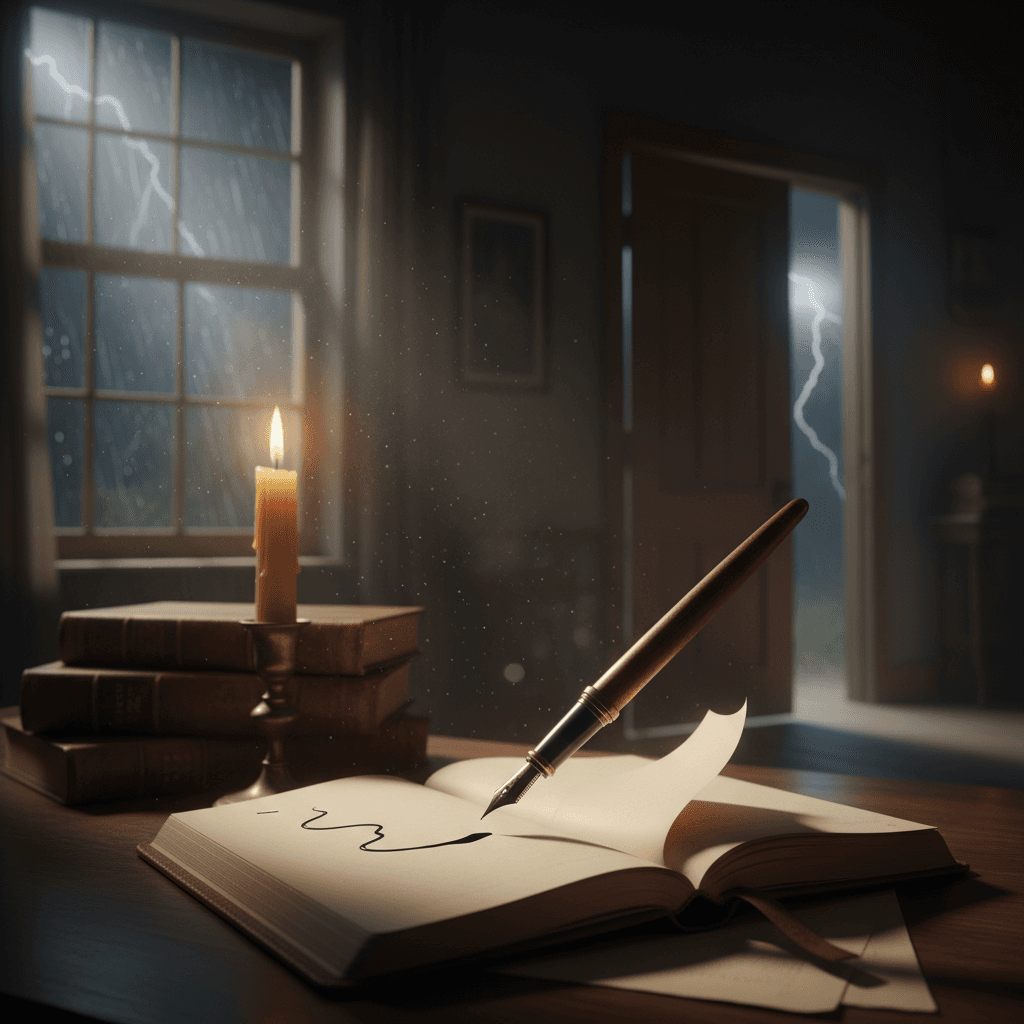
Write the sentence that scares you; it might free the next page. — Virginia Woolf
—What lingers after this line?
Fear as Compass, Not Wall
At the outset, Woolf’s injunction reframes fear as a directional signal rather than a stop sign. The sentence that scares you is usually the one closest to a difficult truth—about desire, grief, power, or shame. Naming it is not merely cathartic; it sets stakes and clarifies the narrative’s necessity. Thus, fear points to the sentence that matters most. Because truth exerts momentum, committing that sentence to the page often releases what was stuck behind it. Once the core risk is taken, subsequent lines can align around its gravity, and the next page becomes writable. In this sense, courage is not ornamental; it is mechanical, converting pressure into flow.
Woolf’s Risks and Formal Freedom
In Woolf’s own practice, what frightened her also opened literature’s doors. Mrs Dalloway (1925) threads party chatter with shell shock and suicide; To the Lighthouse (1927) suspends plot for the interior weather of time; The Waves (1931) dissolves character into chorus. These moves were risky, yet they made space for new forms to breathe. Her essays explain the cost of such bravery. In “Professions for Women” (1931), Woolf describes killing the domesticated ‘Angel in the House’ to write without pleasing or pleasingly lying. And in A Room of One’s Own (1929) and A Writer’s Diary (1953), she confesses both ambition and dread. The fear she faced did not vanish; rather, speaking through it created the freedom she sought.
The Psychology of Opening the Gate
Psychology reinforces this intuition. Expressive writing research shows that articulating feared or taboo material reduces physiological stress and clarifies cognition. James W. Pennebaker’s early studies (1986) and Opening Up (1997) found that short sessions of honest writing improved health markers and narrative coherence. The act of naming reorganizes experience. Neuroscience offers a metaphor: when the amygdala’s alarm is acknowledged rather than avoided, the prefrontal cortex can reappraise and integrate. In practice, rendering the scary sentence converts raw affect into structured meaning. Consequently, the writer’s inhibitions lower, and attention can move forward—onto the next page that was waiting to be unblocked.
One Risky Line as a Lever
Accordingly, craft advice often centers on a single unguarded line that pries the draft open. Anne Lamott’s Bird by Bird (1994) advocates ‘shitty first drafts’ that permit truth before polish; Julia Cameron’s The Artist’s Way (1992) promotes ‘morning pages’ to bypass the inner censor. Woolf’s counsel aligns with both: let fear identify the one sentence worth writing now. Once written, that line becomes a lever. It sets voice, stakes, and direction, inviting concrete scenes and specific choices. Rather than waiting for confidence, the writer manufactures it through action; momentum, not certainty, carries the work into its next movement.
The Ethics of Saying the Unsayable
Beyond craft lies an ethical charge: the sentence you fear may be the sentence a reader needs. Audre Lorde’s “The Transformation of Silence into Language and Action” (1977) argues that withholding truth magnifies danger, while speaking it redistributes power. Likewise, memoirs that name harm can shift public discourse—consider the cultural ripples of survivor narratives like Chanel Miller’s Know My Name (2019). Thus, to ‘free the next page’ is also to free a future reader. When a writer puts the unsayable into words, they create a linguistic path others can walk, modeling how private pain can become public knowledge—and, sometimes, collective change.
Shaping Risk Through Revision
Finally, fear’s first articulation is not the final form. Drafting exposes the nerve; revision dresses it in clarity and rhythm. Sir Arthur Quiller-Couch’s advice to ‘murder your darlings’ (On the Art of Writing, 1914) and Zadie Smith’s two-draft method in “That Crafty Feeling” (2008) both emphasize craft as patient reshaping. In this arc, courage initiates and technique sustains. The scary sentence opens the door; structure, pacing, and image make the room inhabitable. By alternating daring with refinement, writers convert raw honesty into literature—and the next page, once locked, swings wide.
One-minute reflection
Why might this line matter today, not tomorrow?
Related Quotes
6 selectedWe are not here to fit into a mold, but to break the ones that keep our most honest work hidden. — Virginia Woolf
Virginia Woolf
At its core, Virginia Woolf’s statement rejects the quiet pressure to adapt ourselves to preexisting expectations. To “fit into a mold” suggests becoming legible, acceptable, and predictable at the cost of what is most i...
Read full interpretation →Be courageous and try to write in a way that scares you a little. — Hollyn Smith
Hollyn Smith
This quote encourages writers to push the boundaries of their comfort zones. By writing in a way that scares them, they confront their own vulnerabilities and fears, which can lead to more authentic and meaningful work.
Read full interpretation →No man has the right to dictate what other men should perceive, create or produce, but all should be encouraged to reveal themselves. — Ansel Adams
Ansel Adams
At its core, Ansel Adams’s statement rejects artistic authoritarianism. He insists that no individual has the moral authority to prescribe what others must see, make, or express.
Read full interpretation →You do not need anybody's permission to live a creative life. — Elizabeth Gilbert
Elizabeth Gilbert
Elizabeth Gilbert’s statement begins by shifting creativity from something granted to something inherent. Instead of treating art as a special status bestowed by gatekeepers—teachers, critics, institutions—she frames it...
Read full interpretation →Chase your dreams like the wind chasing the leaves; let your spirit dance freely and boldly, for the world is your stage. — Unknown, Global.
Unknown, Global.
This quote encourages individuals to pursue their dreams with the same relentless energy and enthusiasm as the wind that chases leaves, emphasizing the importance of being proactive in the pursuit of one’s aspirations.
Read full interpretation →Everything that is great and inspiring is created by the individual who can labor in freedom. — Albert Einstein
Albert Einstein
This quote highlights the importance of personal freedom for creativity and innovation. When individuals have the liberty to think and act independently, they are more likely to create something remarkable and inspiring.
Read full interpretation →More From Author
More from Virginia Woolf →We are not here to fit into a mold, but to break the ones that keep our most honest work hidden. — Virginia Woolf
At its core, Virginia Woolf’s statement rejects the quiet pressure to adapt ourselves to preexisting expectations. To “fit into a mold” suggests becoming legible, acceptable, and predictable at the cost of what is most i...
Read full interpretation →There is a kind of victory in good sense about not wanting to be everything at once. — Virginia Woolf
Virginia Woolf’s line turns an apparent restraint into a form of triumph. Rather than treating ambition without boundaries as admirable, she suggests that good sense lies in refusing the exhausting wish to be everything...
Read full interpretation →The artist is a sort of emotional archivist, recording the truth of a moment before it slips away into the digital noise. — Virginia Woolf
At its core, the quote imagines the artist as someone who rescues experience from disappearance. A feeling, a gesture, or a passing atmosphere can fade almost as soon as it arrives; therefore, the artist’s work becomes a...
Read full interpretation →Clarity is the counterbalance of complexity. - Virginia Woolf
Virginia Woolf’s remark frames thought and expression as a delicate balance rather than a simple choice. Complexity is often unavoidable because reality is layered, contradictory, and difficult to reduce; yet without cla...
Read full interpretation →