
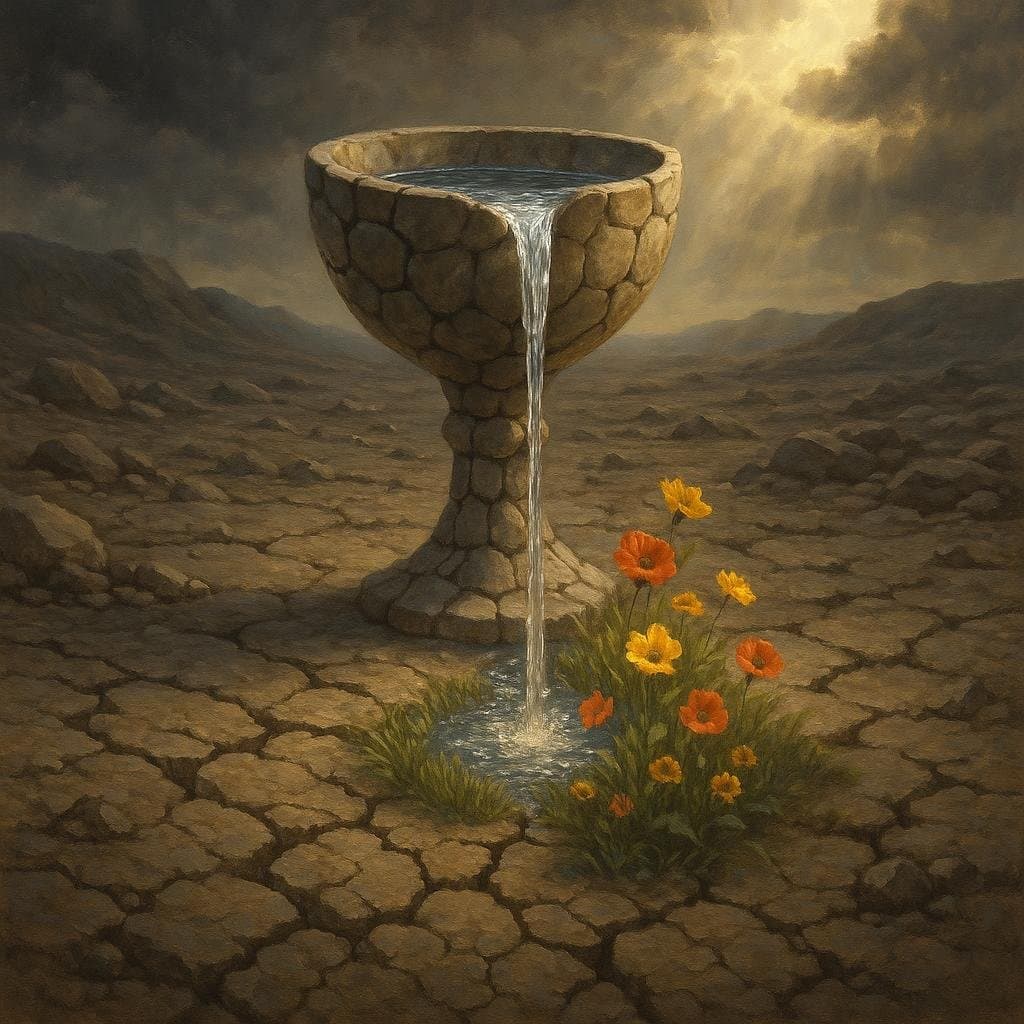
To taste the essence of joy, you must drink from the cup of your own suffering. — Khalil Gibran
—What lingers after this line?
The Interdependence of Suffering and Joy
Khalil Gibran’s evocative metaphor suggests that authentic joy cannot exist without the contrasting experience of suffering. Much like the interplay of shadow and light brings depth to a painting, our personal hardships give meaning to happiness. Gibran’s work, especially in 'The Prophet' (1923), often dwells on this idea that suffering and joy are two sides of the same emotional coin, inseparable and mutually defining.
Philosophical Roots of Emotional Duality
Expanding on Gibran’s insight, philosophers from the Stoic tradition, such as Seneca, have long posited that only by confronting adversity do we appreciate pleasure. This belief echoes in Eastern philosophies as well; for instance, the Buddhist teaching of the Four Noble Truths asserts that recognizing suffering is the first step toward liberation and happiness. Thus, Gibran’s wisdom taps into a universal truth about the human condition.
Personal Transformation Through Pain
Transitioning from philosophy to lived experience, countless individuals recount how periods of pain have deepened their capacity for joy. For example, Viktor Frankl, in his memoir 'Man’s Search for Meaning' (1946), describes finding moments of profound happiness even amidst the horrors of a concentration camp, advocating that meaning and joy are often distilled through suffering. Such narratives reinforce the transformative power embedded within hardship.
Artistic Expression and Emotional Resonance
The arts, too, illustrate this dynamic interplay. Poets, musicians, and painters frequently channel their suffering into works that resonate with audiences, offering catharsis and connection. Gibran himself wrote with a lyrical sensitivity shaped by personal loss and displacement, transforming anguish into beauty. This alchemy allows both creator and audience to savor joy more intensely, precisely because it emerges from pain.
Embracing Suffering to Enrich Life
Ultimately, embracing one’s suffering, rather than resisting or denying it, can foster resilience and a deeper appreciation for life’s pleasures. By 'drinking from the cup of your own suffering,' to borrow Gibran’s words, individuals cultivate empathy, gratitude, and a richer sense of fulfillment. In this way, hardship is not merely endured but becomes the vessel through which the essence of joy is tasted most deeply.
One-minute reflection
Why might this line matter today, not tomorrow?
Related Quotes
6 selectedSecret of joy is the mastery of pain. — Khalil Gibran
Kahlil Gibran
Khalil Gibran’s insight points to a timeless truth: joy is often born from our ability to endure and rise above suffering. Rather than existing as separate experiences, pain and happiness are deeply connected.
Read full interpretation →When you give from the depth of your own joy, you set others free to do the same. — Kahlil Gibran
Kahlil Gibran
At first glance, Gibran’s line suggests that real generosity is not depletion but overflow. In The Prophet (1923), he writes that we truly give when we give of ourselves, implying that joy is the wellspring rather than t...
Read full interpretation →We need joy as we need air. We need love as we need water. We need each other as we need the earth we share. — Maya Angelou
Maya Angelou
Maya Angelou’s words turn emotional needs into elemental ones, placing joy beside air, love beside water, and human connection beside the earth itself. By doing so, she refuses to treat happiness, affection, and communit...
Read full interpretation →When you learn how to suffer, you suffer far less. Resilience is not about avoiding the fire; it is about becoming fireproof. — Thich Nhat Hanh
Thich Nhat Hanh
At first glance, Thich Nhat Hanh’s quote appears paradoxical: how could learning to suffer make suffering lighter? Yet his point is that pain intensifies when we resist it, fear it, or treat it as a personal failure.
Read full interpretation →When we resist change, it's called suffering. But when we can completely let go and not struggle against it, that's called enlightenment. — Pema Chödrön
Pema Chödrön
Pema Chödrön’s quote begins with a stark insight: suffering often arises not simply from pain or loss, but from our refusal to accept that life is constantly shifting. We want relationships, identities, and circumstances...
Read full interpretation →Do not envy those who are free of suffering... because they have nothing that needs cultivation. — C.G. Jung
C.G. Jung
At first glance, Jung’s statement sounds severe, even paradoxical: why should anyone avoid envying a life without suffering? Yet his point is not that pain is good in itself, but that difficulty often exposes the parts o...
Read full interpretation →More From Author
More from Kahlil Gibran →Your home is your larger body. It grows in the sun and sleeps in the stillness of the night. — Kahlil Gibran
At first glance, Gibran transforms the idea of home from a mere structure into something intimate and organic: “your larger body.” In this image, a dwelling is not separate from the person who inhabits it, but an outward...
Read full interpretation →March on. Do not tarry. To go forward is to move toward perfection. — Kahlil Gibran
Gibran’s opening imperative—“March on. Do not tarry.”—sets a tone of disciplined urgency.
Read full interpretation →There must be spaces in your togetherness, and let the winds of the heavens dance between you. — Kahlil Gibran
Gibran’s line opens with a gentle paradox: he speaks to people who are already “together,” yet insists that togetherness is healthiest when it includes room. Rather than portraying love as fusion, he frames it as a relat...
Read full interpretation →Our anxiety does not come from thinking about the future, but from wanting to control it. — Kahlil Gibran
Kahlil Gibran reframes anxiety as something more specific than mere anticipation. The future itself—uncertain, unfolding, and not yet real—doesn’t automatically distress us; rather, distress appears when we demand certai...
Read full interpretation →