
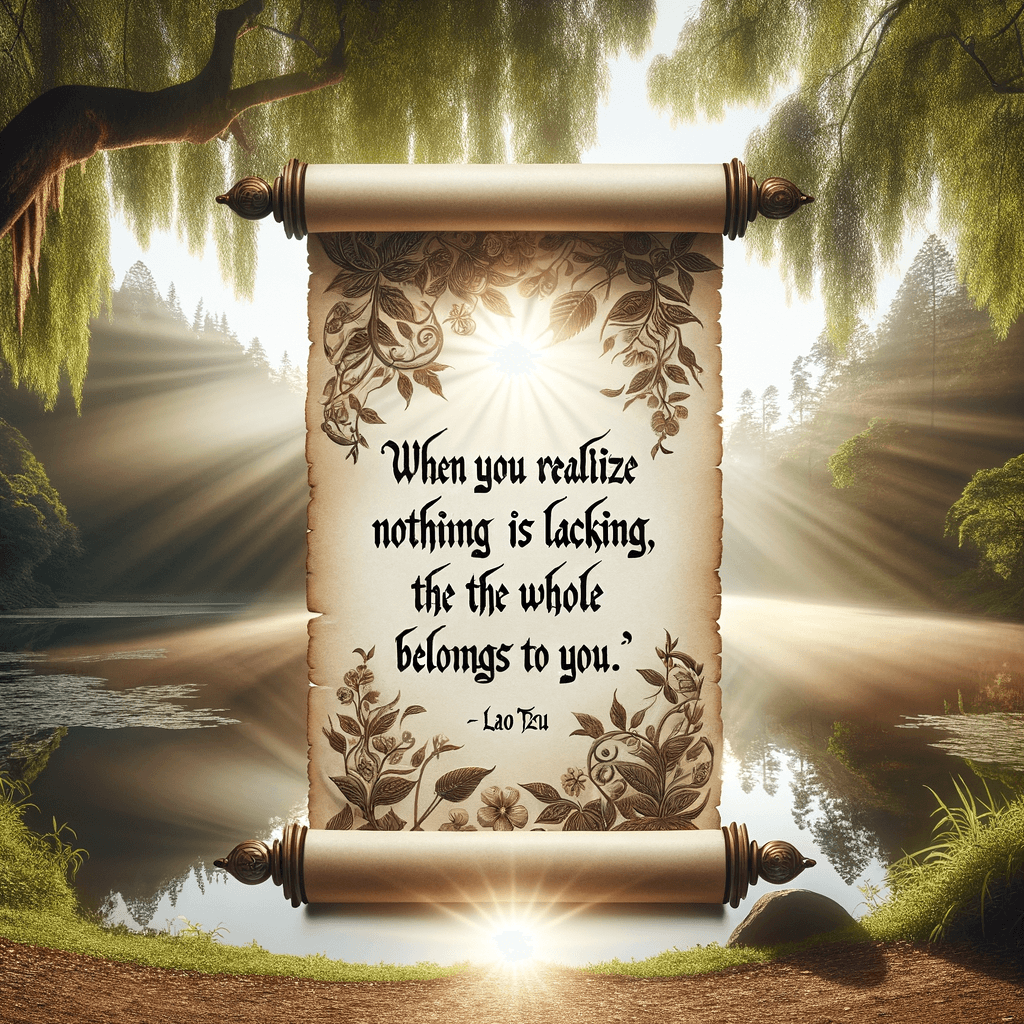
When you realize that nothing is lacking, the whole world belongs to you. - Lao Tzu
—What lingers after this line?
Contentment and Satisfaction
This quote highlights the idea that true satisfaction and contentment come from within. When you perceive that you lack nothing, you achieve a state of inner peace and fulfillment.
Mindset and Perception
Lao Tzu emphasizes that it's our mindset and perception that shape our reality. By realizing that we have everything we need, we feel a sense of abundance and ownership over our own lives.
Philosophical Perspective
The quote reflects Taoist philosophy, which values simplicity, humility, and the understanding that true wealth is not material but spiritual and psychological.
Freedom from Desire
Lao Tzu suggests that releasing desires and recognizing sufficiency in what we have liberates us from feelings of envy, jealousy, and inadequacy, allowing us to feel a greater connection to the world.
Gratitude and Abundance
Appreciating what we have fosters a sense of gratitude, leading to a richer, more abundant experience of life, where we feel as though the whole world is ours to enjoy.
Historical Context
Lao Tzu, an ancient Chinese philosopher and writer, founded Taoism. His teachings often focus on living harmoniously and understanding the natural order of the universe, reflecting the values and beliefs of ancient Chinese culture.
Recommended Reading
As an Amazon Associate, we earn from qualifying purchases.
One-minute reflection
Where does this idea show up in your life right now?
Related Quotes
6 selectedIf you are depressed you are living in the past. If you are anxious you are living in the future. If you are at peace you are living in the present. — Lao Tzu
Lao Tzu
At first glance, this saying offers a simple emotional map: depression is linked to the past, anxiety to the future, and peace to the present. In that structure, Lao Tzu presents inner life as a matter of where conscious...
Read full interpretation →If you want to master the world, first master your own internal chaos. The rest is just noise. — Lao Tzu
Lao Tzu
At its core, this saying shifts the arena of power from the external world to the self. The desire to ‘master the world’ often begins with ambition, competition, and control, yet Lao Tzu redirects that energy inward, tow...
Read full interpretation →To desire nothing is to be serene. — Laozi
Lao Tzu
Laozi’s assertion that ‘to desire nothing is to be serene’ invites us to consider the burdens imposed by desire. In the *Tao Te Ching* (c.
Read full interpretation →The walls of your home should be a fortress of peace, not a cage of isolation. Claim your sanctuary; it is where your nervous system goes to remember who you are. — Nanea Hoffman
Nanea Hoffman
At its core, Nanea Hoffman’s line reframes home as more than a physical structure. Walls can protect, but they can also confine; the difference lies in whether a home restores the self or slowly disconnects it from the w...
Read full interpretation →When you can bear your own silence, you are free. — Mooji
Mooji
At first glance, Mooji’s statement appears simple, yet it points to a demanding inner test: can a person remain alone with silence without immediately reaching for distraction? To ‘bear’ one’s own silence suggests more t...
Read full interpretation →Being at ease with not knowing is crucial for answers to come to you. — Eckhart Tolle
Eckhart Tolle
At its core, Eckhart Tolle’s statement reframes uncertainty as a condition for insight rather than a failure of thought. To be at ease with not knowing is not to become passive; instead, it means loosening the mind’s com...
Read full interpretation →More From Author
More from Lao Tzu →Yield and overcome, bend and be straight. — Lao Tzu
At first glance, Lao Tzu’s line seems contradictory: how can yielding lead to overcoming, or bending result in straightness? Yet this paradox lies at the heart of Taoist thought.
Read full interpretation →Confidence is silent. Insecurities are loud. — (Skipped due to author uncertainty) -> Let's use: A truly strong person does not need to dominate. — Lao Tzu
At its core, Lao Tzu’s saying reframes strength as something inward rather than theatrical. A truly strong person, in this view, does not need to overpower others to prove worth, because genuine power is already settled...
Read full interpretation →If you are depressed you are living in the past. If you are anxious you are living in the future. If you are at peace you are living in the present. — Lao Tzu
At first glance, this saying offers a simple emotional map: depression is linked to the past, anxiety to the future, and peace to the present. In that structure, Lao Tzu presents inner life as a matter of where conscious...
Read full interpretation →If you want to master the world, first master your own internal chaos. The rest is just noise. — Lao Tzu
At its core, this saying shifts the arena of power from the external world to the self. The desire to ‘master the world’ often begins with ambition, competition, and control, yet Lao Tzu redirects that energy inward, tow...
Read full interpretation →