
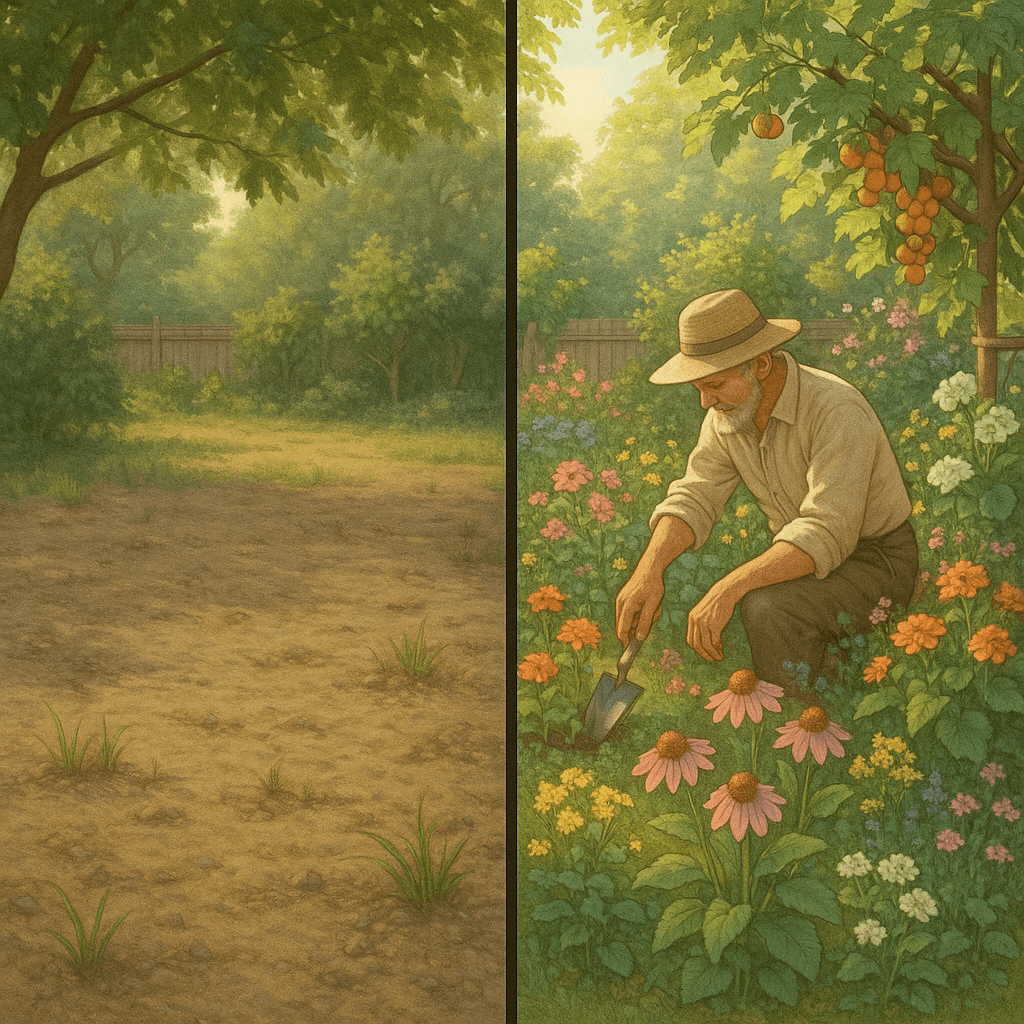
A garden requires patient labor and attention. Plants do not grow merely to satisfy ambitions or to fulfill good intentions. — Liberty Hyde Bailey
—What lingers after this line?
The Value of Patient Labor
Liberty Hyde Bailey’s observation begins by emphasizing the indispensable role of consistent, mindful effort in gardening. Unlike many pursuits that promise swift results, tending a garden demands ongoing, patient labor—watering, weeding, and nurturing over time. This truth resonates with the larger philosophy of delayed gratification, where the fruits of one's work emerge only after sustained diligence.
Attention as an Act of Care
Extending beyond mere effort, Bailey highlights the necessity of attention. In gardening, small details matter: the way sunlight falls, changes in soil moisture, or the appearance of pests can all impact growth. Attentiveness transforms rote tasks into acts of understanding, demonstrating a deeper respect for the living systems within the garden. As Michael Pollan notes in 'Second Nature' (1991), true gardeners observe their plants closely, adapting care to nature’s subtle signals.
Limitations of Ambition
Transitioning to Bailey’s critique of ambition, we see how personal desires alone do not guarantee results in the garden. One cannot simply will a seed to sprout more quickly, no matter how grand the vision. This lesson stands as a humbling reminder that nature operates on its own timeline, and human ego must adapt to its rhythms—a principle echoed in Thoreau’s writings at Walden Pond.
Shortcomings of Good Intentions
Furthermore, good intentions, while admirable, are insufficient if not matched by action. Wishing for a lush garden or planning elaborate beds is fruitless unless accompanied by regular, concrete work. This gap between intent and execution is often a stumbling block, not only in horticulture but in personal projects and growth. As with the garden, hopes must be rooted in perseverance to come to fruition.
Life Lessons from the Garden
Ultimately, Bailey’s words offer broader wisdom for life’s endeavors. The disciplines of patience, close attention, and humble acceptance of nature's limits do not just yield healthy plants; they cultivate character. Each garden, then, becomes a classroom where the rewards of committed effort—and the pitfalls of mere ambition or intent—are made vividly real, providing insight with each season’s cycle.
One-minute reflection
What does this quote ask you to notice today?
Related Quotes
6 selectedWe cultivate our garden, because the world is not ours. — Voltaire
Voltaire
Voltaire’s famous exhortation to ‘cultivate our garden’ at the end of his novella Candide (1759) encapsulates a philosophy of focusing on the tangible rather than the abstract. Here, he suggests that the sphere of our di...
Read full interpretation →A farmer is helpless to grow grain; all he can do is provide the right conditions for the growing of grain. — Richard J. Foster
Richard J. Foster
At first glance, Foster’s farming metaphor shifts attention away from control and toward humility. A farmer cannot command a seed to sprout, just as a person cannot force true growth—whether spiritual, personal, or relat...
Read full interpretation →Stop begging God to increase your territory when you can't even maintain the territory you already have. — Iyanla Vanzant
Iyanla Vanzant
At its core, Iyanla Vanzant’s statement confronts a common contradiction: people often ask for more influence, wealth, opportunity, or responsibility before proving they can care for what is already in their hands. In th...
Read full interpretation →It is not our part here to take thought only for a season, or for a few lives of men, or for a passing age of the world. — J.R.R. Tolkien
J.R.R. Tolkien
At its core, Tolkien’s line rejects narrow, short-term thinking. He urges us to look beyond a single season, a generation, or even an era, and to measure our actions against a far larger horizon.
Read full interpretation →Ours is not the task of fixing the entire world all at once, but of stretching out to mend the part of the world within our reach. — Clarissa Pinkola Estés
Clarissa Pinkola Estés
Clarissa Pinkola Estés begins by stripping away the fantasy of total repair. The quote quietly challenges the heroic impulse to “fix everything,” suggesting that such ambition can become a form of avoidance—grand, exhaus...
Read full interpretation →Keep a quiet steadiness; storms pass and the ground still needs tending. — Thich Nhat Hanh
Thich Nhat Hanh
Thich Nhat Hanh’s line frames life as a field and our responsibilities as ongoing tending of the ground. The storms represent crises, conflicts, or emotional upheavals that feel all-consuming in the moment.
Read full interpretation →More From Author
More from Liberty Hyde Bailey →