
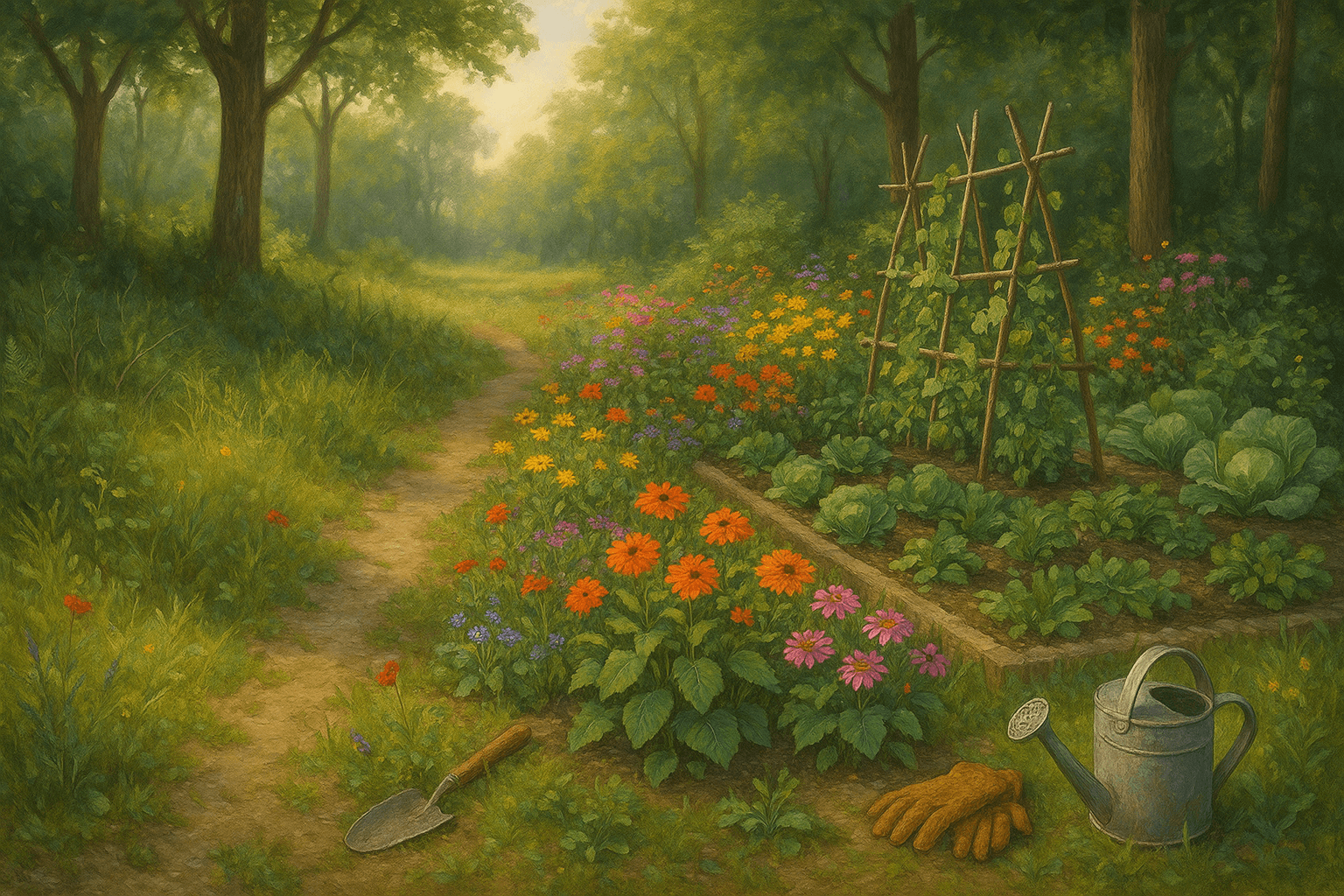
We cultivate our garden, because the world is not ours. — Voltaire
—What lingers after this line?
Voltaire’s Garden as Philosophical Retreat
Voltaire’s famous exhortation to ‘cultivate our garden’ at the end of his novella Candide (1759) encapsulates a philosophy of focusing on the tangible rather than the abstract. Here, he suggests that the sphere of our direct influence—symbolized by the garden—offers solace and purpose, especially in a world governed by chaos and uncertainty. While we may long to command the broader world, our real agency lies in nurturing the small corners we can truly tend.
The Limits of Human Control
Moving from the garden metaphor, Voltaire gently reminds us of our own limitations. The phrase ‘the world is not ours’ acknowledges the unpredictability of fate, nature, and society. History, rife with upheavals and disasters—from the Lisbon earthquake of 1755, which influenced Voltaire’s thinking, to wars and plagues—underscores humanity’s constrained grasp over external events. Thus, we are prompted to redirect our energy toward what is immediately at hand, rather than futilely striving to master an uncontrollable universe.
Personal Agency Amid External Uncertainty
Building on this idea, cultivating one’s own ‘garden’ can be seen as an assertion of personal agency. By tending our relationships, passions, and responsibilities, we create meaning where sweeping control is impossible. This reflects ancient wisdom from Stoic thinkers like Epictetus, who advocated focusing on what one can change while accepting what cannot be altered. Voltaire’s metaphor offers a secular echo of this pragmatic resilience.
Moral Responsibility in Microcosm
Furthermore, the garden suggests a model for ethical living. Rather than pursuing grandiose ambitions or attempting to reshape the world according to utopian ideals—a folly lampooned throughout Candide—Voltaire urges modest stewardship and responsibility. By caring for our immediate environment and community, we fulfill a moral duty that, while humble, radiates positive effects outwards. As Tolstoy wrote in Anna Karenina (1877), ‘Everyone thinks of changing the world, but no one thinks of changing himself’—a sentiment that dovetails with Voltaire’s advice.
Finding Contentment Through Mindful Effort
In conclusion, Voltaire’s statement invites us to find contentment in mindful effort. The act of cultivation—literal or metaphorical—becomes not just a retreat but also a source of inner peace and fulfillment. Rather than passivity, it champions a persistent, modest engagement with life’s realities. Through this, we may discover a sense of belonging and accomplishment, even as the larger world remains elusive and beyond our claims of ownership.
Recommended Reading
As an Amazon Associate, we earn from qualifying purchases.
One-minute reflection
What feeling does this quote bring up for you?
Related Quotes
6 selectedIf you want to be successful, you must take 100% responsibility for everything that you experience in your life. — Jack Canfield
Jack Canfield
At its heart, Jack Canfield’s statement argues that success starts when a person stops treating life as something that merely happens to them. To take “100% responsibility” does not mean blaming oneself for every event i...
Read full interpretation →You are not responsible for fixing everything that is broken. You are only responsible for showing up to your own life. — Elizabeth Gilbert
Elizabeth Gilbert
Elizabeth Gilbert’s quote begins by dismantling a common illusion: that a good, caring person must somehow repair every failure, soothe every conflict, and hold together every fraying edge of life. Instead, she draws a b...
Read full interpretation →Those who will not govern themselves are condemned to find masters to govern over them. — Steven Pressfield
Steven Pressfield
At its heart, Steven Pressfield’s line argues that freedom begins as an inner discipline before it becomes a political or social condition. If people refuse the hard work of governing their impulses, habits, and fears, t...
Read full interpretation →It is not our part here to take thought only for a season, or for a few lives of men, or for a passing age of the world. — J.R.R. Tolkien
J.R.R. Tolkien
At its core, Tolkien’s line rejects narrow, short-term thinking. He urges us to look beyond a single season, a generation, or even an era, and to measure our actions against a far larger horizon.
Read full interpretation →It can't be done for you; it must be done by you. — Frank Sonnenberg
Frank Sonnenberg
Frank Sonnenberg’s statement cuts directly to the heart of personal responsibility: some tasks cannot be outsourced, postponed, or wished into existence by someone else. In that sense, the quote is not merely motivationa...
Read full interpretation →Excuses are a great way to be on the sidelines of your own life. — Jamie Varon
Jamie Varon
Jamie Varon’s line frames excuses as more than harmless explanations—they become a location, the “sidelines,” where you can watch your life unfold without fully participating. The metaphor implies there is a field of pla...
Read full interpretation →More From Author
More from Voltaire →Perfection is attained by slow degrees; it requires the hand of time. — Voltaire
Voltaire’s remark begins with a quiet correction to human impatience: perfection is not seized in a moment but approached step by step. By saying it is attained “by slow degrees,” he frames excellence as a process of acc...
Read full interpretation →Appreciation is a wonderful thing. It makes what is excellent in others belong to us as well. — Voltaire
At first glance, Voltaire’s remark seems simple, yet it contains a generous idea: when we truly appreciate another person’s excellence, we do not merely observe it from a distance—we participate in it. Admiration becomes...
Read full interpretation →To my wonderful family, I'm so grateful for every moment we share. — Voltaire
At first glance, this line reads like a brief note of thanks, yet its emotional power comes from how directly it ties gratitude to shared life. By addressing ‘my wonderful family,’ the speaker does more than praise relat...
Read full interpretation →Originality is nothing but judicious imitation. — Voltaire
At first glance, Voltaire’s remark seems self-defeating: how can originality come from imitation? Yet his point is subtler than it appears.
Read full interpretation →