
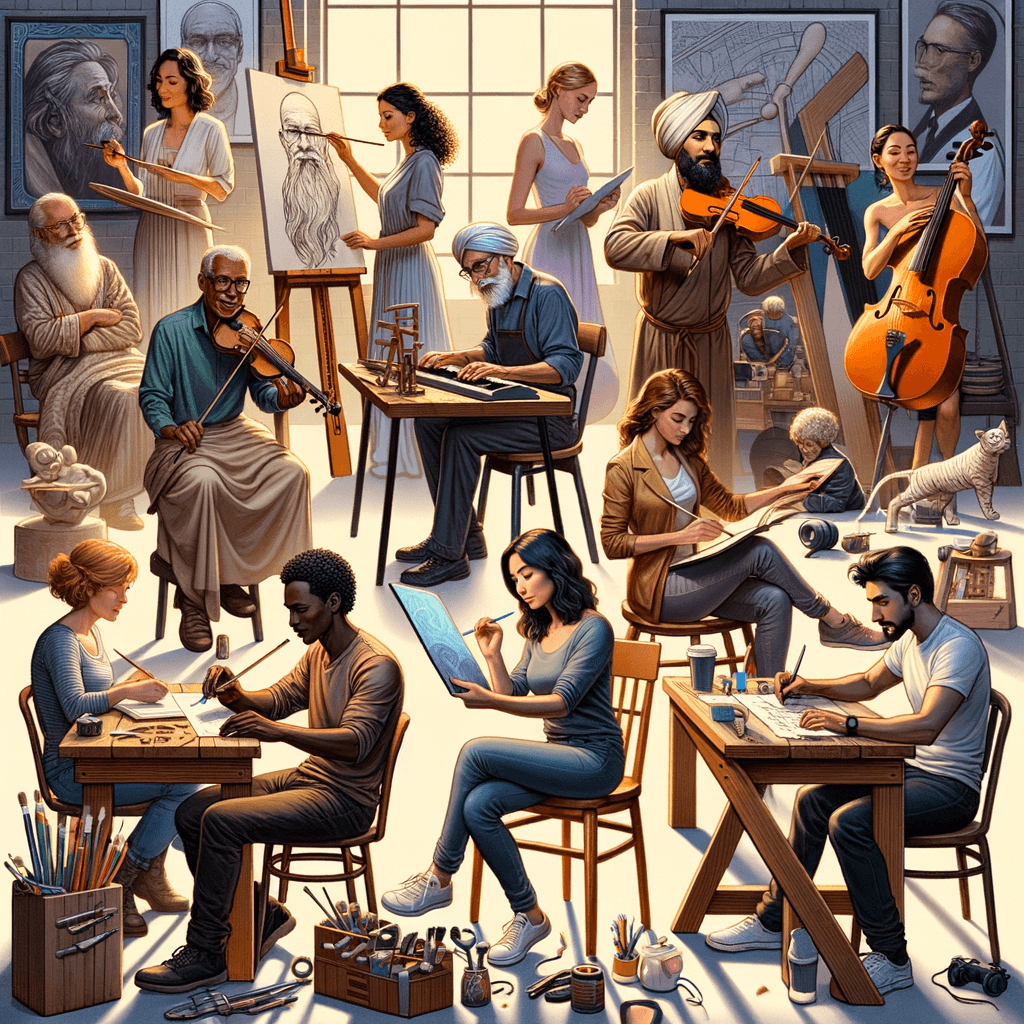
Let each man exercise the arts he knows, or let him acquire new ones. — Thomas Jefferson
—What lingers after this line?
Personal Expertise
Jefferson encourages individuals to make the most of the skills they already possess. By doing what one knows well, a person can contribute to society and achieve personal satisfaction.
Continuous Learning
This quote suggests that if someone doesn’t have a particular skill or art, they should be open to learning and acquiring new ones. This emphasizes the idea that personal growth and development are lifelong processes.
Adaptability and Expansion
The phrase also highlights the importance of adaptability. Jefferson advocates the idea that individuals should not be content with just their current abilities but should strive to expand their knowledge and expertise.
Individual Responsibility
There’s a message of personal responsibility here: each person is accountable for their own improvement and development. It suggests that everyone has the power to shape their future by honing current abilities or learning new ones.
Jefferson’s Enlightenment Ideals
As a prominent figure of the Enlightenment era, Jefferson likely believed in the importance of education and the pursuit of knowledge. His quote reflects the Enlightenment emphasis on reason, self-improvement, and individual capacity for growth.
One-minute reflection
Why might this line matter today, not tomorrow?
Related Quotes
6 selectedLearning is a lifelong process of unlearning the need for immediate results. Patience is the discipline of trusting the slow, quiet compounding of your efforts. — Confucius
Confucius
At its core, this saying presents learning not as a race toward instant achievement, but as a gradual reshaping of expectation. The phrase “unlearning the need for immediate results” suggests that education is not only a...
Read full interpretation →You have to be willing to be bad at something to become good at it. — Rick Rubin
Rick Rubin
Rick Rubin’s line points to an uncomfortable truth: the first step toward competence often looks like incompetence. In a culture that rewards polished outcomes, beginners can feel exposed, as if early mistakes are eviden...
Read full interpretation →Practice isn't the thing you do once you're good. It's the thing you do that makes you good. — Malcolm Gladwell
Malcolm Gladwell
Malcolm Gladwell’s line flips a common belief: that practice is a chore reserved for beginners and abandoned once talent arrives. Instead, he frames practice as the engine that creates competence in the first place, not...
Read full interpretation →Discipline and constant work are the whetstones upon which the dull knife of talent is honed. — Stephen King
Stephen King
Stephen King frames talent as a “dull knife,” something real but incomplete—useful in theory, limited in practice. The metaphor immediately shifts attention away from the romance of natural gifts and toward what gifts re...
Read full interpretation →Plant curiosity like a garden and harvest a lifetime of discovery. — Rabindranath Tagore
Rabindranath Tagore
Tagore’s metaphor turns curiosity from a fleeting impulse into something alive—an ongoing practice that can be nurtured, tended, and expanded. By comparing it to a garden, he implies that wonder is not merely a trait som...
Read full interpretation →Trade comfort for curiosity; new skills pay the richest interest — Paulo Coelho
Paulo Coelho
Paulo Coelho’s line begins by challenging the most seductive bargain we make with ourselves: choosing ease over exploration. Comfort isn’t inherently bad, but it can quietly harden into routine, where the days feel effic...
Read full interpretation →More From Author
More from Thomas Jefferson →Determine never to be idle... It is wonderful how much may be done if we are always doing. — Thomas Jefferson
Thomas Jefferson’s admonition to “determine never to be idle” is less about frantic busyness and more about a deliberate stance toward life. By using the word “determine,” he frames action as a conscious choice, not a me...
Read full interpretation →It is in our lives and not our words that our religion must be read. — Thomas Jefferson
Jefferson is emphasizing that the true measure of a person's religious beliefs is reflected in their actions and behaviors, not merely in their declarations or verbal affirmations.
Read full interpretation →Delay is preferable to error. — Thomas Jefferson
Jefferson emphasizes that it's better to take time to make a correct decision than to rush into one that could prove to be wrong. Thoughtfulness and careful deliberation lead to better outcomes.
Read full interpretation →Do not bite at the bait of pleasure till you know there is no hook beneath it. — Thomas Jefferson
Thomas Jefferson’s vivid imagery draws from the world of fishing: bait lures in fish, tempting them with the promise of food, but often conceals a deadly hook. In human affairs, pleasures frequently tempt us—be it in con...
Read full interpretation →