
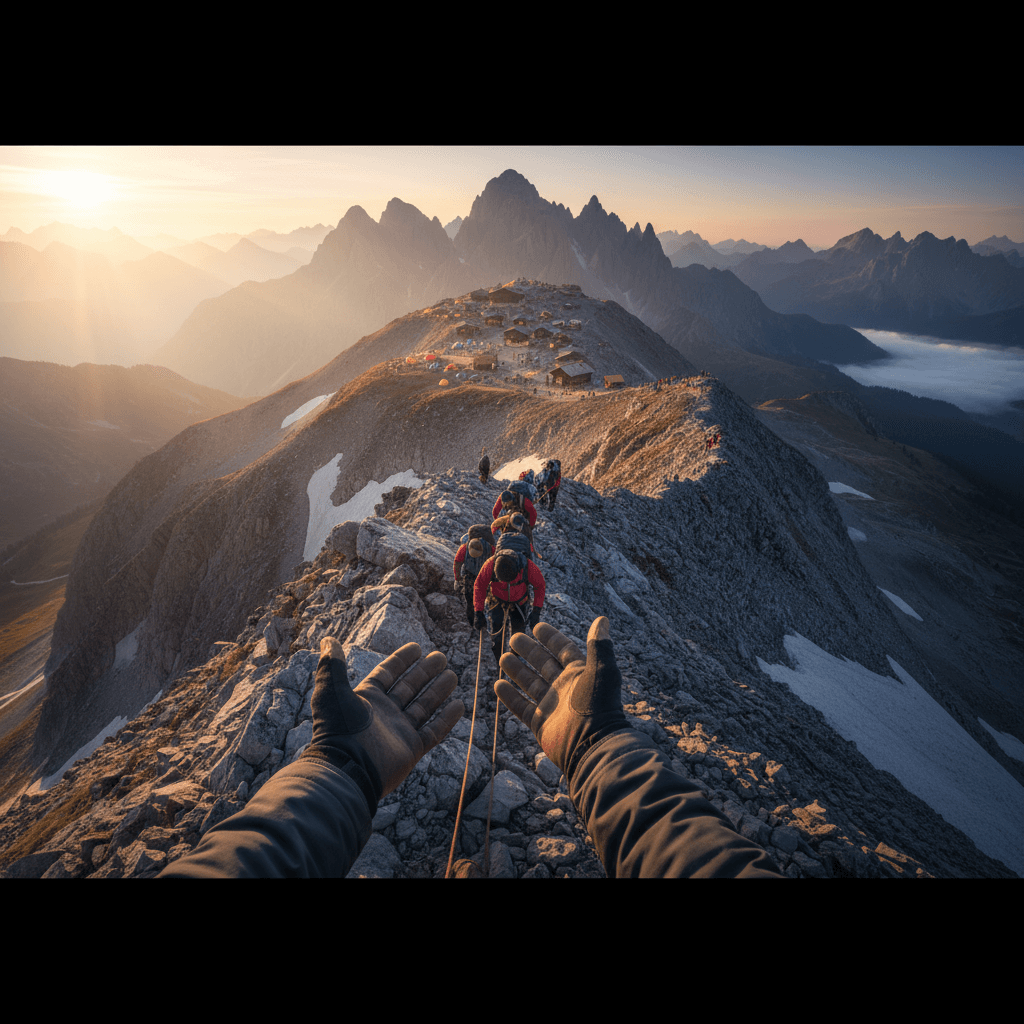
Lift others while you climb, and the summit becomes a village. — Malala Yousafzai
—What lingers after this line?
The Metaphor of Collective Climbing
Malala Yousafzai’s image reshapes success from a narrow peak into a livable place. A summit reached alone is a viewpoint; a summit reached with others becomes a community—sustaining, diverse, and safer for everyone who follows. The metaphor insists that progress isn’t complete until it is made accessible. Moreover, by framing leadership as lifting, she recasts ambition as stewardship. The climber’s rope is not only for personal safety; it is a lifeline extended to those behind. Thus, ascent and inclusion become mutually reinforcing rather than competing goals.
Communal Ethics Across Traditions
This ethic has deep roots. Ubuntu, as Desmond Tutu describes in No Future Without Forgiveness (1999), holds that “a person is a person through other persons,” suggesting that achievement gains meaning only within a shared humanity. Similarly, Aristotle’s Politics (c. 330 BC) portrays humans as political animals whose flourishing depends on the polis, not isolated triumphs. Extending this thread, Kropotkin’s Mutual Aid (1902) documents cooperation in nature and society as a driver of survival. Together, these perspectives echo Malala’s insight: when we climb with others, we build the social scaffolding that turns a peak into a village.
Education’s Multiplier in Malala’s Story
Malala’s own path shows how lifting others transforms the landscape. In I Am Malala (2013), she recounts advocating for girls’ schooling in Pakistan’s Swat Valley, revealing education as both rope and harness: it secures individual futures while creating safe passage for communities. Moreover, development research reinforces the multiplier effect. UNESCO’s Global Education Monitoring reports (2016–2022) link girls’ education to lower infant mortality, higher civic participation, and economic growth. Thus, each student lifted is not just a climber; she becomes a guide, teacher, and builder—expanding the summit into a village square.
Leadership That Sponsors, Not Just Mentors
Moving from classrooms to boardrooms, the mechanism is sponsorship—using one’s influence to open doors. Harvard Business Review’s “Why Men Still Get More Promotions Than Women” (Ibarra, Carter, Silva, 2010) shows that sponsorship, more than advice alone, propels equitable advancement. Adam Grant’s Give and Take (2013) further illustrates how generous networks raise collective performance without sacrificing excellence. Consequently, leaders who attach their reputations to rising talent don’t dilute merit; they compound it. Each promoted voice broadens problem-solving capacity, turning hierarchical ladders into sturdy bridges others can cross.
Institutions That Make the Summit a Village
Scaling solidarity requires design. Elinor Ostrom’s Governing the Commons (1990) identifies principles—clear rules, local monitoring, and graduated sanctions—that enable groups to manage shared resources. In practice, models like the Mondragón cooperatives (founded 1956) and the Grameen Bank’s group lending (since 1983) show how ownership and mutual accountability spread opportunity. By institutionalizing reciprocity, these systems convert individual gains into shared infrastructure—credit, training, and safety nets—so that the peak supports homes, not just flags.
Guardrails Against Tokenistic Climbing
Yet inclusion can ring hollow if newcomers must conform to old norms. Katherine W. Phillips’s “How Diversity Makes Us Smarter” (Scientific American, 2014) shows that diverse groups outperform when differences are genuinely engaged, not merely displayed. Therefore, the village must offer voice, not just visibility: transparent criteria for advancement, distributed decision-making, and feedback loops that surface dissent. Otherwise, the summit becomes a gated enclave rather than a commons.
Daily Practices for Shared Ascent
Finally, the village is built habit by habit. Wayne and Cheryl Baker’s Reciprocity Ring (1999, University of Michigan) operationalizes mutual aid by normalizing specific, trackable asks and offers. Open-source communities—Linux’s evolution since 1991—demonstrate how peer review and shared ownership turn individual contributions into public infrastructure. In that spirit, leaders can map who they sponsor, publish resources openly, and celebrate assists as vigorously as wins. Step by step, the climb widens—and the summit, at last, becomes a village.
Recommended Reading
As an Amazon Associate, we earn from qualifying purchases.
One-minute reflection
Why might this line matter today, not tomorrow?
Related Quotes
6 selectedConnection is the antidote to the feeling of being adrift. We are not meant to navigate this life in isolation; we are meant to be the anchors for one another. — Brene Brown
Brené Brown
At its heart, Brené Brown’s quote turns loneliness into a vivid physical image: drifting without direction. To feel adrift is not merely to be alone, but to lose orientation, steadiness, and a sense of belonging.
Read full interpretation →The cure for burnout is not 'self-care'; it is all of us caring for one another. — Emily Nagoski
Emily Nagoski
Emily Nagoski’s line pivots burnout away from a private failing and toward a shared condition created by overload, low control, and chronic stress. By rejecting “self-care” as the primary cure, she challenges the common...
Read full interpretation →Rarely, if ever, are any of us healed in isolation. Wellness is the fruit of community. — bell hooks
bell hooks
bell hooks challenges the popular fantasy of the self-sufficient survivor by insisting that healing is seldom a solitary achievement. While personal insight and self-care can begin the process, she suggests that restorat...
Read full interpretation →I'm not interested in competing with anyone. I hope we all make it. — Erica Cook
Erica Cook
Erica Cook’s line begins with a simple declaration—“I’m not interested in competing with anyone”—that reframes success as something other than a race. Instead of measuring worth by outperforming others, she suggests step...
Read full interpretation →For the strength of the pack is the wolf, and the strength of the wolf is the pack. — Rudyard Kipling
Rudyard Kipling
Kipling’s line frames strength not as a solitary possession but as something created through interdependence. The pack becomes formidable because each wolf contributes attention, endurance, and skill; likewise, each wolf...
Read full interpretation →When change feels heavy, lift someone else; strength grows in shared burden. — Harriet Tubman
Harriet Tubman
Harriet Tubman’s line begins with an honest admission: change can feel heavy, not exhilarating. Yet instead of waiting for the feeling to pass, she offers a practical pivot—“lift someone else.” In other words, when trans...
Read full interpretation →More From Author
More from Malala Yousafzai →Stand firm in tenderness; strength without compassion narrows the soul. — Malala Yousafzai
Malala Yousafzai’s line reframes tenderness not as softness, but as a disciplined stance—something you “stand firm” in. In other words, compassion is not a mood that comes and goes; it is a choice that can hold steady un...
Read full interpretation →Let your questions be louder than your fears. — Malala Yousafzai
Malala Yousafzai’s line hinges on a simple but powerful metaphor: fears and questions both speak inside us, yet we can choose which one gets the microphone. Rather than pretending fear doesn’t exist, she implies it will...
Read full interpretation →Let your voice be the river that nourishes the valleys of doubt — Malala Yousafzai
Malala Yousafzai’s line turns “voice” into something living and vital: a river that continuously moves, carries, and gives. Rather than portraying speech as a single act—one speech, one post, one declaration—she frames i...
Read full interpretation →Stand where your heart points, even if the road is less traveled. — Malala Yousafzai
Malala Yousafzai’s line treats the heart not as a fickle impulse but as a moral compass—an inner pointer toward what feels true and necessary. To “stand” where it points suggests steadiness: not merely choosing once, but...
Read full interpretation →