
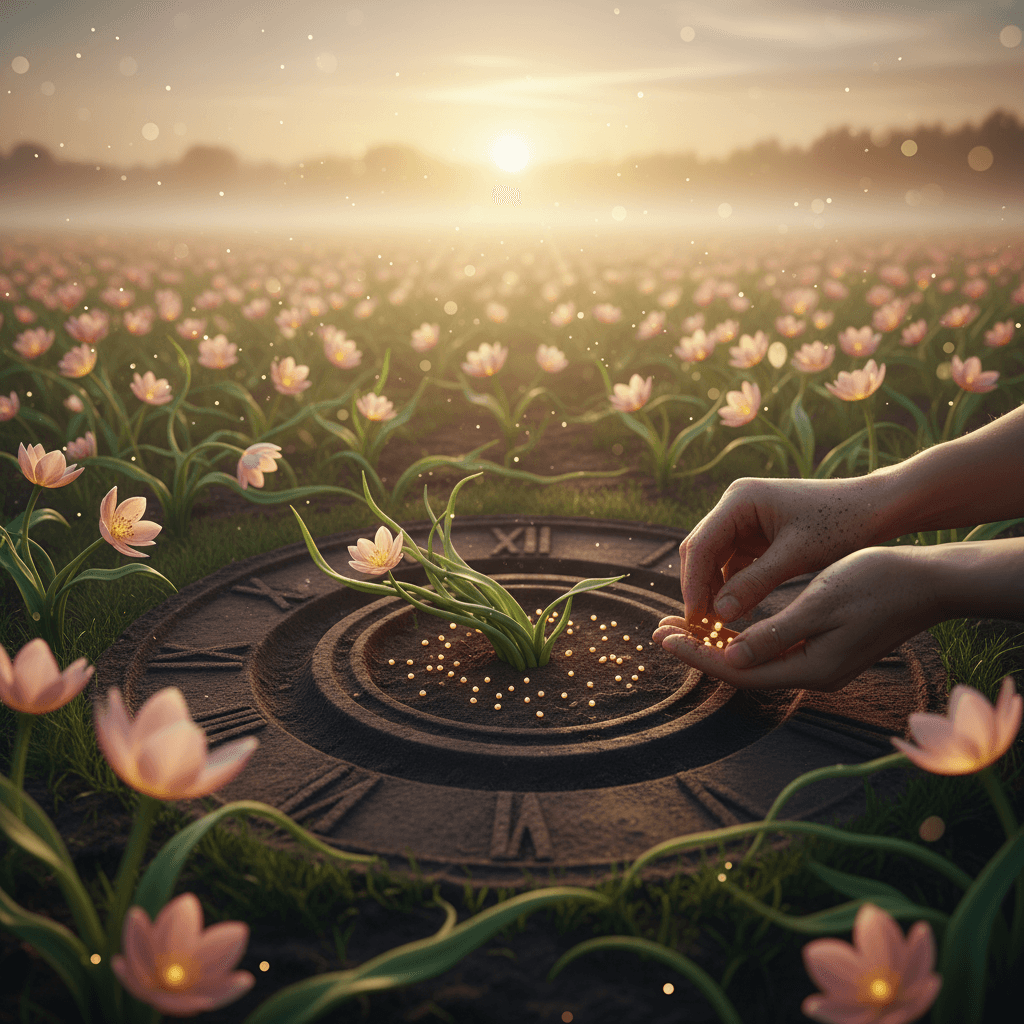
Plant generosity in the soil of your hours and watch tomorrow bloom differently. — Khalil Gibran
—What lingers after this line?
The Seed and the Hour
Gibran’s line treats time as living soil and generosity as a seed. Each hour becomes a plot we cultivate, not merely a slot we fill. The promise that “tomorrow bloom differently” reframes kindness from a momentary gesture into a horticultural investment—what we sow in attention, patience, or help grows roots we may not immediately see. Thus the metaphor invites responsibility for the unseen: even small seeds can alter the garden’s composition. With that image in mind, we can trace how his wider philosophy of giving turns scattered acts into a coherent season of growth.
Gibran’s Vision of Giving
Moving from image to intent, Gibran’s The Prophet (1923) insists, “You give but little when you give of your possessions. It is when you give of yourself that you truly give.” The soil of our hours—our presence, listening, and labor—matters more than grand gestures. He pairs generosity with joy, comparing it to a tree that “gives of its shade and fruit.” In this view, giving is not loss but ripening. Consequently, the quote’s horticulture is no ornament; it is a practical ethic: cultivate a daily climate in which generosity flows as naturally as sap.
How Kindness Alters the Future
Extending Gibran’s ethic, modern research shows that prosocial acts reshape both mood and trajectories. In Science, Dunn, Aknin, and Norton (2008) found that spending on others increased happiness more than spending on oneself. Adam Grant’s Give and Take (2013) further suggests that “givers,” when guided by boundaries and focus, build networks that compound opportunity. Even small favors can set off behavioral cascades; Roman Krznaric’s Empathy (2014) catalogs examples where a single generous act multiplies through communities. In this light, tomorrow “blooms” not by chance but because today’s seeds change the soil’s chemistry of incentives and trust.
Habits that Germinate Change
To translate insight into practice, design generosity as a habit loop. Implementation intentions—“If it’s 3 p.m., I’ll send a thank-you note”—increase follow-through (Gollwitzer, 1999). Habit stacking anchors giving to existing routines: after your morning coffee, message one person with a concrete offer of help (Clear, Atomic Habits, 2018). These micro-seeds exploit compound interest in time; small, repeated deposits yield disproportionate blooms. And because identity follows action, consistent giving reshapes self-concept—“I am someone who waters”—which, in turn, sustains the cycle.
Social Soil and Shared Blossoms
Generosity does not grow in isolation; it thrives in social loam. Robert Putnam’s Bowling Alone (2000) links dense networks and civic trust to communal flourishing. Experiments on cooperative cascades show that one person’s contribution increases others’ willingness to contribute, propagating through networks (Fowler & Christakis, PNAS, 2010). A living illustration is the Neapolitan caffè sospeso, where patrons prepay coffee for strangers; the custom normalizes generosity and invites imitation. Thus, when you plant in your hours, you also seed your neighborhood’s season—tomorrow’s bloom becomes a collective event.
Lessons from Living Soil
Ecology clarifies the metaphor: in healthy forests, mycorrhizal networks shuttle nutrients between trees, so one species’ surplus supports another’s need (Simard, Nature, 1997). Likewise, generous acts enrich the “underground” of relationships—information, goodwill, and resilience—so that diverse lives can flower. Yet soil must be tended: compost builds richness, and cover crops prevent erosion. In human terms, feedback, gratitude, and shared rituals replenish the ground, ensuring that today’s gifts don’t wash away after a single rain.
Guardrails: Generosity Without Burnout
Yet gardens fail when overwatered. Tania Singer distinguishes empathic distress from compassion; the former depletes, the latter energizes (Singer & Klimecki, Social Cognitive and Affective Neuroscience, 2014). Kristin Neff’s self-compassion research (2003) shows that caring for oneself sustains caring for others. Therefore, plant within seasons: set boundaries, rotate “crops” of effort, and rest the field. Paradoxically, by protecting your soil, you enable tomorrow to bloom more abundantly—and more often.
A Daily Ritual of Planting
Therefore, make a simple liturgy: morning—name one person to uplift; midday—offer a practical micro-gift; evening—record a gratitude and a lesson. Once a week, leave margin—time or money—for serendipity, the wildflower patch of generosity. As Plato’s Republic (c. 375 BC) suggests through the just city, structure nurtures virtue. Over time, these rhythms transform hours into humus; and as the ground deepens, you will indeed watch tomorrow bloom differently—by design, by patience, and by a quiet, persistent sowing.
One-minute reflection
What's one small action this suggests?
Related Quotes
6 selectedWhen you give from the depth of your own joy, you set others free to do the same. — Kahlil Gibran
Kahlil Gibran
At first glance, Gibran’s line suggests that real generosity is not depletion but overflow. In The Prophet (1923), he writes that we truly give when we give of ourselves, implying that joy is the wellspring rather than t...
Read full interpretation →Act from the center of your compassion and let generosity be your compass. — Kahlil Gibran
Kahlil Gibran
To begin, Gibran’s counsel places motivation before method: act from the center of your compassion. The word center suggests an interior equilibrium rather than a passing impulse, an anchoring place where concern for oth...
Read full interpretation →Plant generosity in small places; watch resilience bloom in vast fields. — Helen Keller
Helen Keller
Helen Keller’s line frames generosity as something you cultivate deliberately, like planting seeds in overlooked corners of daily life. Instead of portraying resilience as a trait you simply “have,” she suggests it is a...
Read full interpretation →Sow generosity in secret and watch how it returns to color your days. — Kahlil Gibran
Kahlil Gibran
At the outset, Gibran’s image of sowing generosity reframes giving as quiet cultivation rather than public performance. Seeds disappear beneath the soil; likewise, secret acts vanish from view, trusting time and conditio...
Read full interpretation →Your life is a gift, and you are the gift to the world. Share it wisely. — Unknown.
Unknown
This quote emphasizes that life itself is a precious gift, highlighting the importance of cherishing and valuing every moment and experience.
Read full interpretation →Plant seeds of happiness, hope, success, and love; it will all come back to you in abundance. — Steve Maraboli, United States.
Steve Maraboli, United States.
This quote suggests that by cultivating positivity through happiness, hope, success, and love, individuals can expect to receive similar positive outcomes in their own lives, highlighting a principle of reciprocity.
Read full interpretation →More From Author
More from Kahlil Gibran →Your home is your larger body. It grows in the sun and sleeps in the stillness of the night. — Kahlil Gibran
At first glance, Gibran transforms the idea of home from a mere structure into something intimate and organic: “your larger body.” In this image, a dwelling is not separate from the person who inhabits it, but an outward...
Read full interpretation →March on. Do not tarry. To go forward is to move toward perfection. — Kahlil Gibran
Gibran’s opening imperative—“March on. Do not tarry.”—sets a tone of disciplined urgency.
Read full interpretation →There must be spaces in your togetherness, and let the winds of the heavens dance between you. — Kahlil Gibran
Gibran’s line opens with a gentle paradox: he speaks to people who are already “together,” yet insists that togetherness is healthiest when it includes room. Rather than portraying love as fusion, he frames it as a relat...
Read full interpretation →Our anxiety does not come from thinking about the future, but from wanting to control it. — Kahlil Gibran
Kahlil Gibran reframes anxiety as something more specific than mere anticipation. The future itself—uncertain, unfolding, and not yet real—doesn’t automatically distress us; rather, distress appears when we demand certai...
Read full interpretation →