
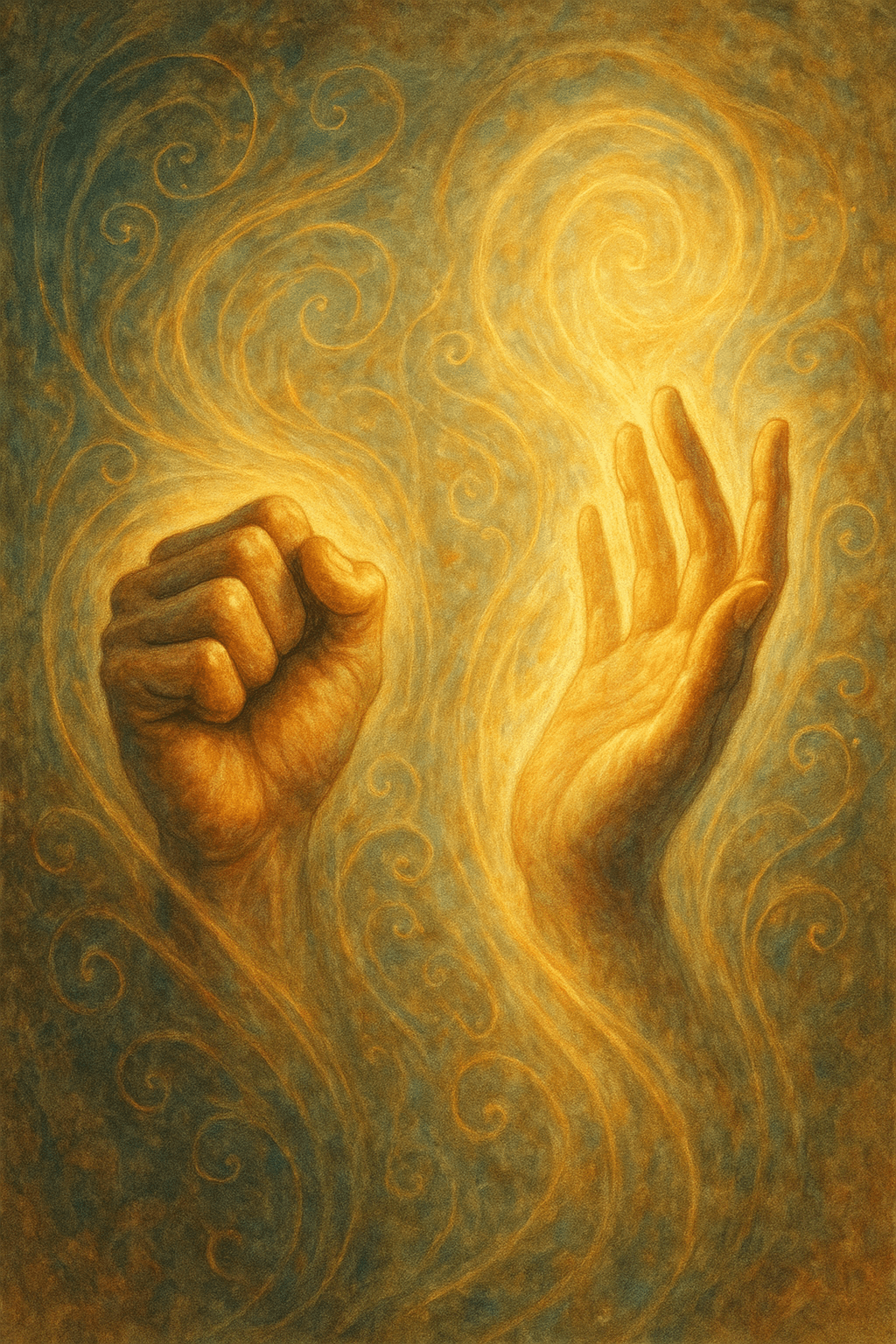
The hand opens and closes, opens and closes. If it were always a fist or always stretched open, we would be paralyzed. The spirit’s progress is a dance. — Rumi
—What lingers after this line?
The Symbolism of the Hand
Rumi’s image of the hand repeatedly opening and closing is more than just a physical observation—it becomes a powerful metaphor for life’s adaptability. Just as the hand cannot serve its purpose if always clenched or perpetually extended, so too are people rendered incapable or stagnant without flexibility. The hand’s function lies in its continual motion, echoing the natural ebb and flow inherent in living well.
Paralysis Through Rigidity
Expanding on this metaphor, Rumi warns against the dangers of rigidity in body and spirit. To stay fixed—whether in anger, fear, or passivity—limits growth and opportunity. This theme echoes ancient wisdom traditions; for example, Laozi’s *Tao Te Ching* (c. 4th century BC) praises the yielding nature of water over the hardness of stone. Just as inflexibility paralyzes the hand, so too can inflexible thinking or unyielding habits paralyze the soul.
Movement as Spiritual Progress
Transitioning from the body to the soul, Rumi draws a direct line between physical movement and spiritual evolution. By calling progress a ‘dance,’ he conjures the image of spiritual development as rhythmic, graceful, and ever-changing. Dance requires both discipline and spontaneity—qualities mirrored in the journey of personal growth. Spiritual progress, then, is not linear but a series of open and closed moments, each essential to growth.
Acceptance of Life’s Rhythms
Building on the notion of spiritual dance, acceptance emerges as a vital element. Life’s cycles—joy and sorrow, gain and loss—demand our response, not resistance. Much like Sufi whirling practices, which Rumi himself often invoked, surrendering to motion lets seekers find balance within chaos. The wise person, Rumi implies, opens and closes emotionally and spiritually as circumstances require, remaining attuned to life’s music.
Integrating Flexibility Into Daily Life
Ultimately, Rumi’s metaphor invites practical reflection on everyday existence. When challenges arise, responding with rigidity leads to suffering, while openness to change fosters strength and resilience. Modern psychology validates this: studies on resilience stress the importance of psychological flexibility in adapting to adversity (Kashdan & Rottenberg, 2010). In learning to dance with life—opening and closing—one becomes truly free, unburdened by paralyzing extremes.
One-minute reflection
Why might this line matter today, not tomorrow?
Related Quotes
6 selectedStruggle is the gardener that makes the soul bloom. — Rumi
Rumi
Rumi, the celebrated 13th-century Sufi poet, often explored themes of transformation in his writings. By likening struggle to a gardener, he suggests adversity is not a mere obstacle but a nurturing force.
Read full interpretation →The rhythm of life flows in the beats of persistence. — Rumi
Rumi
Life, with its ever-changing currents and tides, often moves to an invisible but undeniable beat. Rumi’s metaphor of rhythm captures the natural flow that shapes our experiences.
Read full interpretation →The journey of spirituality is not about perfection, but about progress and evolution. — Anonymous (Replaced with: The greatest adventure is the journey of the soul, exploring the depths of our own being. — Paramahansa Yogananda)
Paramahansa Yogananda
Paramahansa Yogananda’s statement reframes adventure in a striking way: the most profound voyage does not cross oceans or continents, but moves inward through the landscape of the self. Rather than presenting spiritualit...
Read full interpretation →Rest is not a passive indulgence; it is the essential rhythm that allows the heart to beat again. — Pema Chödrön
Pema Chödrön
At first glance, Pema Chödrön’s line challenges a common assumption: that rest is mere inactivity or a reward for productivity. Instead, she frames it as an essential rhythm, something woven into life itself rather than...
Read full interpretation →Clarity rarely comes from urgency; it comes from rhythm. — The Balanced Edit
The Balanced Edit
At its heart, this quote sets urgency against rhythm as two very different ways of moving through thought. Urgency pushes for immediate output, often mistaking speed for insight, whereas rhythm suggests steadiness, pacin...
Read full interpretation →There is no use in being in a hurry; it is much better to be in a rhythm. — Tunde Oyeneyin
Tunde Oyeneyin
Tunde Oyeneyin’s line challenges the modern reflex to equate speed with progress. Being “in a hurry” often feels productive, yet it can scatter attention and invite avoidable mistakes, leaving us tired without moving mea...
Read full interpretation →More From Author
More from Rumi →Everything that happens is a form of instruction if you choose to listen. — Rumi
At its core, Rumi’s line reframes ordinary experience as a living classroom. Nothing is merely random noise if one approaches it with attention; instead, each success, disappointment, encounter, or delay carries the poss...
Read full interpretation →Do not mistake movement for progress; a spinning top stays in one place, while a seed grows by staying rooted in the dark. — Rumi
Rumi’s image draws an immediate contrast between busyness and true development. A spinning top dazzles with speed and motion, yet it remains fixed in essentially the same place.
Read full interpretation →You don't need to escape the chaos to find peace—it's already inside you, waiting to be remembered. — Rumi
At first glance, Rumi’s line overturns a common assumption: that peace must be found by fleeing noise, conflict, or uncertainty. Instead, he suggests that peace is not an external destination but an inner condition alrea...
Read full interpretation →Confidence is silent. Insecurities are loud. Do not feel the need to broadcast your worth to a world that doesn't understand your path. — Rumi
At its core, this saying contrasts two very different emotional states: confidence, which rests quietly within, and insecurity, which seeks constant outward expression. The point is not that confident people never speak,...
Read full interpretation →