
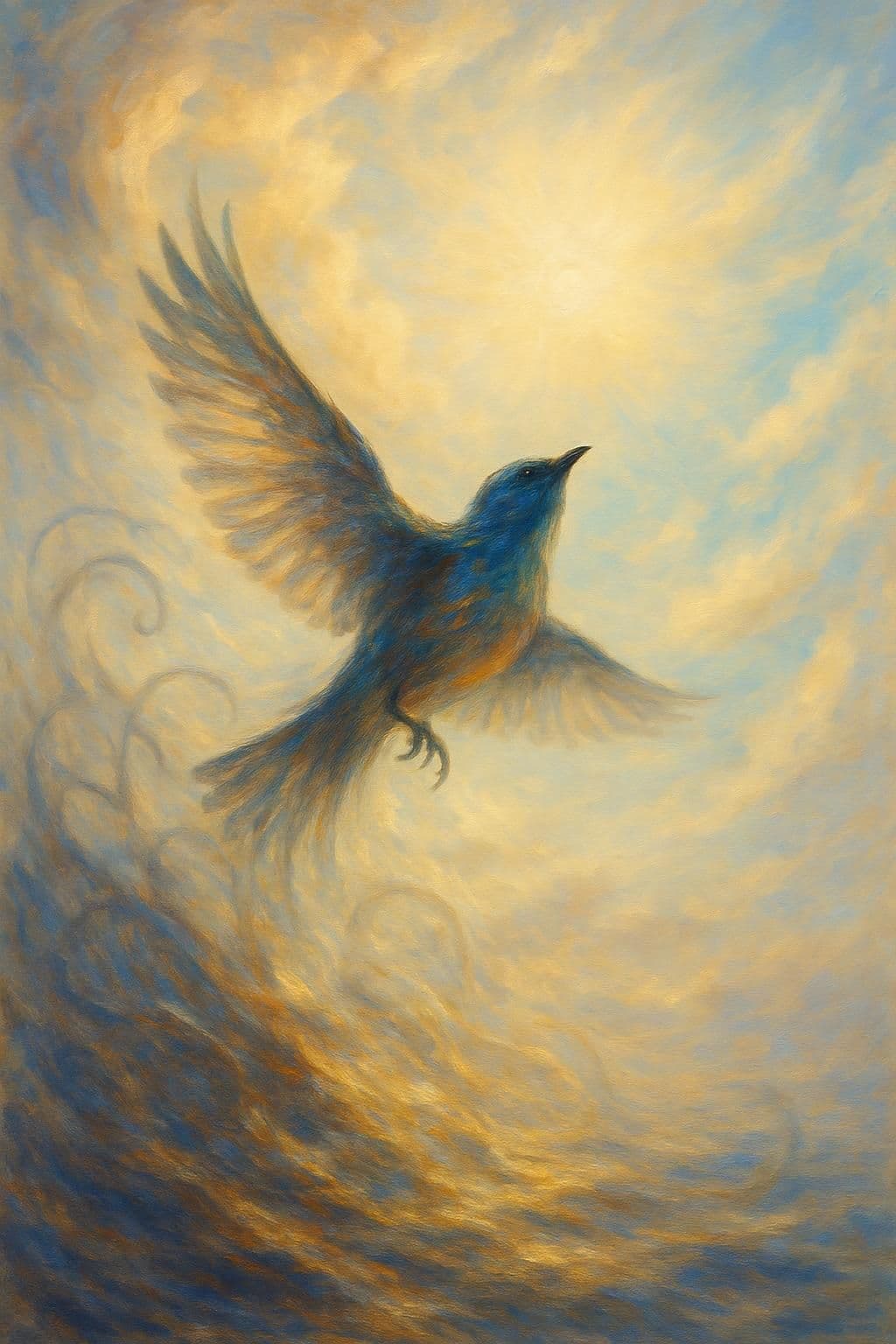
The mind is a restless bird; learning to soar in its desire is the art of freedom. — Rabindranath Tagore
—What lingers after this line?
The Image of the Restless Bird
Tagore’s metaphor begins with a vivid image: the mind as a restless bird. Just as a bird flits, darts, and rarely settles, so too does human thought shift from one desire or curiosity to another. This perpetual motion is not depicted as a flaw, but as an intrinsic quality of the mind—one that fuels creativity, questioning, and growth. Like the migrating swallow or the ceaselessly chirping sparrow, our mental landscapes are alive with possibility and hunger for exploration.
Desire as the Wind Beneath Wings
Building on this avian imagery, Tagore sees desire not as a shackle, but as a wind that enables ascent. Desire propels the bird-mind forward, providing momentum for learning and self-realization. Rather than extinguishing cravings for knowledge or experience, Tagore advocates harnessing them. In this light, desire becomes empowering, much as Plato’s concept of 'Eros' in the *Symposium* (c. 385–370 BC) frames longing as the engine of philosophical ascent.
The Art of Soaring: Learning and Freedom
Transitional from desire, the question arises: how does one truly soar? According to Tagore, the art lies in learning—not simply acquiring facts, but mastering how to direct and ride the currents of one’s own impulses. This deliberate cultivation transforms mere restlessness into flight. Echoing the teachings of Maria Montessori, who emphasized nurturing children’s natural curiosity, Tagore reminds us that real freedom is found when the mind’s energy is guided, not stifled.
Freedom Beyond Restraint
Consequently, freedom is recast not as the absence of boundaries, but as the skilled practice of navigating inner landscapes. Instead of caging the mind-bird, Tagore encourages us to expand the sky. This notion aligns with Viktor Frankl’s insights in *Man’s Search for Meaning* (1946), where liberation is discovered within—by choosing one’s attitude and direction even amidst external limitations.
From Restlessness to Liberation
Ultimately, Tagore’s vision is both hopeful and practical. By embracing the mind’s restless nature and learning to soar in its desires, we discover a dynamic form of liberty. Each of us, he implies, can become an artist of our own freedom, turning internal turbulence into graceful exploration. In this way, the restless bird not only finds peace, but transcends its cage—illustrating that true freedom is born from mindful flight, not motionless tranquility.
One-minute reflection
Why might this line matter today, not tomorrow?
Related Quotes
6 selectedThe only freedom is freedom from the mind. — Muktananda
Muktananda
This quote implies that true freedom is achieved by freeing oneself from the limitations and constant chatter of the mind, which often creates fear, doubt, and attachment.
Read full interpretation →Before complaining that you are a slave to another, be sure that you are not a slave to self. — James Allen
James Allen
James Allen’s warning begins with a reversal: the most immediate master may not be another person, institution, or circumstance, but one’s own impulses. Before condemning external control, he asks us to examine whether a...
Read full interpretation →True freedom is being without anxiety about imperfection. — Seng-tsan
tsan
Seng-tsan’s line shifts freedom away from external conditions and toward an internal posture: a mind no longer bullied by the fear of being flawed. In this framing, you can have choices, status, or even safety and still...
Read full interpretation →Freedom is not given to us by anyone; we have to cultivate it within ourselves. — Thich Nhat Hanh
Thich Nhat Hanh
Thich Nhat Hanh reframes freedom as something more intimate than laws, leaders, or circumstances. Rather than waiting for a benefactor to grant it, he points to a lived capacity—an inner steadiness that can be developed...
Read full interpretation →Flow with whatever may happen and let your mind be free. — Zhuangzi
Zhuangzi
Zhuangzi’s line reads like a gentle instruction: stop tightening your grip on how things should go, and meet life as it actually arrives. In Daoist thought, insisting on control often creates the very tension we hope to...
Read full interpretation →Sketch your days with daring strokes; intimacy with yourself paints freedom. — Anaïs Nin
Anaïs Nin
Anaïs Nin frames daily living as an artistic act: to “sketch your days” suggests that life is not merely endured or recorded, but deliberately composed. The phrase “daring strokes” implies risk—choices made without waiti...
Read full interpretation →More From Author
More from Rabindranath Tagore →Adaptability is not imitation. It means power of resistance and assimilation. — Rabindranath Tagore
At the heart of Tagore’s statement lies a careful distinction between changing and merely copying. Adaptability, he argues, is not the passive act of becoming like one’s surroundings; rather, it is an active power that a...
Read full interpretation →It is not the speed of the work, but the intention behind it that grants it value. — Rabindranath Tagore
At first glance, Tagore’s statement challenges a modern habit of equating worth with speed. In many settings, quick results are praised as signs of competence, yet he redirects attention to the inner motive that shapes t...
Read full interpretation →When I stand before thee at the day's end, thou shalt see my scars and know that I had my wounds and also my healing. — Rabindranath Tagore
At its heart, Tagore imagines an ultimate moment of reckoning in which nothing essential can be hidden. To stand before another “at the day’s end” suggests the close of life, a spiritual homecoming, or simply the end of...
Read full interpretation →A home is not a mere transient shelter of brick and stone, but a place where hearts dwell and souls are nurtured. — Rabindranath Tagore
At its core, Tagore’s statement rejects the idea that a home can be defined by architecture alone. Walls, roofs, and doors may provide protection, yet they do not automatically create belonging.
Read full interpretation →