
The task of the modern educator is not to cut down jungles, but to irrigate deserts. — C.S. Lewis
—What lingers after this line?
Reframing the Educator’s Mission
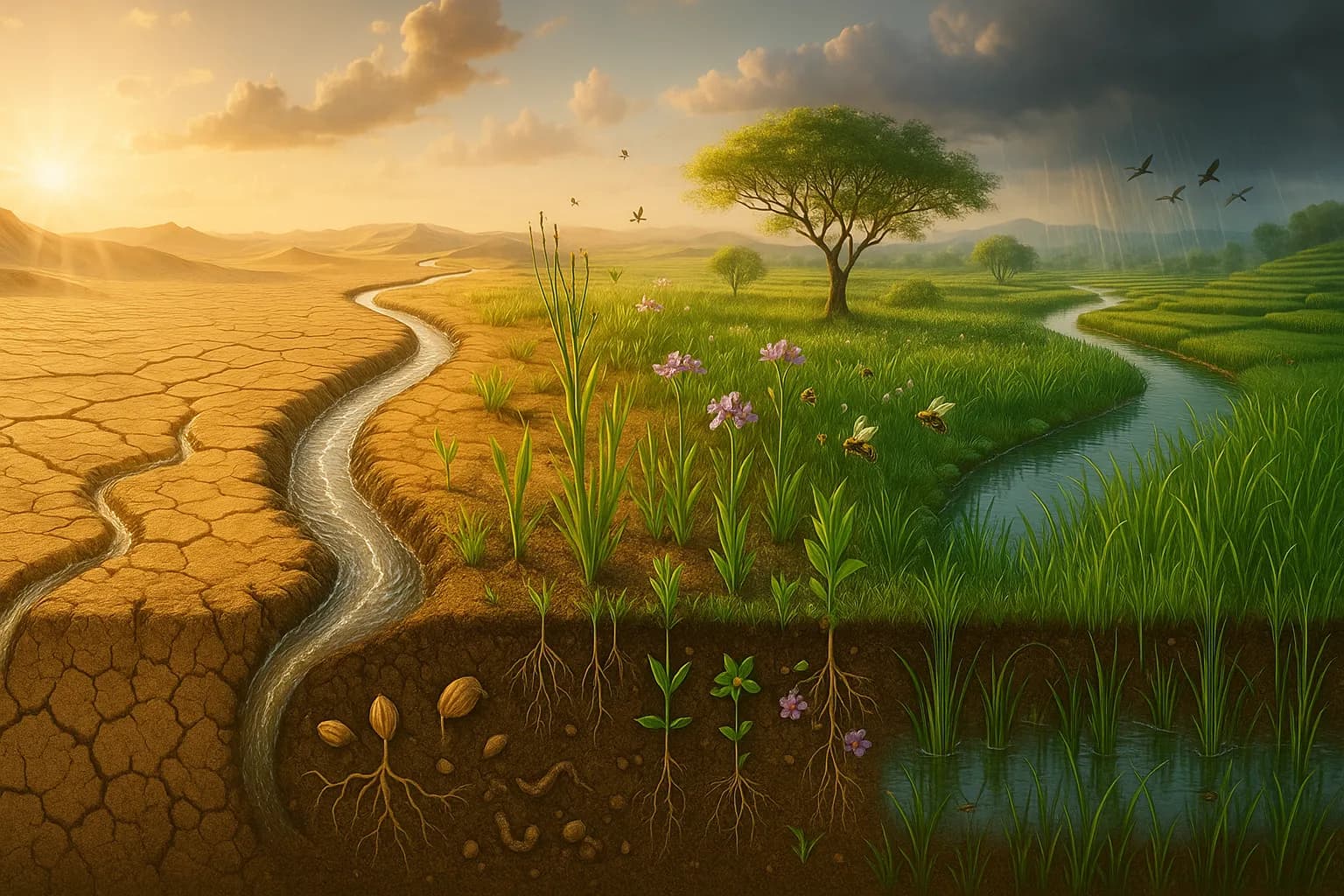
To begin, C.S. Lewis’s image redirects attention from restraining excess to cultivating scarcity. In The Abolition of Man (1943), he contends that the true challenge is not hacking away at intellectual overgrowth but channeling life-giving interest into barren places. The metaphor points to a hidden diagnosis: many learners are not unruly but undernourished—parched for meaning, relevance, and hope. Thus the educator’s craft becomes hydrology rather than horticulture, concerned with flow, access, and renewal.
Scarcity of Curiosity
Building on this, curiosity emerges as the most precious water. George Loewenstein’s “information-gap” theory (1994) shows that questions flourish when learners sense a gap between what they know and what they want to know. Deserts persist where no gap is felt: content arrives as answers to unasked questions. Therefore, educators irrigate by designing experiences that stimulate wonder—provocations, puzzles, and contrasts that make ignorance feel intriguingly solvable rather than shameful.
A Tradition of Nurture, Not Conquest
Historically, this irrigative stance aligns with progressive and liberatory thought. John Dewey’s Democracy and Education (1916) argued that learning grows from experience, not mere transmission. Maria Montessori’s prepared environments invite self-directed exploration, treating the classroom as a landscape carefully arranged for discovery. Likewise, Paulo Freire’s Pedagogy of the Oppressed (1970) rejects the ‘banking model’ in favor of dialogic co-creation. Across these strands, the educator is less a machete-wielder than a steward of conditions.
Motivation, Mindset, and Autonomy
Psychologically, irrigation means nourishing the roots of motivation. Self-Determination Theory (Deci & Ryan, 1985/2000) shows that autonomy, competence, and relatedness catalyze durable engagement. When students feel choice, see growth, and belong to a learning community, attention flows. Complementing this, Carol Dweck’s work on growth mindset (2006) reframes difficulty as a signal to persist, not a verdict on ability. Together, these insights suggest that the ‘water’ is not merely content but the felt experience of agency and progress.
Designing the Channels of Practice
In practice, irrigation requires channels that carry interest steadily across time. Inquiry prompts and project-based tasks create an initial current; formative feedback keeps it moving by clarifying next steps. Retrieval practice and spaced review further prevent evaporation—Roediger and Karpicke (2006) show that recalling information strengthens learning more than re-reading. Moreover, choice pathways, well-scaffolded challenges, and public showcases act like reservoirs, storing momentum so that understanding survives dry spells.
Equity: Where Deserts Persist
Yet we must admit that deserts are not evenly distributed. Resource gaps, linguistic barriers, and the digital divide leave some communities with far less rainfall of opportunity. UNESCO’s Global Education Monitoring Reports repeatedly note that marginalized learners face systemic droughts—fewer books, unstable connectivity, and constrained time. Consequently, irrigation is also justice work: expanding access, adapting culturally, and investing in community partnerships so that curiosity can take root where it has been historically denied.
A Classroom Oasis in Practice
For instance, a middle-school science teacher began a unit with a simple, local mystery: Why does the neighborhood stream change color after storms? Students collected water samples, mapped runoff, and interviewed city officials. As questions multiplied, so did reading, math, and argumentation. One student quipped, “We’re doing real science, not just answers.” The project became an oasis—engagement flowed outward into other subjects—illustrating how authentic inquiry irrigates far beyond a single lesson.
Toward Cultivation, Not Conquest
Ultimately, Lewis’s counsel invites a humble posture: rather than subdue exuberance, cultivate possibility. When we design for curiosity, autonomy, and equitable access, classrooms transform from arid compliance into living ecosystems. The educator becomes a patient engineer of conditions—testing channels, tending reservoirs, and celebrating rain. In that steady work of irrigation, deserts green, and with them, the futures students imagine for themselves.
Recommended Reading
As an Amazon Associate, we earn from qualifying purchases.
One-minute reflection
What feeling does this quote bring up for you?
Related Quotes
6 selectedTo cultivate anything—a garden, a skill, a soul—requires the courage to wait for what you have planted. — Wendell Berry
Wendell Berry
At first glance, Wendell Berry’s quote seems to praise patience, yet it goes further by naming patience as courage. To plant anything—a seed, a habit, a belief in oneself—is to act without immediate proof of success.
Read full interpretation →Right things are rare flowers that need cultivation. — Charles Spurgeon
Charles Spurgeon
Spurgeon’s image immediately turns morality into something living, fragile, and beautiful. By calling right things “rare flowers,” he suggests that goodness does not appear everywhere by accident; instead, it emerges und...
Read full interpretation →Plant the seeds of your intentions today and tend them with steady hands — Langston Hughes
Langston Hughes
Langston Hughes frames intention not as a passing wish but as something alive—small at first, yet capable of becoming substantial. A seed holds potential, but it also requires placement in the right ground; likewise, an...
Read full interpretation →Plant intention in the soil of effort, harvest the life you imagine. — Kahlil Gibran
Kahlil Gibran
Kahlil Gibran frames personal transformation in the language of cultivation: intention is a seed, effort is soil, and the imagined life is the harvest. This metaphor immediately implies patience and process—nothing bloom...
Read full interpretation →Carry wonder like water; build gardens from its streams — Kahlil Gibran
Kahlil Gibran
To begin, the line treats wonder as a portable reservoir and creativity as cultivation. Carrying wonder “like water” implies both nourishment and responsibility: a traveler who knows each drop sustains future growth.
Read full interpretation →Grass isn't always greener on the other side; it’s greener where you water it. — Neil Barringham
Neil Barringham
This quote challenges the common belief that life is better somewhere else. Instead of constantly seeking external changes, it emphasizes the importance of nurturing what one already has.
Read full interpretation →More From Author
More from C.S. Lewis →Even in literature and art, no man who bothers about originality will ever be original: whereas if you simply try to tell the truth, you will, nine times out of ten, become original without ever having noticed it. — C.S. Lewis
At first glance, C.S. Lewis presents a paradox: the harder an artist chases originality, the less likely it is to appear.
Read full interpretation →To love at all is to be vulnerable. Love anything and your heart will be wrung and possibly broken. If you want to make sure of keeping it intact, you must give it to no one. — C.S. Lewis
C.S. Lewis begins with a stark truth: to love anything at all is to accept vulnerability.
Read full interpretation →You cannot hold others to standards you refuse to apply to your own souls. — C.S. Lewis
At its core, C.S. Lewis’s statement confronts hypocrisy in its plainest form.
Read full interpretation →Friendship is born at that moment when one person says to another, 'What! You too? I thought I was the only one.' — C.S. Lewis
C.S. Lewis locates the beginning of friendship in a moment of startled recognition rather than in mere proximity or politeness.
Read full interpretation →