
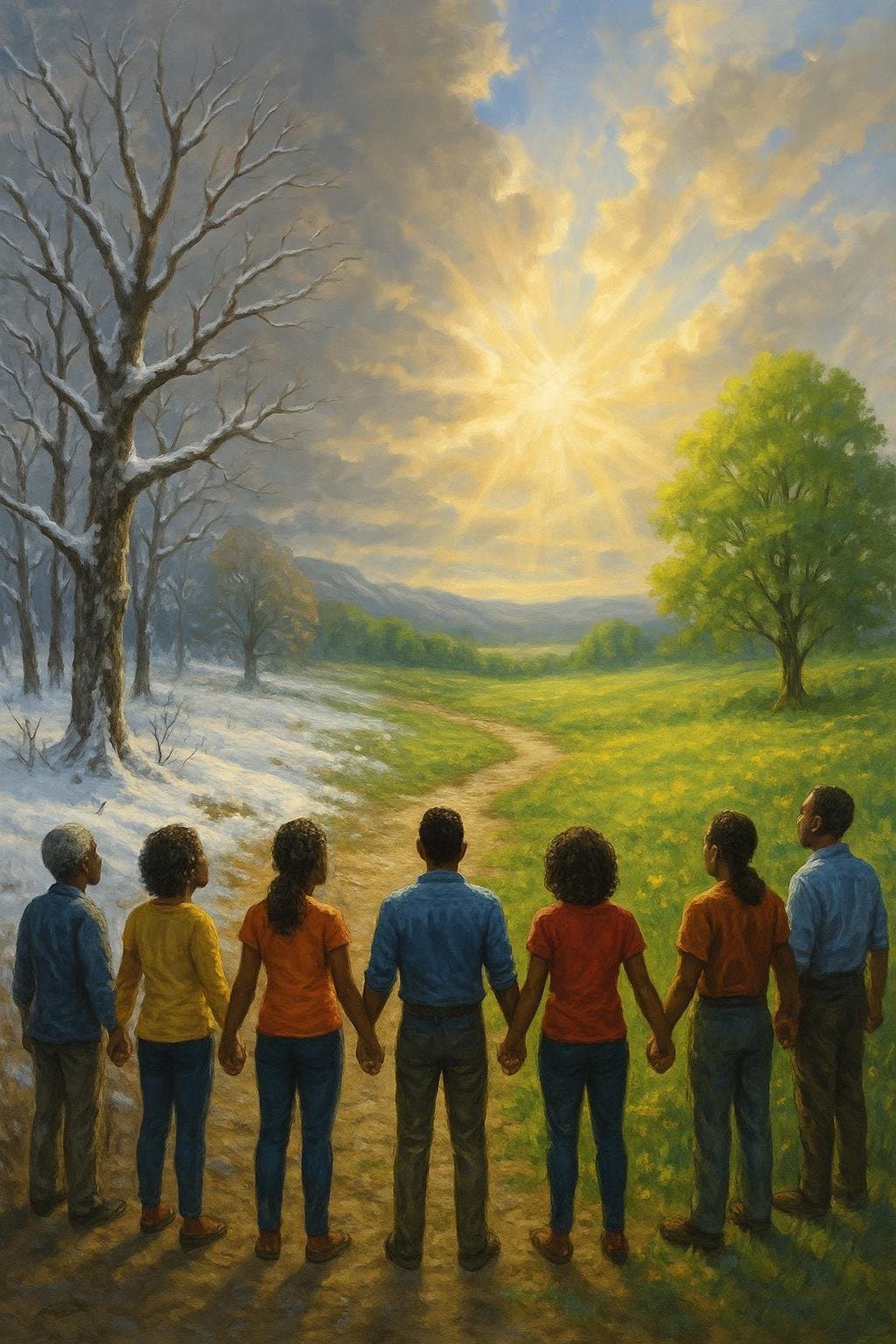
Change will not come if we wait for some other person or some other time. We are the ones we've been waiting for. — Barack Obama
—What lingers after this line?
Call to Personal Responsibility
Obama’s words urge individuals to assume personal responsibility in creating positive change. Rather than relying on unseen heroes or future solutions, each person is called to rise to the task themselves. This sentiment echoes Mahatma Gandhi’s mantra, 'Be the change you wish to see in the world,' emphasizing the ability of individuals to spark transformation.
Empowerment of the Collective
The quotation shifts agency from external forces to the collective 'we.' By saying 'we are the ones,' Obama rallies togetherness and shared purpose. The Civil Rights Movement exemplified this, as ordinary Americans united for justice, demonstrating that social change is possible when communities act in concert (see Taylor Branch’s *Parting the Waters*, 1988).
Urgency Against Procrastination
The statement warns against the trap of perpetual waiting—postponing action until an ideal person or moment appears. Procrastinating reform can allow injustice to persist, as Dr. Martin Luther King Jr. lamented in his 'Letter from Birmingham Jail' (1963), criticizing those who delayed civil rights on grounds that the 'right time' had not arrived.
Leadership and Initiative
Obama highlights that leadership is not the exclusive duty of prominent figures. Groundbreaking change often begins with those who may not perceive themselves as leaders. Rosa Parks’s refusal to surrender her seat in 1955 embodies this ethos—her individual act sparked a mass movement, showing leadership emerges from ordinary citizens (Douglas Brinkley's *Rosa Parks*, 2000).
Historical Context and Hope
Spoken during a period of political and economic uncertainty (2008), Obama's phrase aimed to inspire hope and activate the American public in crafting a better future. It reinvigorates the notion, rooted in American history, that progress stems from active participation rather than passive hope.
One-minute reflection
Why might this line matter today, not tomorrow?
Related Quotes
6 selectedWhat we need to do is recognize that we have the power to change the world. — Barack Obama
Barack Obama
This quote emphasizes the concept of empowerment, suggesting that individuals hold the capability and responsibility to influence and effect change in the world around them.
Read full interpretation →We have it in our power to begin the world over again. — Thomas Paine
Thomas Paine
Thomas Paine’s declaration, written amid the upheaval of the late eighteenth century, rests on a bold conviction: ordinary people possess the power to reshape the world’s political and moral order. Rather than viewing hi...
Read full interpretation →Building a better you is the first step to building a better America. — Anthony J. D'Angelo
Anthony J. D’Angelo
This quote highlights the importance of individual growth and responsibility. It suggests that societal improvement starts with self-improvement, as individuals collectively shape the fabric of a nation.
Read full interpretation →It is not what we have that will make us a great nation; it is the way in which we use what we have. — Theodore Roosevelt
Theodore Roosevelt
The quote emphasizes that greatness comes not from the abundance of resources or possessions but from how effectively and responsibly those resources are used to benefit society.
Read full interpretation →The greatest danger to our future is apathy. — Jane Goodall
Jane Goodall
At its core, Goodall's line is born of fieldwork. After years among chimpanzees in Gombe, she saw how human choices at forest edges determine whether habitats endure.
Read full interpretation →Speak your truth; silence is a luxury the world cannot afford. — James Baldwin
James Baldwin
James Baldwin issues a moral deadline: speak your truth now, because delay compounds harm. Writing in the civil rights era, he tied language to survival; in The Fire Next Time (1963) he insisted that naming reality is th...
Read full interpretation →More From Author
More from Barack Obama →Let your hands learn bravery before your mind catches up. — Barack Obama
In this line, Barack Obama frames courage as something practiced physically and behaviorally—through what we do—rather than something we perfect intellectually first. “Let your hands learn bravery” suggests that the body...
Read full interpretation →Make each choice a brushstroke in the portrait of your future — Barack Obama
Barack Obama’s line frames the future not as a fixed destination but as a canvas gradually filled in. By calling each choice a “brushstroke,” he suggests that even small decisions—what you practice, what you ignore, what...
Read full interpretation →We did not come to fear the future. We came here to shape it. — Barack Obama
Obama’s statement reframes why we are present in any pivotal moment—whether in a nation, a classroom, or a community. Rather than existing simply to endure uncertainty, he insists we are here to act upon it.
Read full interpretation →Lead with ideas, then sustain them with persistent effort. — Barack Obama
Obama’s line distills a discipline: set a direction with lucid ideas, then earn outcomes through sustained work. Vision without stamina drifts into rhetoric; effort without an anchoring idea degenerates into motion witho...
Read full interpretation →