
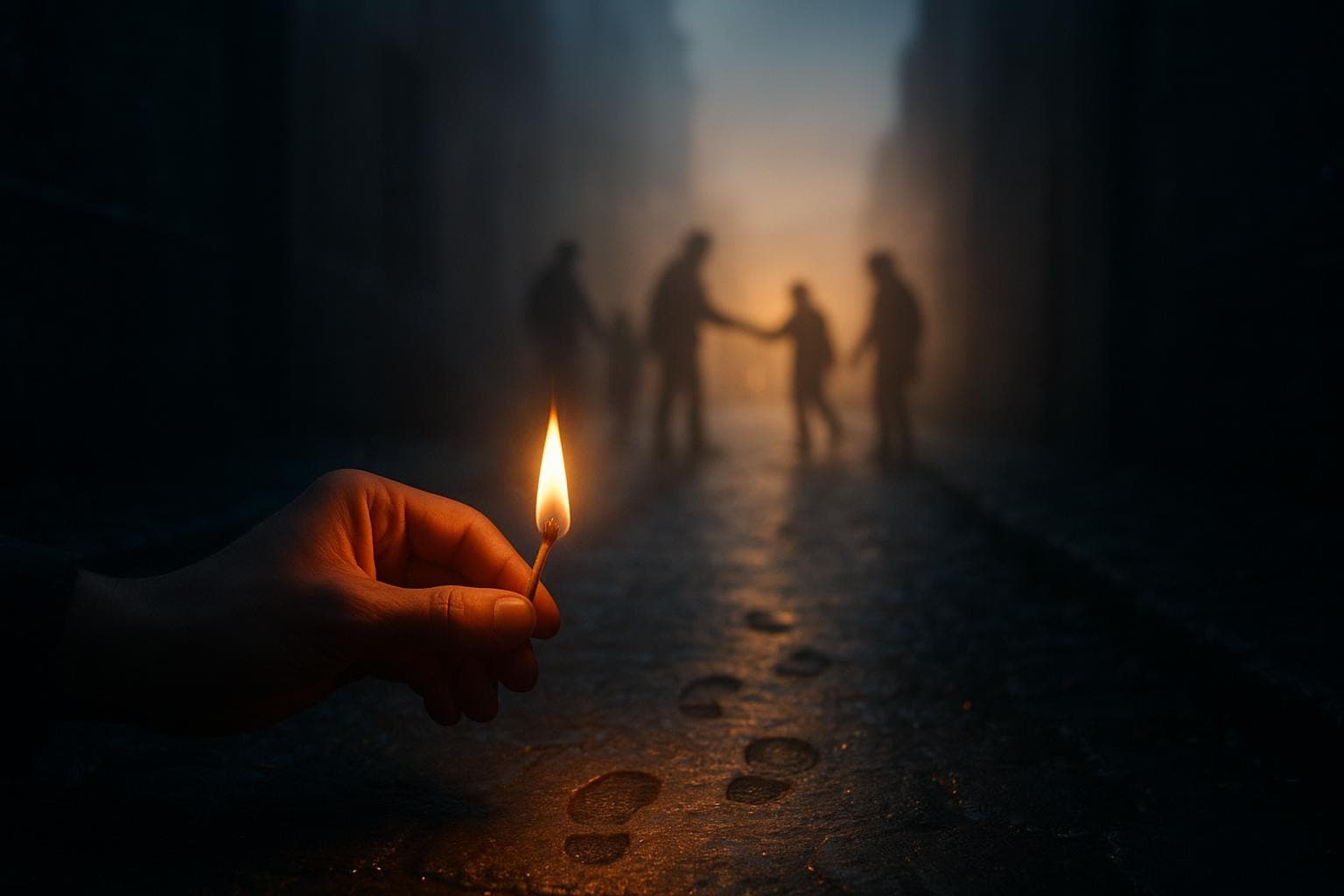
Light a match of kindness; it will reveal ways forward that doubt obscured. — Pablo Neruda
—What lingers after this line?
A Small Spark That Changes the Room
Neruda’s image begins with something almost laughably modest: a single match. Yet the point is precisely that kindness doesn’t need grand scale to matter; it only needs to be struck. In the same way a match briefly overpowers darkness, a small, intentional act—an honest compliment, a patient pause, a practical offer—can shift the emotional climate of a moment. From there, the metaphor invites a recalibration of what “progress” looks like. Instead of waiting for certainty or perfect conditions, Neruda suggests that the first step is often a gesture that warms and clarifies, however briefly, what’s around us.
Doubt as a Kind of Darkness
If kindness is the match, doubt is the dark room it enters. Doubt doesn’t only mean skepticism; it can be the fog of self-criticism, the paralysis of too many options, or the suspicion that nothing will help. In that state, even obvious routes—apologizing, asking for help, trying again—can feel invisible. Consequently, Neruda implies that doubt is not always defeated by argument or willpower. Often it lifts when the nervous system feels safer, when shame loosens, or when connection is restored. Kindness works at that level, making the “room” navigable again.
Kindness as Practical Illumination
The line is not sentimental; it’s directional. Kindness “reveals ways forward,” suggesting that clarity emerges through action rather than before it. A manager who chooses curiosity over blame may discover the real cause of a mistake; a friend who listens without correcting may hear the fear underneath a complaint. This resembles the ethics of care described by thinkers such as Nel Noddings in Caring (1984), where moral insight often arises from attentiveness and responsiveness. In other words, kindness is not merely niceness—it is a method of seeing.
Why Doubt Hides Options
Doubt narrows attention. Under stress, people tend to fixate on threats and worst-case outcomes, which can make creative problem-solving feel inaccessible. That’s why someone can “know” what to do in theory but remain unable to do it in practice. Against that narrowing, kindness widens the frame. A simple act of generosity can interrupt rumination, reduce defensiveness, and create enough psychological space to consider alternatives. The match doesn’t solve everything, but it changes what the mind can notice.
The Contagion of Gentle Courage
Once struck, a match can light another. Similarly, kindness often propagates: one person’s patience makes it easier for someone else to be honest; one person’s apology makes repair feel possible. In this way, Neruda’s “ways forward” are frequently relational—paths that appear only when people feel safe enough to walk them together. Anecdotally, many conflicts de-escalate not through winning arguments but through a single disarming gesture: “I may be wrong—help me understand.” That sentence is a small flame, and it can reveal exits that pride and suspicion kept hidden.
Keeping the Match from Burning Out
At the same time, a match is brief, which hints at a practical lesson: kindness must be renewed. One warm moment can open a door, but moving forward usually requires repeated, concrete care—boundaries stated respectfully, help offered sustainably, empathy paired with honesty. Ultimately, Neruda’s counsel is both poetic and tactical. When doubt makes the future feel sealed off, start with the smallest workable kindness. The light may be temporary, but it is often long enough to see the next step.
One-minute reflection
What's one small action this suggests?
Related Quotes
6 selectedA hopeful mind carves possibilities from doubt like light from stone. — Pablo Picasso
Pablo Picasso
Picasso’s image begins with an apparent contradiction: stone is opaque, yet he imagines light emerging from it. By pairing “doubt” with “stone,” he frames uncertainty as heavy, resistant material—something that does not...
Read full interpretation →Light a small candle for hope; its glow invites others to kindle warmth. — Desmond Tutu
Desmond Tutu
Desmond Tutu’s image of lighting a small candle captures how even fragile gestures can confront overwhelming darkness. A candle is ordinary, easily extinguished, and yet it remains one of humanity’s oldest symbols of res...
Read full interpretation →Just because your light flickers does not mean it is about to go out. — Yohancé Salimu
Yohancé Salimu
At first glance, Yohancé Salimu’s line separates appearance from reality. A flicker suggests instability, fatigue, or interruption, yet it does not automatically signal extinction.
Read full interpretation →Today's tears water tomorrow's gardens. — Matshona Dhliwayo
Matshona Dhliwayo
At first glance, Matshona Dhliwayo’s line transforms grief into something unexpectedly fertile. Tears, usually seen as signs of pain or loss, become water for a future garden, suggesting that suffering is not merely endu...
Read full interpretation →Hope is passion for the possible. — Søren Kierkegaard
Søren Kierkegaard
At first glance, Kierkegaard’s line transforms hope from a passive feeling into an active force. To call hope “passion for the possible” means that hope is not mere daydreaming; rather, it is an inward energy that leans...
Read full interpretation →A ship should not ride on a single anchor, nor life on a single hope. — Epictetus
Epictetus
At first glance, Epictetus turns a practical image into a moral lesson: a ship secured by only one anchor is vulnerable to shifting winds, rough tides, and hidden strain. In the same way, a life fastened to a single hope...
Read full interpretation →More From Author
More from Pablo Neruda →Let the rain kiss you. Let the rain beat upon your head with silver liquid drops. — Pablo Neruda
Neruda’s lines open as a gentle imperative: instead of bracing against bad weather, we are asked to welcome it. “Let the rain kiss you” reframes rain as a gesture offered to the body rather than an inconvenience imposed...
Read full interpretation →Build a bridge of resolve and walk across it one brave step at a time. — Pablo Neruda
Neruda’s image begins with a striking implication: resolve is not merely a feeling you wait for, but a structure you build. A bridge doesn’t appear because the river is intimidating; it exists because someone decided to...
Read full interpretation →Let each sunrise find you leaning toward action. — Pablo Neruda
Neruda’s line frames each sunrise as more than scenery; it’s a daily reset that gently pressures us to move. “Leaning” matters because it suggests a posture, not a perfect performance—an inclination toward doing, even be...
Read full interpretation →Make your hands busy with making—words, gardens, music—and life answers back. — Pablo Neruda
Neruda’s line frames creativity less as self-expression and more as initiation: when you keep your hands busy making, you open a channel through which the world can respond. The emphasis on “hands” matters, because it gr...
Read full interpretation →