
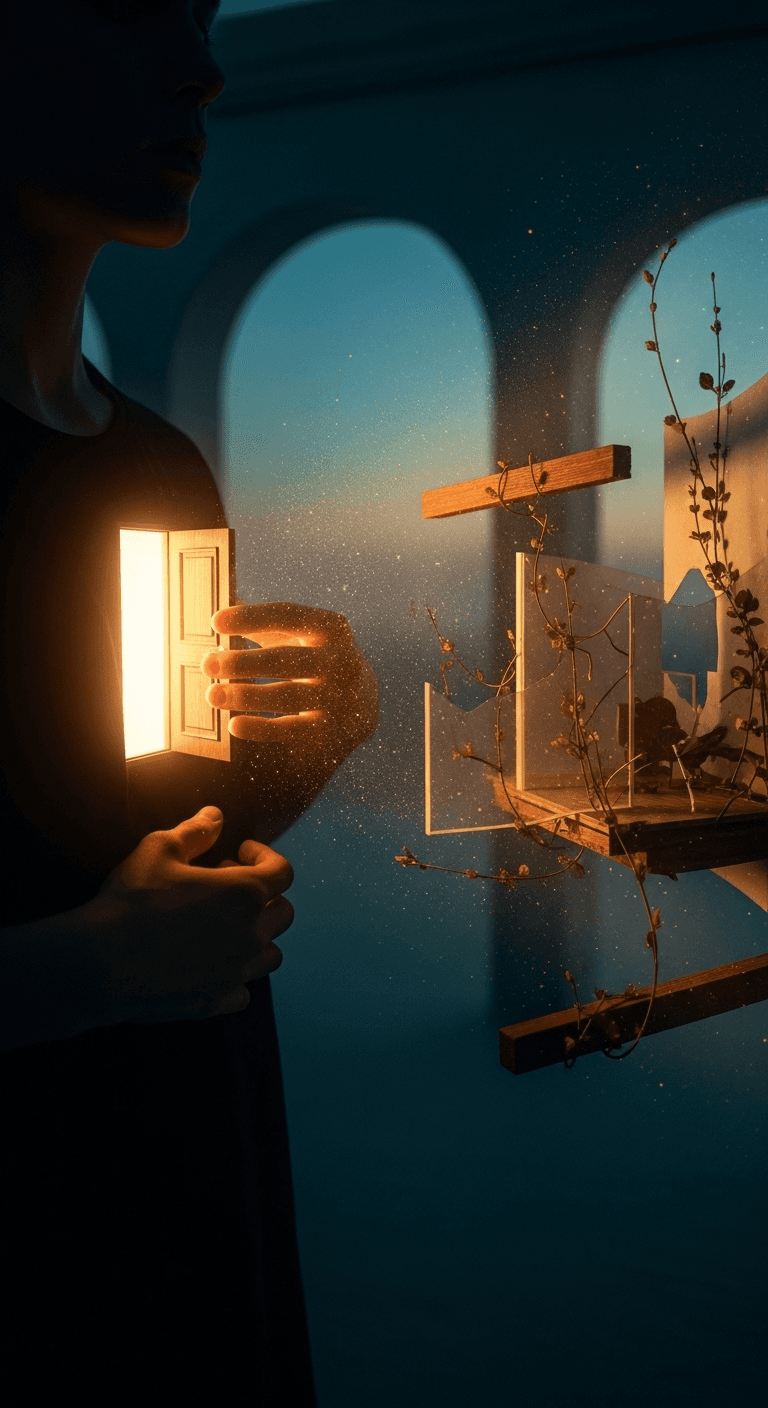
Open the door in your chest where hope waits; step through and build the room beyond. — Rumi
—What lingers after this line?
A Threshold Hidden in the Chest
To begin, the image of a door in the chest reframes hope as a presence already within, not a distant rescue. Rumi’s imperative—open, step, build—turns a feeling into a sequence of actions: awareness, courage, craftsmanship. The door suggests a threshold: on one side, inertia; on the other, a space under construction. In this light, hope is less a mood and more a workshop waiting for hands. A traveler pauses before a dark passage, lantern in hand; when she unbars the door, she discovers not a ready-made chamber but beams, tools, and raw light. So the line invites us to move from passive yearning to embodied making, where the heart becomes both site and source of renewal.
Sufi Architecture of the Heart
From there, Rumi’s Sufi lineage casts the heart as a house God visits. A Sufi saying, attributed to a hadith qudsi, holds: the heavens and earth cannot contain the Divine, but the faithful heart can. In Rumi’s Masnavi, the reed flute’s opening lament (Book I) voices separation—and thus the ache that precedes hope. Likewise, “The Guest House” (Masnavi) imagines emotions as visitors to be welcomed, not evicted; hospitality, then, becomes carpentry for the soul. By treating inner states as guests rather than invaders, we clear a foundation. Doors in this tradition symbolize consent: to open is to agree to transformation. The room beyond, therefore, is not an escape from life but a sanctuary where life is met, named, and transfigured.
Turning Hope into Motion
In practical terms, stepping through means converting anticipation into small, repeatable deeds. Viktor Frankl’s Man’s Search for Meaning (1946) observes that meaning often arises when we take a stance toward what we cannot control; hope, accordingly, is a posture expressed by choices. Rumi’s verbs are deliberately kinetic: open, step, build. The sequence mirrors craft apprenticeship—first you unlock the shop, then you cross the sill, then you measure and join. By adopting a maker’s mindset, we move from wishing to workmanship. Even a single plank—one conversation, one promise kept—alters the floor plan of the possible. Over time, action retrofits emotion: behavior carves channels where courage can flow, and the once-locked door becomes a habitual way through.
Plans and Tools for the Room
Consequently, the room grows through consistent practices. Brief breathwork before difficult tasks steadies the hand; journaling translates vague longing into schematics; a daily act of service lays bricks where walls felt thin. Behavioral activation research shows that structured, value-aligned actions can lift mood and restore momentum (Jacobson et al., 1996). Similarly, studies on contemplative training report measurable shifts in attention and emotion regulation, suggesting that repeated practice reshapes the brain’s scaffolding (Lazar et al., NeuroReport, 2005). A simple blueprint might read: morning stillness to open the door, one meaningful task to step through, an evening reflection to note what you built. In this way, rituals become joists; attention, the mortar; and patience, the slow-cured stone.
Windows, Doors, and Neighboring Rooms
Extending this architecture, the room beyond is never solitary. Rumi’s verse “Beyond ideas of wrongdoing and rightdoing, there is a field…” (Dīwān-e Shams) invites us to cut windows toward others. Community enlarges interior space: when we share tools—stories, meals, songs—the roof lifts. An old dervish tale tells of a lodge swept each dawn so guests would find a floor they could trust; the broom was a theology of welcome. Likewise, offering refuge to another polishes the lintel of our own heart. By designing for permeability—listening that lets air move, boundaries that frame safety—we avoid building a bunker. Hope breathes best where rooms connect, and doors open both inward for rest and outward toward service.
Renovation After Storms
Ultimately, every room meets weather. Grief buckles beams; fear stains ceilings. Post-traumatic growth research notes that meaning-making and deliberate engagement can help rebuild stronger frameworks after loss (Tedeschi and Calhoun, 1996). Rumi’s counsel anticipates this: opening the door again—especially when swollen by rain—is itself a brave craft. We salvage what can be saved, replace what cannot, and let in fresh light. Over time, repairs become artistry, and scars—like joinery marks—prove the integrity of the structure. Thus the cycle repeats: open, step, build. Each pass refines the architecture of hope until the room beyond becomes a dwelling you can inhabit, and a shelter you can share.
Recommended Reading
As an Amazon Associate, we earn from qualifying purchases.
One-minute reflection
What feeling does this quote bring up for you?
Related Quotes
6 selectedIn the depths of despair, one often finds the most beautiful hope.
Unknown
This quote highlights the human capacity to find hope during the darkest times. Even when faced with extreme challenges and despair, individuals can discover a profound sense of hope that can inspire them to move forward...
Read full interpretation →In the heart of every dream, there are seeds of hope waiting to bloom.
Unknown
This quote suggests that within every dream lies the potential for hope. Dreams are seen as beacons that harbor the possibility of positive outcomes and new beginnings.
Read full interpretation →The deep roots never doubt spring will come. — Marty Rubin
Marty Rubin
At first glance, Marty Rubin’s line turns a simple natural image into a meditation on trust. Deep roots, hidden from view and buried in cold earth, symbolize the part of life that endures when nothing visible seems alive...
Read full interpretation →I am fascinated by tiny, incremental changes, almost imperceptible shifts in how people orient themselves in the world, because those are in some ways the most hopeful. — Rebecca Solnit
Rebecca Solnit
Rebecca Solnit’s reflection begins with a striking claim: the smallest changes may carry the greatest promise. Rather than celebrating dramatic revolutions, she turns our attention to subtle adjustments in how people see...
Read full interpretation →The main thing is to be moved, to love, to hope, to tremble, to live. — Auguste Rodin
Auguste Rodin
Rodin’s statement begins with a striking priority: “the main thing” is not to possess, achieve, or control, but to feel deeply. To be moved suggests openness to beauty, sorrow, wonder, and human connection.
Read full interpretation →Home isn't where you're from, it's where you find light when all grows dark. — Pierce Brown
Pierce Brown
At first glance, Pierce Brown’s line separates home from birthplace, inheritance, or mere address. In doing so, it reframes home as an experience rather than a location: the place, person, or community that restores mean...
Read full interpretation →More From Author
More from Rumi →Do not mistake movement for progress; a spinning top stays in one place, while a seed grows by staying rooted in the dark. — Rumi
Rumi’s image draws an immediate contrast between busyness and true development. A spinning top dazzles with speed and motion, yet it remains fixed in essentially the same place.
Read full interpretation →You don't need to escape the chaos to find peace—it's already inside you, waiting to be remembered. — Rumi
At first glance, Rumi’s line overturns a common assumption: that peace must be found by fleeing noise, conflict, or uncertainty. Instead, he suggests that peace is not an external destination but an inner condition alrea...
Read full interpretation →Confidence is silent. Insecurities are loud. Do not feel the need to broadcast your worth to a world that doesn't understand your path. — Rumi
At its core, this saying contrasts two very different emotional states: confidence, which rests quietly within, and insecurity, which seeks constant outward expression. The point is not that confident people never speak,...
Read full interpretation →There is a channel between voice and presence, a way where information flows. In disciplined silence the channel opens. — Rumi
Rumi’s line begins with a subtle distinction: voice is not the same as presence. Voice suggests expression, language, and outward communication, while presence points to something deeper—an inner reality felt before it i...
Read full interpretation →