
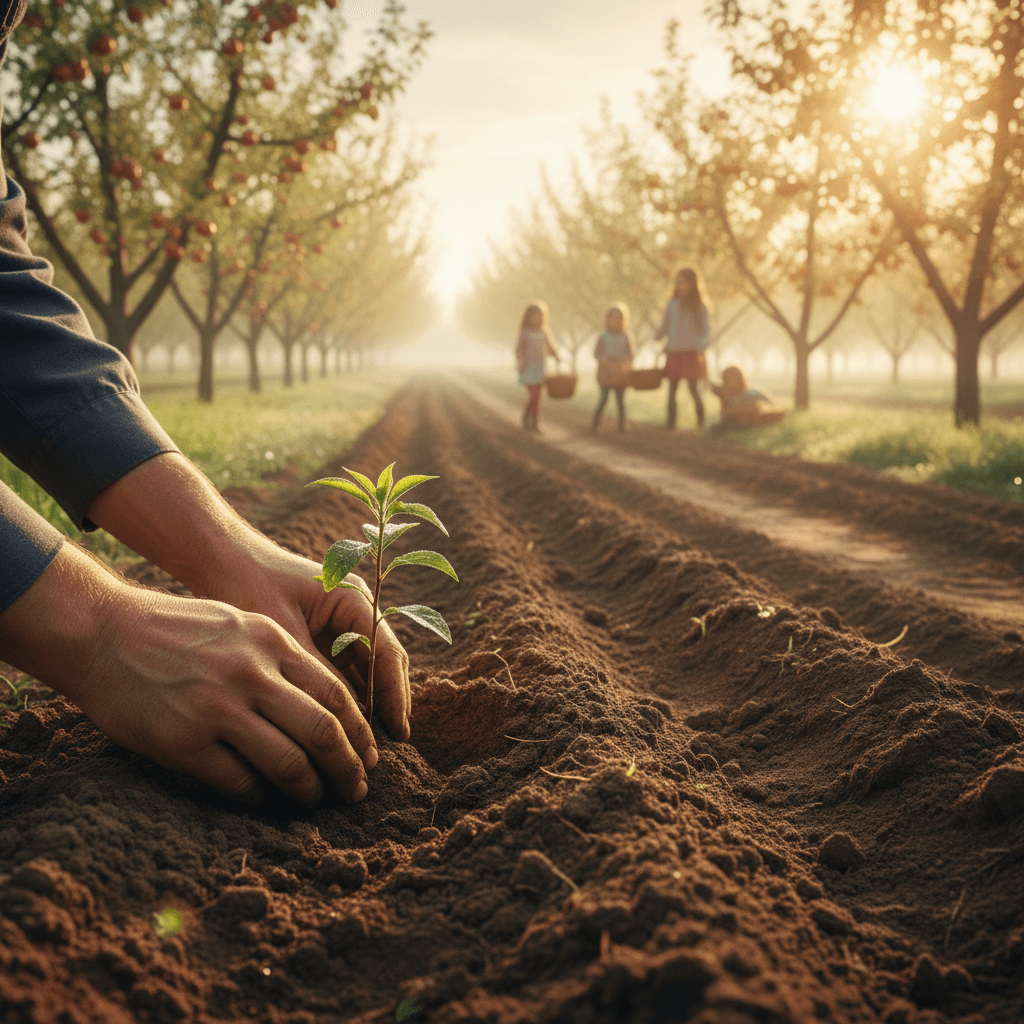
Plant hope today so future hands can gather its fruit. — Chinua Achebe
—What lingers after this line?
The Seed and the Future
At the outset, the farming image reminds us that hope behaves like a seed: it is buried in uncertainty, tended with patience, and harvested later—often by someone else. Planting, then, is an act of trust in time and in community. We invest in a harvest we may never taste, acknowledging that continuity, not immediacy, is the measure of meaningful work.
Achebe’s Communal Vision
Building on this, Chinua Achebe’s fiction draws power from Igbo oral wisdom, where personal action is braided with communal destiny. In Things Fall Apart (1958), he notes that “proverbs are the palm-oil with which words are eaten,” signaling that guidance is meant to be shared and passed on. The proverb-like cadence of his line about planting hope situates responsibility in the present while honoring those who will inherit its results.
Literary Legacies Across Generations
Consequently, Achebe’s characters reveal how today’s choices ripen into tomorrow’s conditions. Okonkwo’s rigidity in Things Fall Apart (1958) echoes painfully in his son Nwoye’s alienation, illustrating how fear can be a bitter seed. Likewise, No Longer at Ease (1960) follows Obi Okonkwo, whose entanglements show how colonial histories and familial expectations bear fruit in a new era. Literature, in this light, becomes a ledger of what was planted—and what grew.
Earthkeeping as a Hopeful Practice
Moreover, environmental movements translate the metaphor into soil and shade. Wangari Maathai’s Green Belt Movement (founded 1977) mobilized Kenyan women to plant tens of millions of trees, tangible promises that outlived their planters; her memoir Unbowed (2006) chronicles how saplings became social and ecological resilience. Similarly, the Svalbard Global Seed Vault (opened 2008) stores crop diversity so future farmers can replant after catastrophe—hope, sealed and chilled, awaiting hands not yet born.
Policy, Foresight, and Shared Harvests
Extending further, public health and education show how societies plant for distant seasons. Vaccination campaigns that culminated in smallpox eradication (WHO, 1980) began as small, localized efforts, while schooling investments often pay dividends a generation later. This ethos echoes the Haudenosaunee “seven generations” principle and inspires “cathedral thinking,” the long-span mindset behind projects like the Long Now Foundation’s 10,000-Year Clock. Good policy, like good gardening, aligns patience with purpose.
Everyday Acts that Outlast Us
Finally, the metaphor returns to our daily lives. Mentoring a teenager, founding a reading circle, or planting a neighborhood orchard are modest seeds whose fruit others will gather. A city that installs saplings along a barren street may only see their full canopy decades on, yet children will walk in the shade. Thus, by sowing hope now—through care, craft, and coalition—we join a quiet lineage that measures success by the harvest of future hands.
One-minute reflection
What feeling does this quote bring up for you?
Related Quotes
6 selectedPlant hope like trees of fruit: their shade and harvest arrive long after the first seed. — Kahlil Gibran
Kahlil Gibran
Gibran frames hope as something planted rather than simply felt, shifting it from a mood into a practice. A seed is small, even unimpressive, yet it carries a future that can’t be rushed into view.
Read full interpretation →To build is to insist that tomorrow will be better. — Chinua Achebe
Chinua Achebe
Achebe’s line fuses action with anticipation: to build is not merely to assemble materials, but to take a stand against fatalism. The verb insists; it refuses collapse into cynicism.
Read full interpretation →He who plants a tree, plants a hope. - Lucy Larcom
Lucy Larcom
Trees symbolize life, growth, and the future. Planting a tree represents the planting of hope for future generations and the well-being of the planet.
Read full interpretation →Harvest hope from the ordinary and use it to build the extraordinary. — Chinua Achebe
Chinua Achebe
Achebe’s line reads like an engineer’s spec for human flourishing: begin with the ordinary, extract hope as raw material, and assemble the extraordinary piece by piece. It rejects the myth of sudden miracles, insisting t...
Read full interpretation →In the heart of every dream, there are seeds of hope waiting to bloom.
Unknown
This quote suggests that within every dream lies the potential for hope. Dreams are seen as beacons that harbor the possibility of positive outcomes and new beginnings.
Read full interpretation →In the glow of every dawn, seeds of hope are nurtured.
Unknown
Dawn represents a new beginning, a fresh start. The glow of dawn symbolizes the light that drives away darkness, much like hope that dispels despair.
Read full interpretation →More From Author
More from Chinua Achebe →It is a common mistake to think that art is a luxury. It is a necessity of the human spirit. — Chinua Achebe
At first glance, Achebe challenges a deeply rooted modern assumption: that art belongs to the realm of extras, something pleasant but dispensable. By calling this belief a “common mistake,” he suggests that reducing art...
Read full interpretation →The sun does not forget a village just because it is small. — Chinua Achebe
Achebe’s line begins with a quietly radical premise: importance is not measured by scale. By imagining the sun as impartial, he suggests that attention, care, and recognition are not rewards reserved for the powerful; th...
Read full interpretation →Rise with the sun of your intentions and work until the horizon answers — Chinua Achebe
Achebe’s line opens with a vivid image: rising “with the sun of your intentions.” Intention here isn’t a vague wish—it’s something bright, scheduled, and unavoidable, like sunrise itself. By pairing waking with purpose,...
Read full interpretation →An army of sheep led by a lion can defeat an army of lions led by a sheep. — Chinua Achebe
Achebe’s line hinges on a startling reversal: the weaker group can prevail if guided by a forceful, capable leader, while the stronger group can squander its natural advantages under timid direction. By contrasting sheep...
Read full interpretation →