
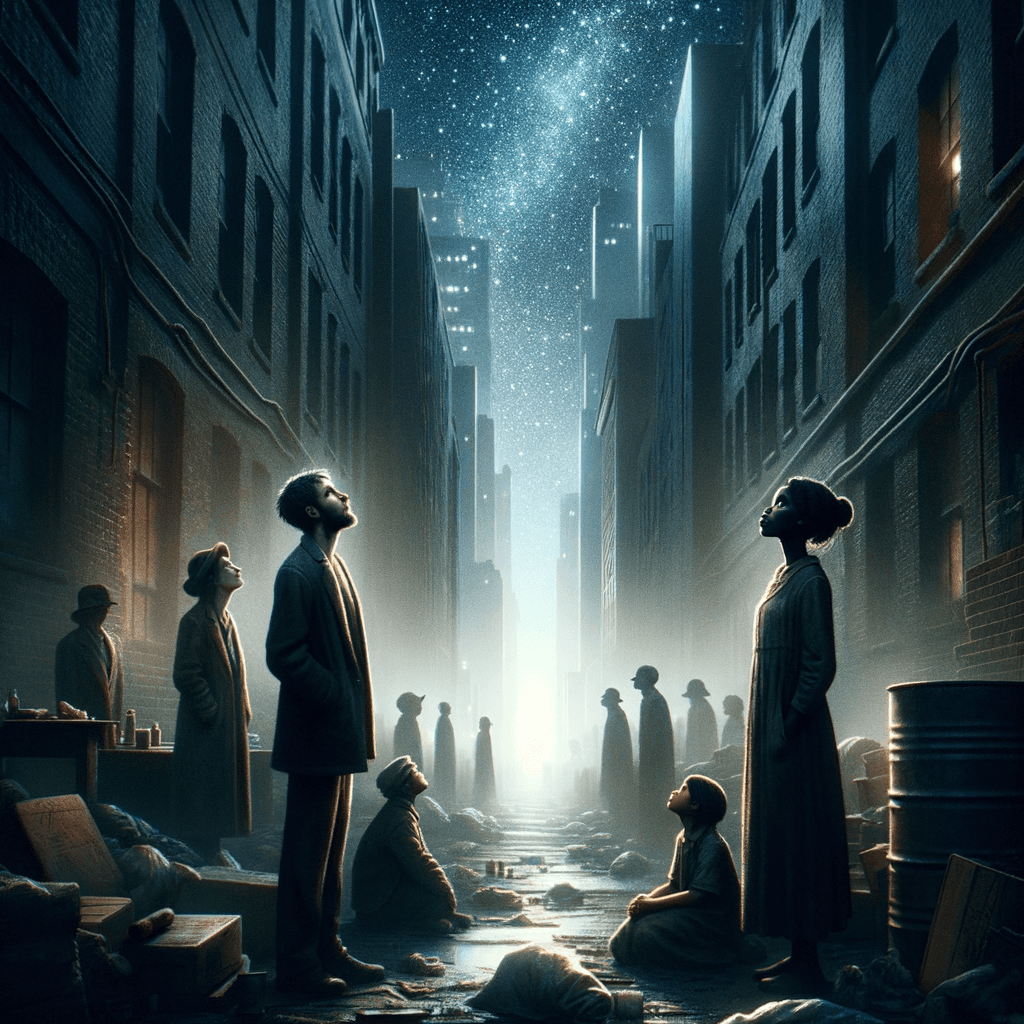
We are all in the gutter, but some of us are looking at the stars. — Oscar Wilde
—What lingers after this line?
Hope and Aspiration
This quote signifies the idea that despite being in dire or challenging circumstances ('the gutter'), one can still aspire to achieve greatness or find beauty ('looking at the stars').
Perspective on Life
It highlights the importance of perspective. While some may be consumed by their immediate problems, others choose to focus on their dreams and the possibilities beyond their current situation.
Resilience and Optimism
The quote reflects resilience, showcasing the ability to remain optimistic even in difficult times. It suggests a mindset that directs attention toward positive outcomes rather than dwelling on negativity.
Social Commentary
Wilde's words also serve as a commentary on society. It implies that while many may face hardships, a select few can transcend their circumstances through vision and ambition.
Historical Context
Oscar Wilde, an Irish poet and playwright, was known for his sharp wit and criticism of Victorian society. This quote encapsulates his belief in the potential for transcendence through art and creativity amidst societal struggles.
One-minute reflection
Why might this line matter today, not tomorrow?
Related Quotes
6 selectedIn the depths of despair, one often finds the most beautiful hope.
Unknown
This quote highlights the human capacity to find hope during the darkest times. Even when faced with extreme challenges and despair, individuals can discover a profound sense of hope that can inspire them to move forward...
Read full interpretation →In the heart of the night, each star is a hope.
Unknown
This quote uses stars as a metaphor for hope. Just as stars light up the night sky, hope illuminates our darkest moments, bringing light and direction when everything seems bleak.
Read full interpretation →Just because your light flickers does not mean it is about to go out. — Yohancé Salimu
Yohancé Salimu
At first glance, Yohancé Salimu’s line separates appearance from reality. A flicker suggests instability, fatigue, or interruption, yet it does not automatically signal extinction.
Read full interpretation →Today's tears water tomorrow's gardens. — Matshona Dhliwayo
Matshona Dhliwayo
At first glance, Matshona Dhliwayo’s line transforms grief into something unexpectedly fertile. Tears, usually seen as signs of pain or loss, become water for a future garden, suggesting that suffering is not merely endu...
Read full interpretation →Hope is passion for the possible. — Søren Kierkegaard
Søren Kierkegaard
At first glance, Kierkegaard’s line transforms hope from a passive feeling into an active force. To call hope “passion for the possible” means that hope is not mere daydreaming; rather, it is an inward energy that leans...
Read full interpretation →A ship should not ride on a single anchor, nor life on a single hope. — Epictetus
Epictetus
At first glance, Epictetus turns a practical image into a moral lesson: a ship secured by only one anchor is vulnerable to shifting winds, rough tides, and hidden strain. In the same way, a life fastened to a single hope...
Read full interpretation →More From Author
More from Oscar Wilde →Always forgive your enemies; nothing annoys them so much. — Oscar Wilde
At first glance, Oscar Wilde’s remark sounds like simple moral advice, yet its brilliance lies in its inversion of expectation. Instead of presenting forgiveness as saintly self-denial, he recasts it as a sly strategy: t...
Read full interpretation →It is only shallow people who require years to get rid of an emotion. A man who is master of himself can end a sorrow as easily as he can invent a pleasure. — Oscar Wilde
Oscar Wilde’s remark is deliberately provocative, drawing a sharp line between those ruled by feeling and those who govern it. At first glance, he seems almost cruel in dismissing prolonged sorrow as a mark of shallownes...
Read full interpretation →The mark of all good art is not that the thing done is done exactly or finely, but that it is worked out with the head and the workman's heart. — Oscar Wilde
Oscar Wilde immediately shifts the standard by which art is judged. Rather than praising work simply because it is exact, polished, or finely executed, he argues that true artistic value comes from something deeper: thou...
Read full interpretation →Everything in moderation, including moderation. — Oscar Wilde
Oscar Wilde’s line, “Everything in moderation, including moderation,” works by first borrowing a familiar moral rule and then twisting it into a paradox. If moderation is always good, then we should practice it without e...
Read full interpretation →